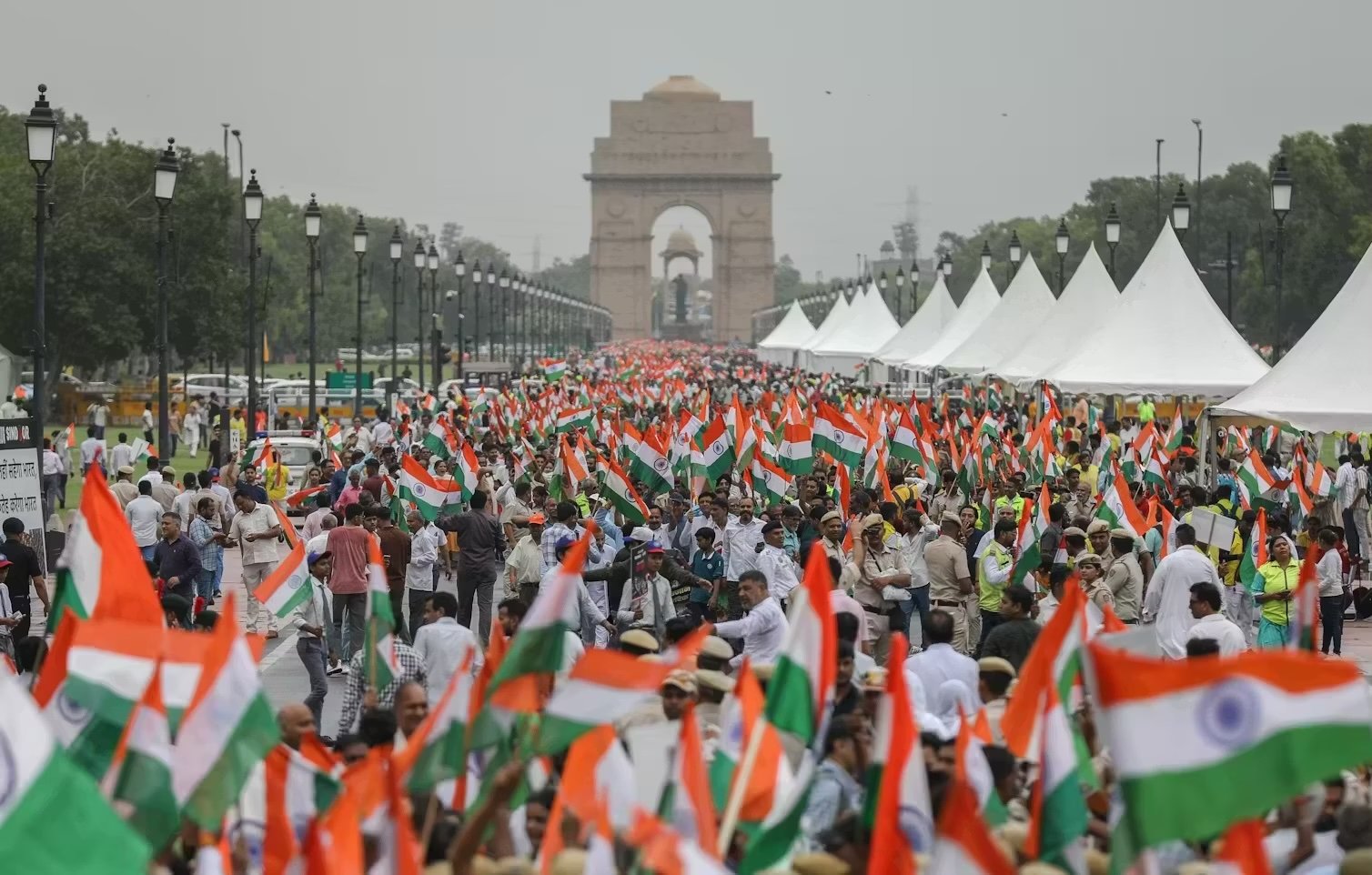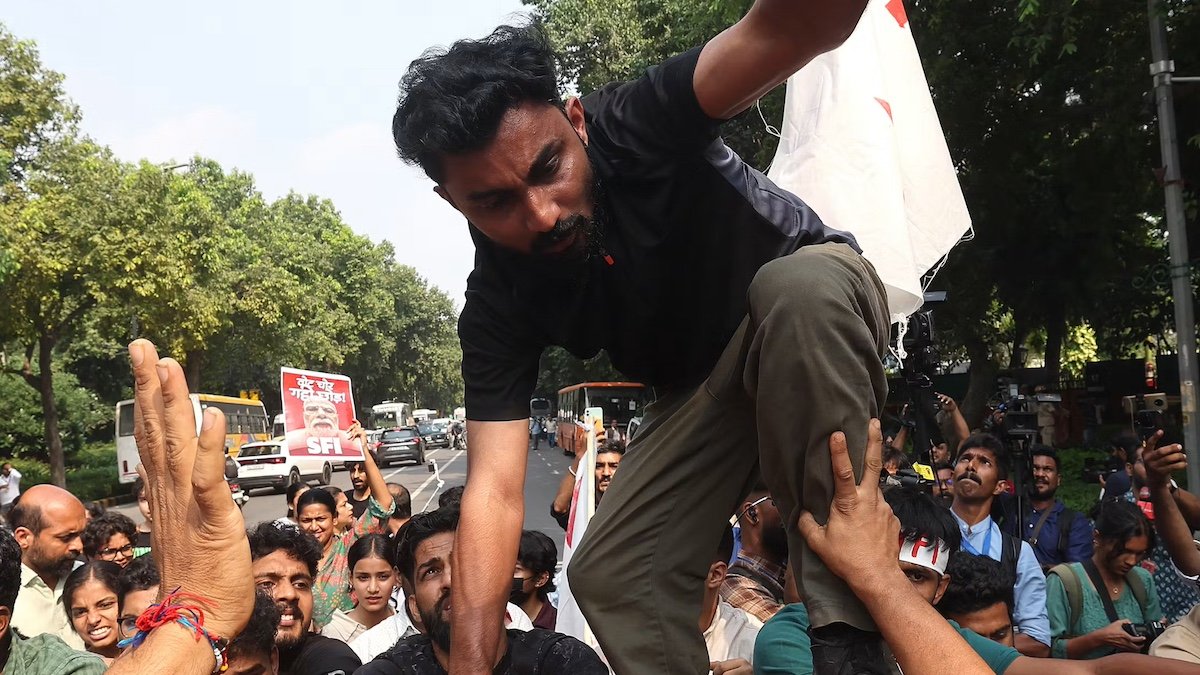
In a dramatic show of force, more than 25,000 police officers were deployed across New Delhi to quash demonstrations organized by the Cockroach Janta Party (CJP), a fledgling youth-led political movement. Authorities denied permission for the protests, citing public-order concerns, and then moved to shut down one in six metro stations, barricade dozens of central roads, and cancel over 250 trains—an "unprecedented closure" according to Indian rail officials. Thousands of protesters were detained, with reports of police brutality. While Delhi is the epicenter, protests have erupted in at least five other major cities.
The standoff underscores a paradox at the heart of Indian politics. On one hand, it highlights how far India's democracy has eroded under Prime Minister Narendra Modi's government. On the other, it reveals the raw ingredients for democratic renewal: broader political participation, opposition coordination, and mobilization around concrete demands.
The trigger: mass voter roll deletions
The protests were ignited by the Special Intensive Revision, a nationwide electoral roll review launched in 2025 that has removed more than 130 million names—nearly a tenth of India's population—from eligible voter lists. The Election Commission defends the exercise as necessary to purge duplicate and ineligible voters, but critics see a political motive.
In West Bengal, almost 12% of registered voters were struck off before the ruling Bharatiya Janata Party (BJP) won a state it had never governed. An analysis found that in many constituencies the BJP captured, the number of deleted voters exceeded the party's margin of victory. While not definitive proof of manipulation, the pattern is deeply troubling. The Indian Express reported that Election Commission members themselves raised 14 objections to the exclusions, all overruled by Chief Election Commissioner Gyanesh Kumar. The CJP has called for his resignation.
This comes amid a broader democratic decline documented by watchdogs. Freedom House downgraded India from "free" to "partly free" in 2021, and the V-Dem Institute now classifies the world's most populous nation as an "electoral autocracy." Executive power has centralized, anti-terror laws are used more aggressively, and media ownership has become increasingly concentrated.
Why the movement faces an uphill battle
The protests are unlikely to reverse these trends. Modi's government is backed not just by the BJP but by the Rashtriya Swayamsevak Sangh (RSS), a century-old Hindu nationalist organization with deep networks in schools, unions, charities, and neighborhoods. This grassroots machinery, combined with effective control of the media, makes the government exceptionally adept at mobilizing supporters—a key reason Modi has stayed in power for 12 years in a country known for tossing out incumbents.
Yet the cockroach movement is getting three things right. First, it is restoring a sense of political efficacy. Earlier in 2026, CJP-led protests forced Education Minister Dharmendra Pradhan to resign over a leaked exam paper scandal. The stakes are high: university graduates make up two-thirds of unemployed Indians aged 20–29, and exam success is a rare ladder to upward mobility.
Second, the protests are uniting disparate forces. Lawyers, farmers' organizations, and activists have joined hands. Crucially, there is potential for coordination between the CJP and the Indian National Developmental Inclusive Alliance (INDIA), the main opposition bloc. The CJP brings youthful energy without historical baggage, while the INDIA alliance offers parliamentary representation and organizational heft. As India's superpower rhetoric wears thin, such alliances could matter.
Third, the movement has a clear, specific demand: the resignation of the Chief Election Commissioner and a halt to the voter roll purge. This echoes Mahatma Gandhi's 1930 Salt March, which crystallized opposition to colonial rule around a single, tangible grievance. The CJP's focus on electoral integrity resonates beyond party lines.
Popular YouTuber Dhruv Rathee, who recently joined his first protest, told the BBC: "Basically the foundation of our democracy is at stake here." His participation signals widening engagement, especially among the young.
Whether the cockroach movement can truly reverse India's democratic decline remains uncertain. But it has already achieved something significant: it has made democratic backsliding a visible, contested issue. As India's top court demands answers on the deletions, the movement's next steps will be crucial. For now, it offers a glimmer of hope in a darkening landscape.