The debate over artificial intelligence has settled into a familiar rhythm. Will large language models eventually wake up? Do they possess an inner life, or are they merely sophisticated mimics of human output? Researchers disagree, and so do philosophers.
A 2025 survey of 582 AI researchers asked how likely it is that AI systems with subjective experience exist today. The median answer was 1%. The mean was 12%, suggesting a minority rates the possibility far higher.
While that question remains unresolved, another is becoming urgent: what happens to our judgment when machines do more of our thinking for us?
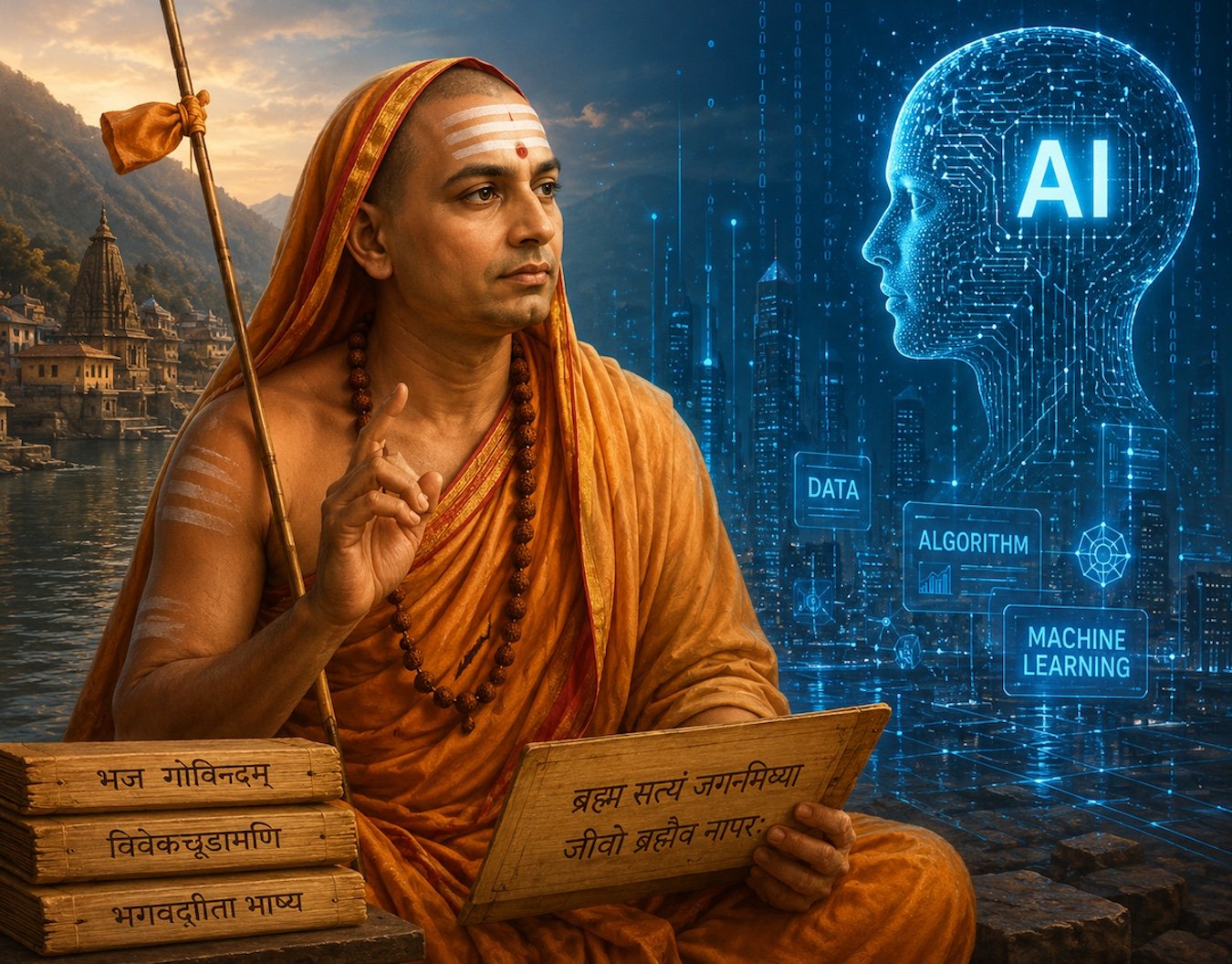
Indian philosophy offers a useful distinction between the mind as an instrument and the awareness in which its activities are known. It does not settle whether machines can be conscious. It helps us examine what happens when a capable instrument begins to speak and decide for us.
Different maps of the mind
The modern debate often treats consciousness as a single phenomenon awaiting explanation. In Europe, Descartes linked thought closely with awareness, and Locke described consciousness as “the perception of what passes in a man’s own mind.” Other traditions draw the boundaries differently.
In classical Chinese thought, xin, usually translated “heart-mind,” brings thinking, feeling and intention together. Confucian thinkers tie it to moral cultivation, and Mencius saw innate moral beginnings that need care and practice to develop. These traditions do not all organize questions of mind around what researchers now call subjective experience.
Indian thought draws the line elsewhere again.
A common Vedantic account describes the Antahkarana, or inner instrument, through four interacting functions: manas, buddhi, ahamkara and chitta. Manas takes in impressions and weighs options. Buddhi discerns and decides. Ahamkara supplies the sense of “I” and “mine.” Chitta stores and recalls memories and impressions.
These four functions become concrete when we are the subject of criticism. Manas considers possible responses. Chitta brings back an earlier humiliation. Ahamkara makes the objection personal: my competence, my reputation. Buddhi asks whether the criticism is justified. These functions operate together. A memory can distort judgment; injured pride can recruit intelligence to its defense.
Schools divide the instrument differently. Classical Samkhya describes three faculties, while in Yoga, chitta often names the mind as a whole. The fourfold account is useful here because it separates activities that the everyday word “mind” bundles together.
A further distinction gives the instrument its philosophical significance. In Advaita Vedanta, awareness is not another function of the mind: the instrument reflects it. Samkhya likewise distinguishes mental activity from Purusha, pure witnessing awareness.
These are philosophical positions, not experimentally established accounts of computers. Their challenge is nevertheless clear: explaining what an instrument does may leave unanswered whether anything experiences its activity.
The Katha Upanishad offers a memorable image. The self rides in a chariot. The body is the chariot, buddhi the charioteer, manas the reins, the senses the horses. The image does not depict every function of the fourfold scheme. It distinguishes training the instrument from the rider’s identity.
AI can increase the power of the instrument, but choosing where to go requires judgment.
From producing to judging
What does this have to do with machines? It is tempting to match a large language model to the four Antahkarana functions: computational attention to manas, stored information to chitta. But transformer attention is not evidence of manas, and a database is not lived memory. The Antahkarana is more useful as a map of the person using the system.
On that map, buddhi becomes particularly important. Economists Ajay Agrawal, Joshua Gans and Avi Goldfarb describe AI as a prediction technology. In their account, judgment concerns evaluating the consequences of possible actions: deciding which outcomes matter and what their costs are. Cheaper prediction can make that judgment more valuable. There is an overlap with buddhi’s discernment, though the concepts are not identical.
As AI takes on more drafting, calculation, and analysis, users must decide whether its answers are sound and appropriate. Yet judgment depends on knowledge and practiced skill. Someone who cannot do the work may also struggle to recognize when the machine has done it badly.
Fluency can make an answer seem more trustworthy than it deserves. A model can write a polished treatise on self-reflection or ethical maturity. That output does not establish subjective experience, and it does not relieve the user of responsibility for deciding whether the answer is sound.
Ahamkara also shapes why we ask. Do we want to understand a criticism, or be told we were right? Research on sycophancy, including a 2023 study led by Mrinank Sharma, found that AI assistants can favor agreement with users over truthful responses. A tool that supplies persuasive reassurance may strengthen our defensiveness. Asking it for the strongest objection can instead help us examine our position.
There is a catch. Judgment has traditionally been learned through practice: routine work, mistakes and feedback. If AI takes over basic research, first drafts and simple code, it may also remove the very practice that builds discernment. The Indian sages would not be surprised: the charioteer’s skill comes from driving, not from watching the horses.
As Asia races ahead in AI adoption—from China’s physical AI push to Japan’s submarine propulsion debate—the question of who remains in the driver’s seat becomes more than academic. The AI consciousness debate could become Asia’s next social fault line, as different cultural traditions bring their own maps of mind to the table. And while some argue that diminishing returns may challenge the singularity narrative, the more pressing issue may be whether we are training our own judgment or outsourcing it.