The global conversation about artificial intelligence often circles a single dramatic idea: the Singularity, the moment when a disembodied artificial general intelligence emerges from a server farm, slips human control, and either rescues or ruins civilization. This vision is deeply software-centric, shaped by a culture that imagines intelligence as something detachable from bodies, institutions, and physical infrastructure.
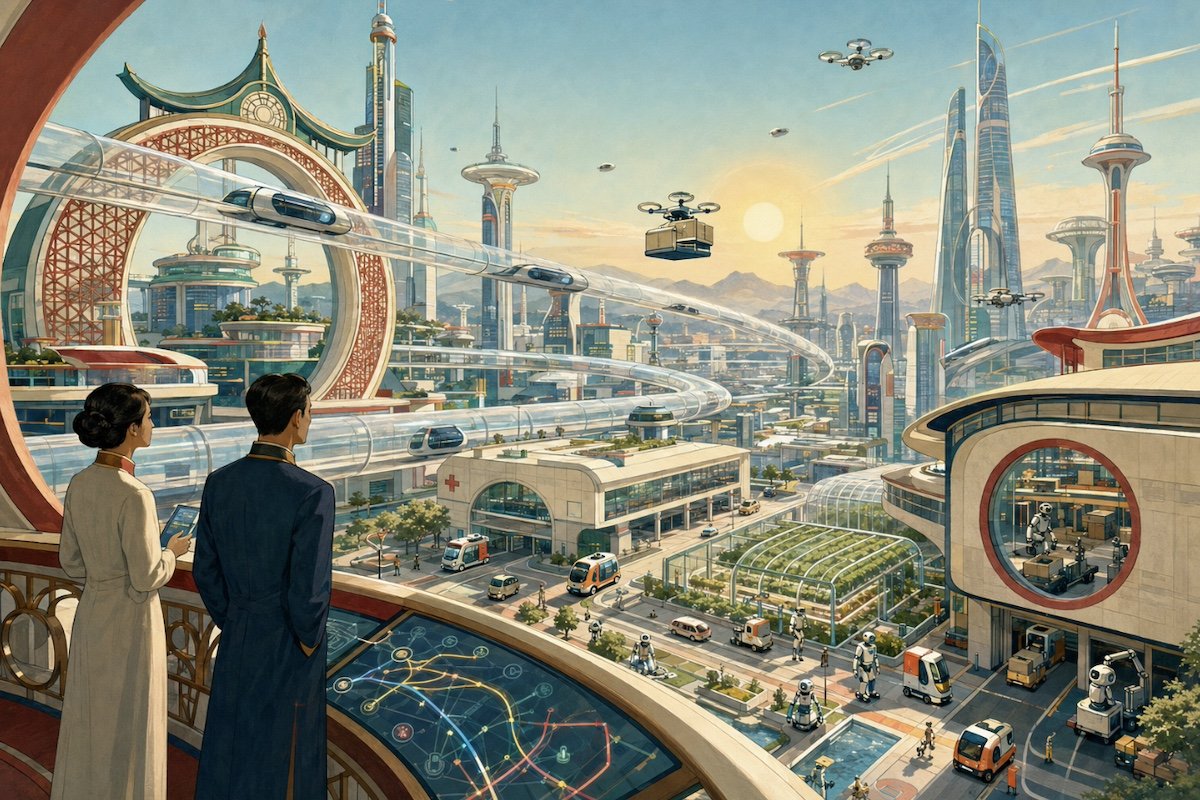
But the Singularity is not the most plausible description of the AI future now taking shape. The more immediate revolution is the systematic embedding of intelligence into the physical world—traffic lights, hospital wards, delivery trucks, nursing homes, farms, and assembly lines. The future may belong not to one superintelligence but to thousands of specialized AI systems coordinating material and administrative processes.
Just as the United States built much of the digital backbone of the information age, China is positioning itself to shape the emerging infrastructure of physical AI: artificial intelligence embodied in machines and woven into the systems that organize daily life. Within 30 to 50 years, China could become the first major country to coordinate much of its physical and administrative infrastructure through AI. This is not a prediction of inevitability but a forecast grounded in manufacturing scale, demographic pressure, infrastructure capacity, and state coordination. The open question is what kind of society this transition will produce—and who will define the purposes embedded in its machinery.
Singularity's blind spots
Many Singularity narratives conflate four distinct concepts: intelligence, agency, autonomy, and power. A system can outperform a human at a specific task without possessing a will. It can have operational autonomy—functioning without continuous human intervention—without being free to redefine its purpose. Even an exceptionally capable system cannot impose its will unless people grant it access to infrastructure, money, communications, weapons, robots, or institutional authority.
The hidden assumption is that intelligence becomes agency, agency becomes autonomy, and autonomy becomes power. Each step is often assumed rather than demonstrated. The reality is more prosaic and more immediate: AI systems acquire social power when institutions connect them to consequential systems without adequate limits, monitoring, and accountability. The danger is not necessarily that machines will develop minds of their own, but that people will connect them to too many systems, grant them too much authority, and fail to build the institutional safeguards that contain their errors.
Body and brain
In the 1980s, roboticist Hans Moravec observed a curious asymmetry: it was comparatively easy to make computers perform well on formal tests, but extraordinarily difficult to give them the sensorimotor abilities of a young child. A child can recognize faces, navigate a cluttered room, and pick up a cup without spilling it—actions that remain difficult for robots in unpredictable environments. Moravec's paradox helps explain why physical AI presents a different technological challenge from the software-centered systems that dominate public attention. It must connect perception, movement, judgment, and adaptation in the physical world, where mistakes have material consequences.
The comparison between the United States and China is one of emphasis and comparative advantage, not a binary opposition. The United States has warehouse robotics, autonomous-vehicle programs, aerospace automation, Nvidia's robotics platforms, and substantial military and industrial AI. China also develops frontier foundation models and consumer platforms, but its center of gravity differs. The United States treats AI primarily as a frontier technology and commercial product, focusing on advanced models, massive computing power, and systems that expand the boundaries of machine capability. China places greater emphasis on AI as infrastructure, embedding it in factories, transport networks, hospitals, power systems, and urban management. Its horizon is integration: systems coordinating across domains to reduce friction and anticipate demand.
This difference is reinforced by industrial structure. China is the world's largest manufacturing economy. According to the International Federation of Robotics, it accounted for 54% of global industrial-robot installations in 2024 and operated more than two million industrial robots—the largest stock of any country. The United States does not currently match this deployment loop, partly because its manufacturing base is smaller and less integrated.
China's robotic advantage is not automatic. Physical data must be standardized, labeled, shared where appropriate, and converted into transferable learning before it improves robotic performance. Simulation, sensors, model design, safety testing, and semiconductors also matter. Yet the volume and variety of physical operations in China provide its companies and institutions with an unusually large field in which to test and refine automated systems.
US export controls on advanced semiconductors remain a significant constraint. They may limit the large-scale training of cutting-edge models. At the same time, they may encourage Chinese firms to emphasize efficient models, domestic chips, edge computing, and application-specific systems. Which effect will predominate remains uncertain. As China's lithography gap shows, the semiconductor bottleneck is real, but it may also spur alternative paths.
Aging societies
Physical AI is not only a technological choice. In East Asia, it is increasingly a demographic response. Japan, China, South Korea, and parts of Europe are undergoing some of the most rapid population aging in modern history. Official Chinese projections indicate that the number of people over sixty will exceed 400 million around 2035, straining labor forces and care systems. Robots and AI-driven automation are seen not as luxuries but as necessities to maintain productivity and social services.
This demographic pressure gives China and its neighbors a powerful incentive to deploy physical AI at scale. The question is whether the resulting systems will be designed to serve human needs or simply to optimize efficiency. The answer will depend on political choices, regulatory frameworks, and the values embedded in the technology. As the region races ahead, the world will be watching whether China's physical AI revolution becomes a model for others—or a cautionary tale.