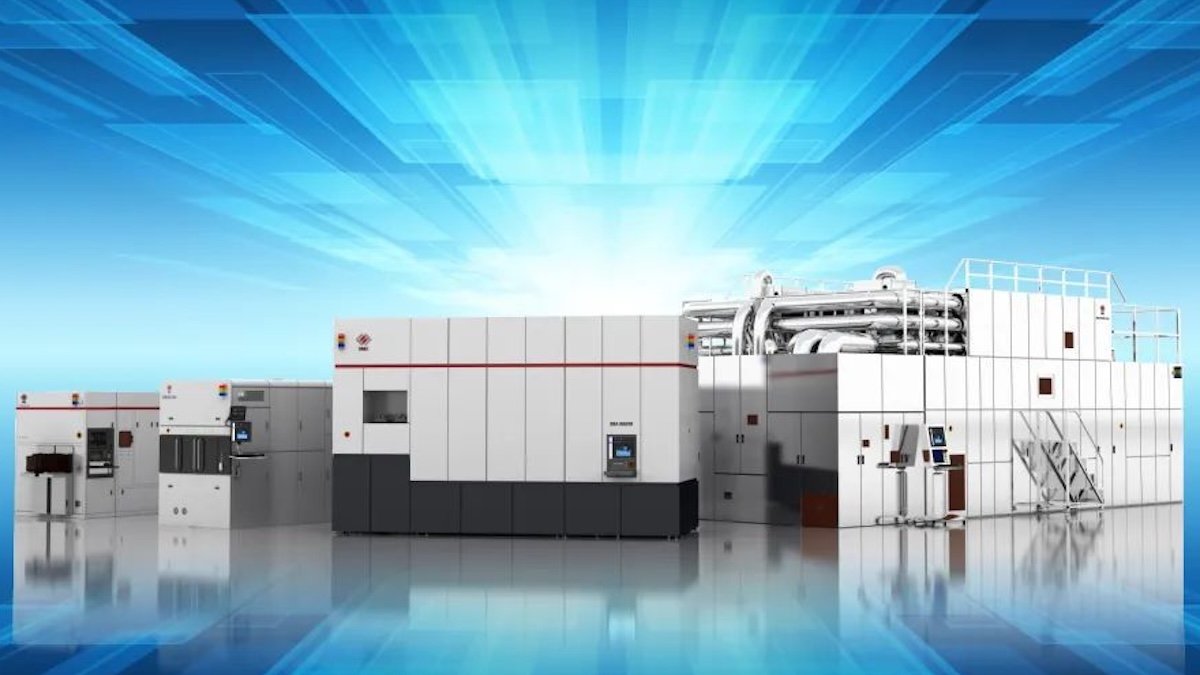
Reports that China has begun mass-producing its own immersion deep ultraviolet (DUV) lithography machines sent European chip equipment stocks tumbling this week, but Chinese analysts and state media caution that the homegrown tools still lag far behind those of Dutch giant ASML.
The Information reported on Monday that a state-backed manufacturer, whose identity was initially undisclosed, has started producing the machines. Output is expected to be modest: about five units this year and roughly 20 more in 2027, destined for leading Chinese chipmakers including Semiconductor Manufacturing International Corp (SMIC), Hua Hong Semiconductor, and ChangXin Memory Technologies. Reuters later identified the producer as Shanghai Aishengna Electronic Technology Group, a secretive firm founded in August 2023 with registered capital of 7 billion yuan (about US$1 billion), backed by Shanghai Electric Holding and a subsidiary of Shanghai International Trust.
The report noted that the breakthrough could eventually challenge ASML's position in China, but stressed that the system still lags in performance and reliability and requires further testing before full-scale deployment.
Market reaction and state media response
ASML shares fell 13% over the first three trading days of the week, while BE Semiconductor Industries dropped 16.3% and Infineon Technologies slipped 15.5%. The stocks rebounded on Thursday after JP Morgan analysts called the selloff disproportionate to the actual news, though they have yet to recover to last Friday's levels.
The Global Times, a unit of the People's Daily, said in an editorial that the sharp decline showed "Western investors' blind faith in the effectiveness of blockades has been shaken, and the US-led decoupling strategy has lost much of its momentum." The editorial added that "Western technology companies like ASML understand that once China achieves a genuine breakthrough, their market share will face a direct hit," and described the stock fluctuations as "a realistic risk assessment by the industry."
State media urged China to "stay focused, keep doing the work, and not be distracted by the external buzz," and Chinese commentators have largely remained silent this week, with only a few stock market bloggers suggesting that shares of domestic chip equipment suppliers may gain support.
Technical reality: four generations behind
Despite the hype, Chinese pundits acknowledge that the domestically developed 28-nanometer DUV machine is roughly equivalent to ASML's TWINSCAN NXT:1950i, a tool the Dutch company launched in 2008. "China's self-developed 28 nm DUV lithography machine still lags about four generations behind ASML's products, with performance roughly equivalent to the Dutch company's lithography tool from 15 years ago," wrote a Liaoning-based columnist.
The machine, known as the SSA800, is being developed by a team that has been consolidated under Aishengna. It shares engineers with Shanghai Yuliangsheng, which began testing a DUV prototype last year, and with Shanghai Micro Electronics Equipment (SMEE). Yuliangsheng was founded in 2022 and is jointly owned by SiCarrier and the state-backed Chuangkewei (Shanghai) Technology. Last year, SMEE restructured, moving its immersion DUV lithography technologies and engineers into Yuliangsheng while retaining its extreme ultraviolet (EUV) project.
Media reports say about 70% of the SSA800's components are made in China, with suppliers including Nanjing Wavelength Opto-Electronic Science and Technology for non-objective lenses, MLOPTIC Corp for 300mm large-aperture lenses, the Changchun Institute of Optics, Fine Mechanics and Physics for the exposure system, Beijing U-Precision for the dual-stage system, and Beijing Naura Electronics for temperature control.
However, the machine still relies on imports for critical parts such as 193nm excimer laser mirrors, Zeiss lenses, vacuum chambers, synchronization control algorithm software, and argon fluoride (ArF) immersion light sources, or must source them from secondary markets.
Chinese chipmakers are still allowed to import ASML's NXT:1980i machines, and SMIC is reportedly using such equipment, combined with multiple-patterning techniques, to produce 7nm chips for Huawei Technologies despite US sanctions. This suggests that while China is making progress in domestic lithography, it remains heavily dependent on foreign technology for advanced nodes.
The sell-off in European stocks may have been an overreaction, but the underlying reality is that China's DUV machines are still years behind ASML's current offerings. The country's push for self-sufficiency in semiconductor manufacturing is real, but the road to parity remains long.