Demanding a minister's resignation is one thing—uncomfortable for a government, occasionally embarrassing for a prime minister, but ultimately manageable. Ministers can be sacrificed, their departures framed as accountability, and governments can move on. But demanding the resignation of the chief election commissioner is another matter entirely, and for Indian Prime Minister Narendra Modi, the difference could hardly be more consequential.
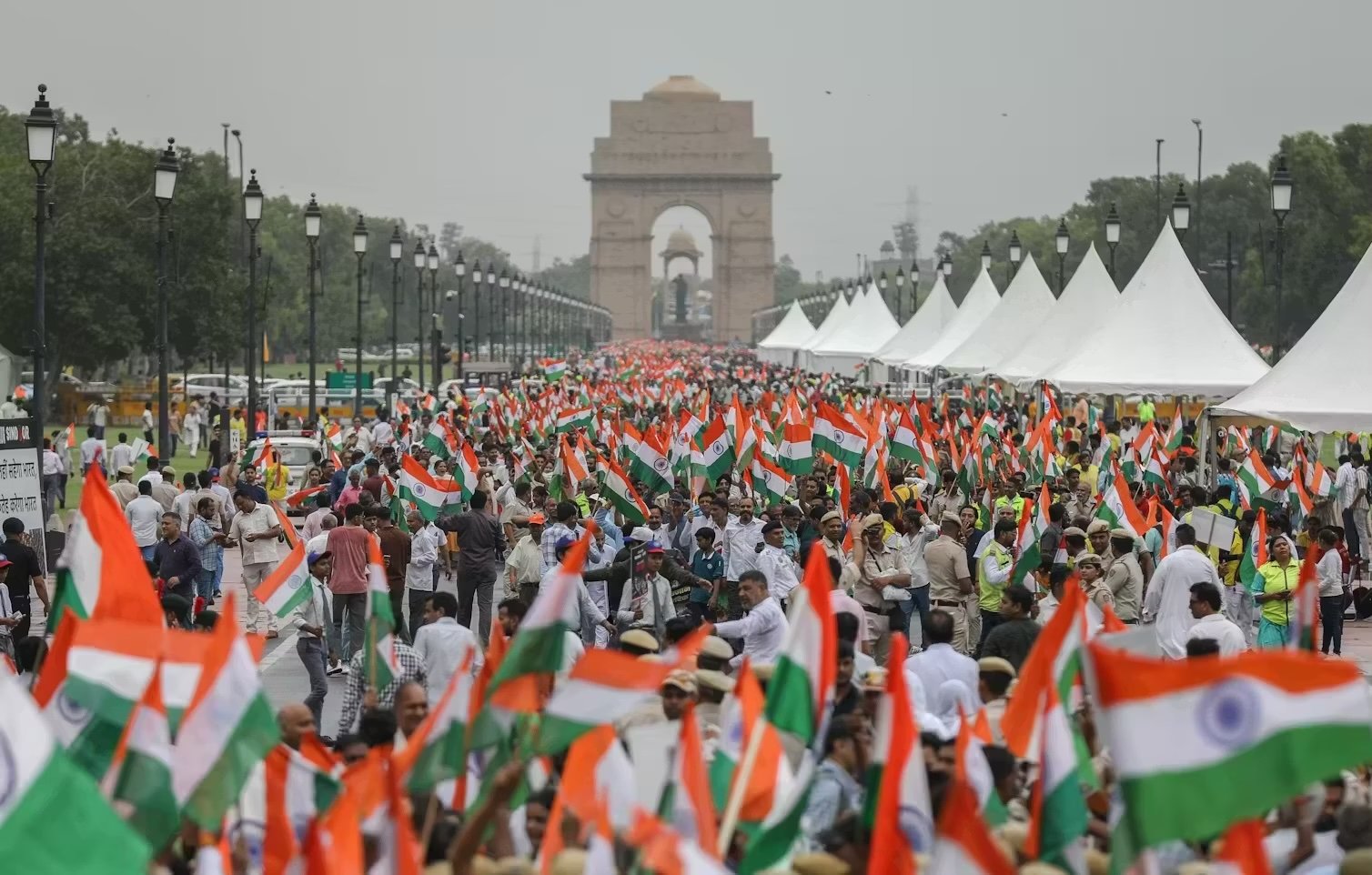
The latest wave of protests in New Delhi centers on allegations of widespread voter manipulation through the Special Intensive Revision (SIR) of electoral rolls and other suspected irregularities. Demonstrators are calling for the resignation of Chief Election Commissioner Gyanesh Kumar. A resignation under such circumstances would not, by itself, establish that votes were stolen. But it could be interpreted as an acknowledgment of serious failures in the institution entrusted with protecting India's electoral integrity.
Would it inevitably raise a much more uncomfortable question for Modi: were his electoral victories secured entirely through the mandate of the people, or did the machinery administering those elections help tilt the contest in his favor? That is a question no prime minister wants to face, particularly one whose political authority has been built on repeated electoral victories and the claim of an overwhelming popular mandate.
Modi remains popular. Unlike Sheikh Hasina, who presided over three deeply rigged elections in Bangladesh, he has won genuinely competitive contests. The Bharatiya Janata Party even lost its outright parliamentary majority in 2024. There is no established evidence so far that Modi stole those elections. But political legitimacy depends on more than winning. It also depends on public confidence that the rules governing the contest were fair. And that is where the current protests become particularly significant.
From ministerial sacrifice to electoral accountability
Bangladesh's 2024 uprising offers a useful comparison. Hasina did not fall because of one protest or one unpopular decision. Her government had weathered successive waves of dissent before the final confrontation. But eventually the nature of the public's grievance changed, and protesters began questioning its right to govern. India has not reached that point. But the shift from demanding a minister's resignation to demanding the chief election commissioner's removal shows why the latest protests carry implications far beyond the streets of Delhi.
On Saturday, Delhi's central districts resembled a city preparing for an invasion rather than a demonstration. Police barricaded roads, suspended mobile internet services, shut metro stations, and deployed thousands of security personnel. More than 2,000 protesters were detained, according to Reuters. Among them were leaders of the youth-driven Cockroach Janata Party (CJP), whose campaign has increasingly challenged the Modi government. The movement's founder, Abhijeet Dipke, was detained after arriving in Delhi, as was prominent YouTuber Dhruv Rathee. Several opposition politicians also faced detention.
The detentions have not ended the agitation. Dipke and other movement leaders were subsequently released following court intervention, while protesters continued gathering on Sunday. The CJP first attracted national attention over examination irregularities, helping generate pressure that preceded Education Minister Dharmendra Pradhan's resignation in July. Its campaign has since expanded from administrative grievances to electoral accountability.
Meanwhile, the opposition INDIA bloc has mounted its own protests. Congress leader Rahul Gandhi and other lawmakers have demanded Kumar's resignation, alleging that electoral roll revisions were manipulated to benefit the BJP. Gandhi has vowed that the protests will continue. The government, for its part, accuses opposition parties of exploiting the controversy after electoral defeats.
The CJP and INDIA bloc are not the same political formation. Their interests, constituencies, and strategies differ. Yet their separate mobilizations are converging on the same institution. This is where Bangladesh's recent history becomes relevant. Hasina's government survived repeated challenges long before the uprising that removed her in August 2024. The Shahbag movement in 2013, the subsequent Hefazat-e-Islam mobilisation, BNP-led opposition campaigns, the 2018 road safety protests, and successive quota reform demonstrations all exposed different sources of dissatisfaction. They were not one continuous movement. Their demands frequently conflicted. Some were barely concerned with electoral politics. But each confrontation contributed to a political environment in which the government increasingly relied on coercion, administrative restrictions, and partisan institutions to manage dissent.
Hasina survived them all. That became part of the problem. Repeated victories encouraged an assumption that every protest could eventually be contained. When students mobilized over government job quotas in July 2024, the authorities initially approached the agitation as another familiar disturbance. The protest escalated after Hasina's remarks invoking Razakars, the collaborators of Pakistan's military during the 1971 Liberation War. Students appropriated the insult, and the movement rapidly expanded beyond its original demands. The crackdown proved catastrophic. The UN estimated that as many as 1,400 people were killed during the uprising and its suppression. By August 5, Hasina had fled to India.
There is an intriguing parallel in the CJP's choice of name. The movement appropriated the word cockroach, associated with disparaging remarks about unemployed young activists, and turned it into a political identity. In both cases, an insult intended to diminish protesters became a means of mobilization. The similarities should not obscure the differences. India has a far larger and more robust democratic framework, a more independent judiciary, and a more vibrant civil society than Bangladesh under Hasina. But the trajectory of protest—from specific grievances to a broader questioning of institutional legitimacy—is a pattern that has proven dangerous for incumbents across the region. For Modi, the question is whether he can restore confidence in the electoral machinery before the protests evolve into something more existential. As Hasina's return pledge shows, once a leader's legitimacy is fundamentally challenged, it is difficult to recover. The coming weeks will test whether India's institutions can withstand the scrutiny—and whether Modi's mandate can survive the questions being raised in the streets of Delhi.