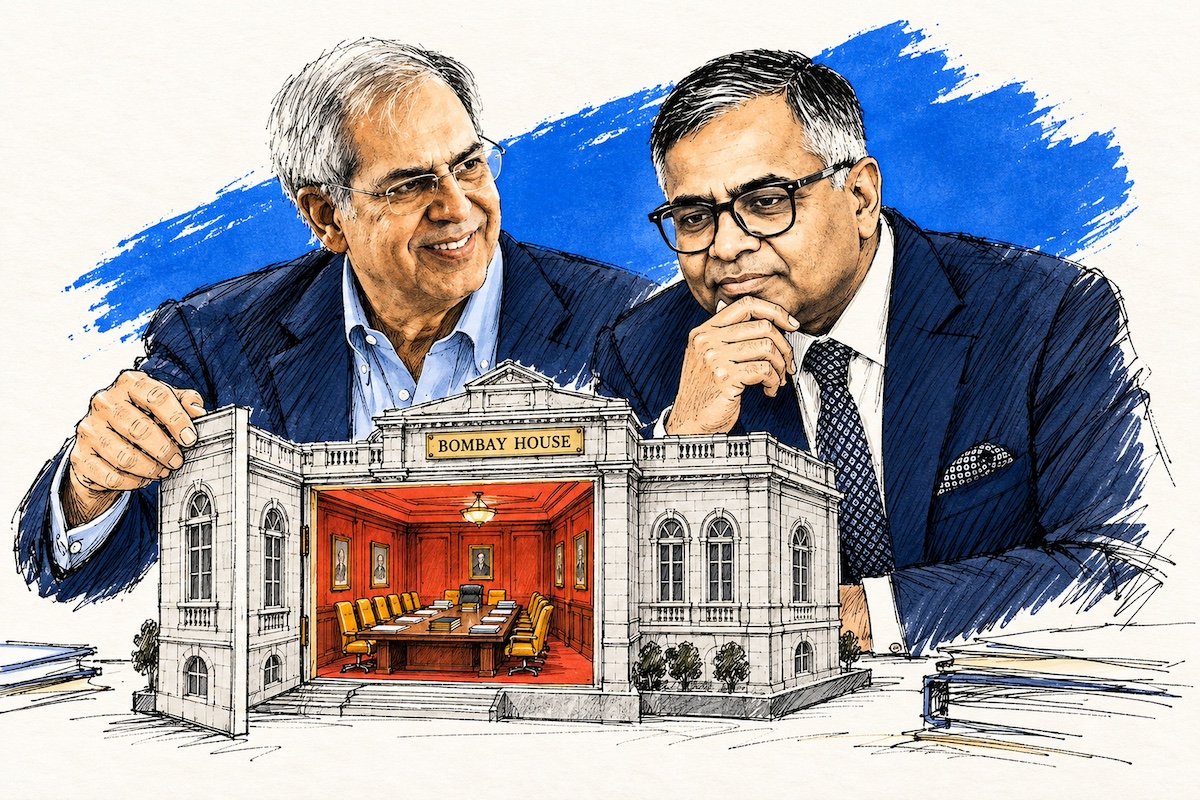
The Reserve Bank of India's decision to keep Tata Sons on its register of systemically important core investment companies has been widely read as a step toward a blockbuster initial public offering. That reading overstates the case. There is no prospectus, no pricing, and no timetable. What the central bank has done is close the holding company's most convenient route around a listing requirement. The real significance lies elsewhere: it forces a reckoning with a model of corporate control that has shaped much of Asia's industrial rise.
Tata Sons is the parent of a sprawling conglomerate that includes Tata Consultancy Services, Tata Motors, and Tata Steel. Its ownership structure is unusual. Charitable trusts hold roughly two-thirds of the parent, and dividends from operating companies fund hospitals, universities, and research. That arrangement gives concentrated capital a moral purpose and buys patience for long-haul bets like rebuilding Air India or building semiconductor and battery capacity. Noel Tata, who chairs the group, has argued that a public listing would undermine this character. He has a point. Listed holding companies face relentless pressure to raise payouts, sell stakes, and justify every project against quarterly reporting cycles.
Much of Asia's industrial transformation depended on controllers willing to absorb years of weak returns before a new industry reached scale. That bargain worked when the controller's judgment was trusted and the consequences of failure were contained. But Tata Sons is not merely a patient owner. It is the promoter, the principal investment vehicle, and the owner of the Tata brand itself. More than 90% of its net assets consist of investments and loans to group companies, according to its own disclosures. What happens at the parent ripples through listed companies, into strategic sectors, and down to the portfolios of millions of ordinary shareholders.
Three claims in tension
This structure puts three legitimate claims in tension. Property gives owners the right to deploy capital and bear risk. Trusteeship asks them to use that capital for purposes larger than immediate profit. Regulation asks what disclosure is owed when private choices create public consequences. The Shapoorji Pallonji Group's roughly 18% stake in Tata Sons illustrates why private control cannot resolve all three. The stake is enormously valuable but illiquid. Tata Trusts has floated a proposal to pay SPG at least 25,000 crore rupees (about $2.6 billion) through a selective capital reduction, drawing on some combination of Tata Sons' own cash flow, sales of listed shares, outside investment in newer businesses, and public offerings of subsidiaries.
Each option moves the conflict rather than ending it. Selling down listed holdings weakens Tata's strategic influence and shrinks future dividends. Bringing in outside investors into newer ventures creates fresh valuation benchmarks and new governance rights. Using the parent's resources to buy out one shareholder raises the uncomfortable question of whose interests the holding company serves when its owners disagree.
A public listing would not automatically fix this. Minority investors in Tata Sons would still be sitting beneath charitable control and above a portfolio of listed operating companies. More disclosure would make the balance sheet more visible but would not decide when one group company should support another, how losses from new ventures should be shared, or what duties the parent owes to shareholders lower in the structure.
Pricing Tata Sons would also be a governance judgment disguised as arithmetic. Any valuation must account for controlling stakes, unlisted ventures, tax exposure, the value of the Tata brand, and the discount markets apply to holding companies generally. A rupee held inside TCS is not equivalent to a rupee held by a parent company that may never sell the share—and may instead route the dividend into an airline or a chip factory.
The current board dispute adds urgency. Tata Trusts and Tata Sons directors disagree over whether a vote tied to N. Chandrasekaran's reappointment was even legally valid. Courts may eventually settle the merits. But the institutional weakness underneath the dispute is already visible: the people responsible for running the same organization cannot agree on who has the authority to run it.
The lesson for Asian capitalism is not that listed ownership is an inherently superior model. Markets often over-reward short-term behavior, and disclosure is no substitute for sound judgment. The lesson is that systemic importance changes what private control must explain. Conglomerates have often defended concentrated ownership as the price of patience. That bargain can endure only if control remains legible on who decides, who bears losses, how capital moves, and what protection exists for those outside the controlling circle.
Tata's reputation was built over a century, but reputation alone can no longer serve as the group's only system of assurance. The RBI's decision does not yet force Tata Sons to open every door. It signals that, for Asia's largest private controllers, keeping those doors closed is no longer a sufficient claim to public trust. As India recalibrates its global posture amid shifting power dynamics, the governance of its corporate giants will be watched closely.