Over the past two decades, China has emerged as the world's largest bilateral creditor, reshaping global development finance. Yet the debate over its lending to Africa remains polarized between Western accusations of 'debt-trap diplomacy' and Beijing's rhetoric of 'South-South cooperative altruism.' A closer look reveals a more nuanced reality: China's overseas credit model operates with a split personality, combining internal Keynesianism with external neoliberalism.
To understand this, one must examine the structural mechanics of China's domestic economy. For decades, Beijing directed massive liquidity through state-owned policy banks and commercial banks, fueling an unprecedented credit expansion that sustained high GDP growth. However, by the mid-2010s, this state-Keynesian regime faced diminishing returns, leading to severe overcapacity in sectors like construction and manufacturing, along with mounting subnational debt.
Facing a structural imperative to find an external outlet for surplus industrial capacity and accumulated U.S. dollar reserves, China turned to overseas infrastructure projects. This mirrors what geographer David Harvey calls a 'spatial fix'—the displacement of overaccumulated domestic capital abroad. The Belt and Road Initiative (BRI) emerged as the logical extension of this internal model, channeling Chinese state-backed capital into long-term infrastructure projects across Africa and Asia.
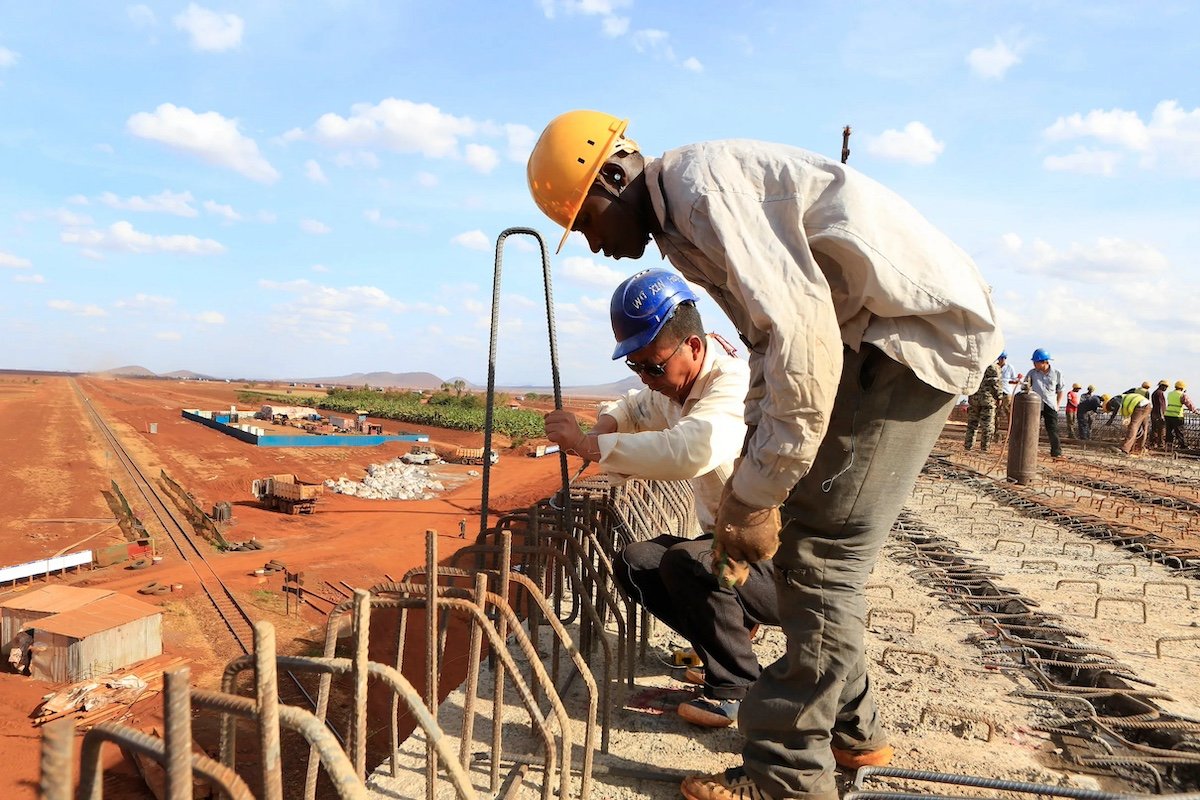
The micro-financial loop of this externalization is precise: a Chinese policy bank extends a dollar-denominated sovereign loan to an African government, with strict procurement clauses requiring the project to be built by designated Chinese state-owned enterprises. Critically, the capital rarely leaves China's banking system—funds are transferred directly from the bank's headquarters in Beijing to the corporate accounts of the executing Chinese firms. This arrangement converts low-yielding dollar reserves into overseas orders for China's industrial base, effectively exporting overcapacity.
External Neoliberalism in Practice
While the macro-level motivation is rooted in state-backed Keynesianism, Chinese banks behave differently once they enter international markets. On foreign soil, they operate with a pragmatic, commercial focus on capital preservation and risk insulation that mirrors neoliberal financial logic. Unlike Western multilateral institutions such as the World Bank and IMF, which impose political conditions like fiscal austerity or privatization under the 'Washington Consensus,' China adheres to a doctrine of 'non-interference' and 'no political strings attached.'
However, this lack of political conditionality does not mean an absence of commercial or legal safeguards. Chinese banks insulate themselves from host-country governance risks through strict contractual mechanisms. The clearest example is the 'Angola Mode,' a commodity-backed infrastructure lending structure. When extending credit to low-rated sovereign states with restricted access to international capital markets, Chinese institutions design a tightly closed-loop system: an offshore escrow account, typically maintained in an international financial hub or directly with the lending bank in Beijing, bypasses the borrowing state's domestic central bank and fiscal systems. The borrowing state mandates that revenues from its strategic commodity exports be paid directly into this escrow account, giving the creditor bank senior security over repayment.
This dual system challenges simplistic narratives. For instance, while Western critics point to Zambia's debt distress as evidence of 'debt-trap diplomacy,' the reality is more complex: Chinese lenders have also renegotiated terms and extended grace periods, reflecting their pragmatic risk management. Similarly, Beijing's claims of altruism ignore the commercial logic driving its lending. The split personality means that China's Africa lending is neither purely predatory nor purely benevolent—it is a sophisticated mechanism for managing domestic economic pressures while expanding global influence.
This model has implications beyond Africa. In Southeast Asia, similar structures are visible in infrastructure projects under the BRI, such as the China-Laos railway, which uses Chinese loans and contractors. The approach also intersects with broader geopolitical dynamics, as seen in the US wartime buildup racing against China's industrial clock in the Indo-Pacific. Understanding this split personality is essential for policymakers and analysts seeking to navigate the complexities of Chinese development finance.