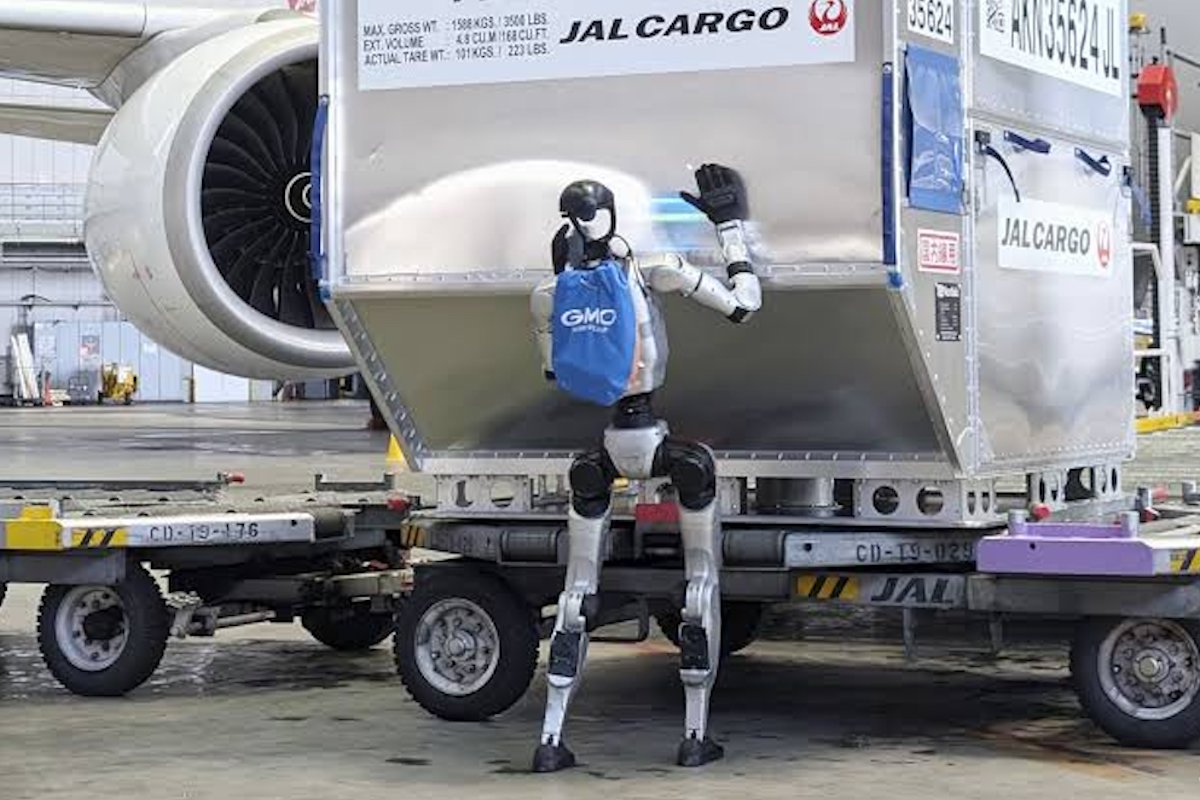
While headlines focus on the US-China technology rivalry, a quieter shift is taking place in the baggage bays of Tokyo's Haneda Airport. There, Japanese ground handlers are working alongside Chinese-made humanoid robots, a collaboration born not of diplomatic rapprochement but of demographic necessity.
Japan's working-age population is shrinking rapidly. Official projections indicate the country will need 6.5 million foreign workers by 2040 to sustain economic growth, even as political pressure mounts to curb immigration. In this context, a humanoid robot costing roughly US$4,900—a fraction of a single foreign worker's annual wage—becomes an irresistible proposition.
From Exhibition to Conveyor Belt
The shift from spectacle to practical deployment crystallized in April 2026. A Beijing half-marathon saw an android outpace human runners; days later, a viral video from Singapore's Changi Airport captured a ground handler struggling under an overwhelming workload, hurling suitcases in frustration. Concurrently, Tokyo's Haneda announced trials of 130cm-tall Unitree humanoids, scheduled for full operations in May.
These events mark a departure from the curated robot exhibitions that have long fascinated audiences. At Changi's Terminal 5 exhibition in January, robots performed flawlessly in a climate-controlled gallery. But the uncurated reality of the conveyor belt tells a different story: one of overburdened workers and the universal fragility of the human spine.
Hangzhou-based Unitree, known for perfecting a dynamic balancing technique dubbed the "Drunken Fist" by observers, has moved beyond spectacle. The same motor torque and sensory perception that allow its robots to stumble and recover in kung fu-inspired demos now enable them to navigate the chaotic, rain-slicked environment of a cargo loader.
Pragmatism Over Politics
For Japan, a nation historically wary of its neighbors and actively pursuing economic security measures to reduce dependence on China, this logistical infiltration is profound. Yet at the level of the luggage loader, the "China threat" yields to the more immediate threat of a broken supply chain.
China's massive smartphone and electric vehicle industries have built a hardware supply chain that no other country can match. This has brought humanoid robots out of expensive laboratories and turned them into affordable commercial tools. With prices starting at roughly $4,900 per unit—the most affordable humanoid on the market, according to Forbes—the economic calculus is simple. Geopolitical worries take a back seat to basic business survival.
This technological pragmatism operates beneath the radar of geopolitics. In an era of "de-risking," the only place where seamless global flow has been achieved is in the baggage bays, where Chinese algorithms protect Japanese and potentially Singaporean backs. The visual shock of the Changi baggage toss should end the fascination with tech exhibitions. We do not need robots that can perform kung fu for applause; we need robots that can navigate a real-world cargo hold.
The implications extend beyond Japan. Hong Kong's air cargo hubs have long relied on rigid Automated Guided Vehicles constrained to fixed paths. Humanoids offer a solution for the messy, uncurated chaos of human space. From the Greater Bay Area to Haneda, a new reality is setting in: biological limits have become the only true neutral ground left in an era of geopolitical friction.
This is not merely a story of technological prowess, but of demographic desperation. As Japan's working-age population continues its precipitous decline, the humanoid is no longer a luxury of science fiction; it is a mechanical necessity for a nation that cannot afford to break more human backs. The true irony of 2026 is unfolding beside the conveyor belts of Haneda Airport, where a quiet form of mercy requires no diplomatic communiqués.