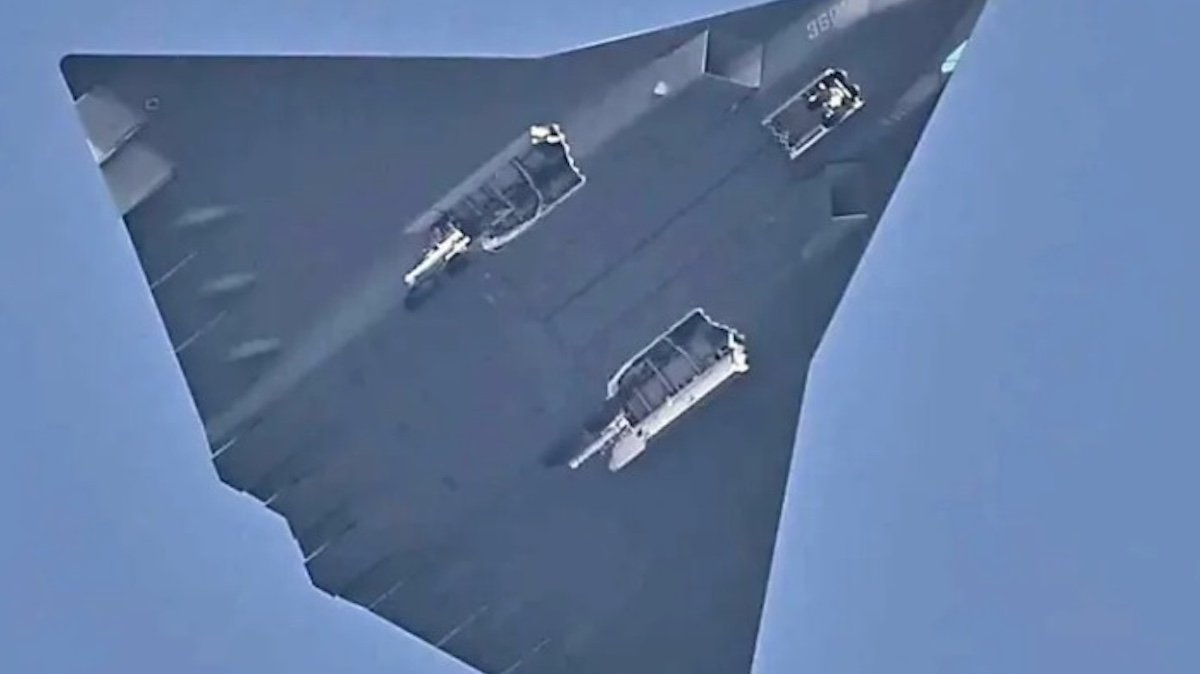
China’s state-owned aerospace giant AVIC has offered the clearest signal yet that it is developing high-energy lasers for next-generation fighter aircraft. At a recent defense exposition, the Beijing Precision Engineering Institute for Aircraft Industry displayed materials describing a “fighter aircraft laser-weapon tracking and aiming system” weighing under 380 kilograms and delivering at least 100 kilowatts of power.
The promotional imagery featured the J-36, a heavy, three-engine sixth-generation fighter-bomber first observed flying in late 2024. With an estimated takeoff weight of 50 to 55 tons and a wingspan of roughly 20 meters, the tailless design offers the internal volume and electrical capacity to host such a system without compromising its stealth profile.
Why the J-36 is suited for lasers
Sixth-generation fighters are defined by breakthroughs rather than incremental upgrades. Typical features include manned-unmanned teaming, AI-assisted operation, adaptive structures, and directed-energy weapons. The J-36’s three-engine layout provides the power generation needed for a 100-kilowatt laser, which could burn through cruise missiles or blind the optical seekers of incoming air-to-air missiles.
Operating such a weapon requires massive electrical output and complex cooling systems. Smaller tactical fighters have historically lacked the space and power margins for these demands, making the J-36 an ideal host platform.
If successfully integrated, a laser would offer a magazine-independent defense—engaging threats at the speed of light without depleting conventional munitions. This capability is particularly relevant against low-cost drones, where firing a million-dollar missile is economically unsustainable.
The US experience: a cautionary tale
The United States pursued a similar concept under the SHiELD program, with Lockheed Martin delivering a sub-100-kilowatt pod-mounted laser in 2022. However, The War Zone reported in May 2024 that the US Air Force canceled the effort without flight testing on a fighter. Integration failed due to extreme size, weight, and power constraints, severe thermal dissipation issues, aircraft vibration, and atmospheric turbulence degrading beam focus.
Technical delays repeatedly pushed planned trials from 2021 to 2025 before officials halted evaluations. The US experience underscores the formidable engineering challenges of airborne lasers, yet China’s continued investment suggests it believes these hurdles are surmountable.
Cost dynamics and drone swarms
The operational urgency of laser weapons is already visible in the Middle East. Air & Space Forces Magazine reported that the US Air Force rushed to equip F-15E Strike Eagles with laser-guided rockets to counter Iranian-manufactured drone swarms. Intercepting cheap one-way drones previously required AIM-120 AMRAAM missiles costing around $1 million each, or $500,000 AIM-9X Sidewinders, quickly exhausting fighter arsenals.
By adapting the Advanced Precision Kill Weapon System (APKWS), the US fielded an air-to-air interceptor costing roughly $35,000 per rocket, allowing a single F-15E to carry up to 42 munitions. Yet even that price is far higher than a single laser shot, which could cost as little as $3.
China’s manufacturing base could further skew this calculus. In November 2025, Defense Security Asia reported that China unveiled the Feilong-300D suicide drone at just $10,000 per unit, undercutting the Iranian Shahed-series drones it was inspired by, which cost between $20,000 and $80,000.
In response, US Assistant Secretary of Defense for Critical Technologies Michael Dodd urged contractors in August 2026 to deliver lighter, more efficient airborne directed-energy weapons. He called for testable hardware, not conceptual designs, to mount high-energy lasers and microwaves on aircraft. The Pentagon, amid loosened domestic airspace restrictions, has pressed for routine live-fire evaluations.
China’s pursuit of fighter-mounted lasers, if successful, would mark a significant leap in air combat capabilities. It would provide an active defense against long-range Western munitions and offer a cost-effective answer to drone swarms—an advantage that could reshape aerial warfare in the Indo-Pacific and beyond.