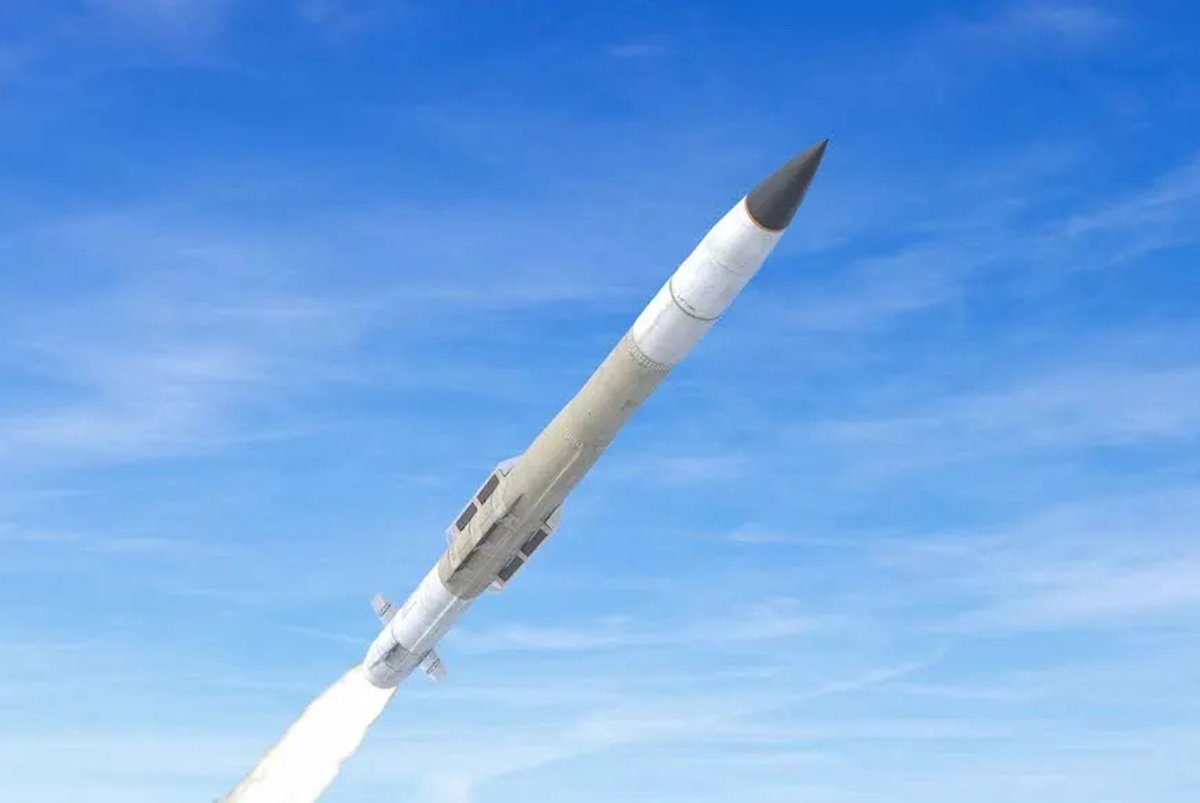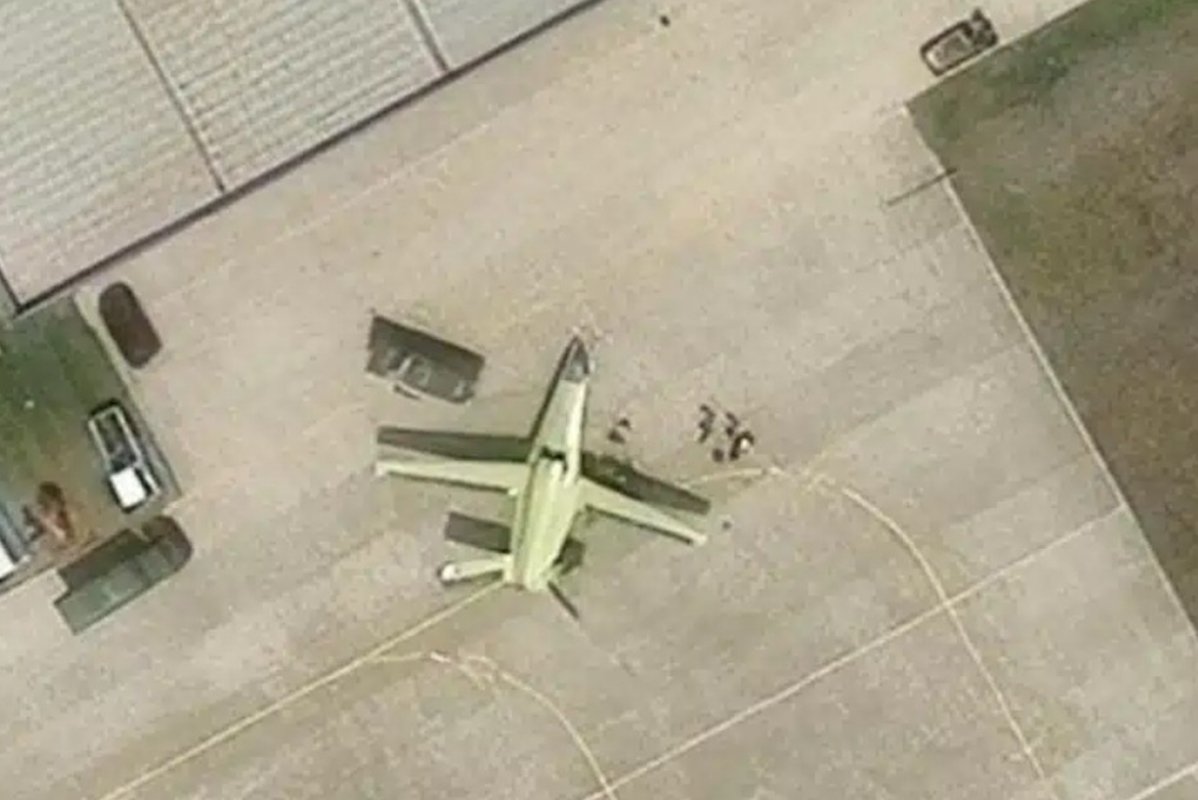
Satellite imagery has revealed an unidentified uncrewed aircraft at Pucheng Neifu Airport in Shaanxi Province, China, bearing a strong resemblance to Boeing's MQ-25A Stingray carrier-based tanker. The aircraft, photographed alongside a CH-7 stealth flying-wing drone and a Jiutian drone mothership, suggests a new direction in China's naval aviation ambitions.
Measurements by analysts at Vantor indicate a wingspan of roughly 20.12 meters and a length of 14.94 meters, slightly smaller than the MQ-25's 22.86-meter span and 15.54-meter length. The yellow-primer airframe features a tapered nose that could house a radar or radome, a dorsal intake with apparent serrations or channel separation, and a laterally flared V-tail. These design elements point toward a multirole tanker or intelligence, surveillance, and reconnaissance (ISR) platform, though external imagery cannot confirm internal fuel volume, propulsion, mission systems, or carrier compatibility.
Extending the Carrier Air Wing's Reach
The potential tanker role is significant. China's carrier-based fighters, such as the J-15 and J-35, face clear reach and endurance limits. A May 2026 report from the China Aerospace Studies Institute (CASI) notes that J-15s operating from the ski-jump carriers Liaoning and Shandong are constrained by short takeoff profiles and takeoff weight ceilings, which restrict fuel and ordnance loads. This leaves them reliant on shore-based command-and-control and ISR aircraft for wide-area battlespace awareness.
Similarly, the Chosun Daily reported in February 2026 that China's J-35 stealth fighter suffers from severe range and loiter limits due to its reliance on the WS-21 engine rather than the anticipated WS-19. The report states that this engine setup limits the J-35 to just seven minutes of operation at 900 kilometers from the Fujian carrier, raising questions about its long-range naval strike effectiveness.
An uncrewed tanker could help offset these limitations. By shuttling fuel from larger manned tankers to fighters in contested areas, it could keep vulnerable manned tankers farther from threats while sustaining fighter operations. This approach aligns with China's broader push for aerial refueling capabilities.
Carrier Modernization and Uncrewed Systems
Carrier modernization reinforces this trajectory. In a November 2025 analysis for the International Institute for Strategic Studies (IISS), Douglas Barrie notes that Fujian's electromagnetic catapults and arrester gear mark a major advance over earlier ski-jump carriers. Trials with J-15 Flanker K, J-35, and KJ-600 aircraft have demonstrated the ability to launch with heavier payloads and longer ranges, supporting more ambitious deployments beyond the First Island Chain.
Looking further ahead, an October 2026 report from the Center for Strategic and International Studies (CSIS) by Matthew Funaiole and co-authors states that China's upcoming Type 004 carrier, likely nuclear-powered and larger than Fujian, will enable longer-duration operations farther from China's shores. Nuclear propulsion would remove ship-refueling limits, sustain higher speeds, generate more power for electromagnetic catapults, and free interior space for more aircraft, munitions, and supplies.
Land-based tanker expansion adds another layer. In a January 2026 Lowy Institute article, David Vallance argues that China is expanding its air-to-air refueling fleet to narrow the gap with the US and support long-range power projection. The PLAAF is fielding Y-20B multirole tankers alongside YY-20As, potentially giving it over 100 refuelers within a decade while phasing out older IL-78s and converted H-6s.
Uncrewed ISR and kill-web concepts further shape how such a platform could operate. An October 2026 brief from the American Foreign Policy Council (AFPC) by Robert Pierce and co-authors notes that unmanned systems strengthen the PLA's ability to find, fix, track, and identify US forces across the First Island Chain and beyond. Combining high- and low-altitude unmanned aircraft supports layered multi-intelligence collection.
The emergence of this MQ-25-like drone underscores China's determination to extend its carrier air wing's reach. While the aircraft's exact role remains unconfirmed, its design and the context of China's carrier modernization point toward a future where uncrewed systems play a central role in Pacific power projection. As China continues to develop its carrier fleet and supporting infrastructure, the implications for regional security are profound.