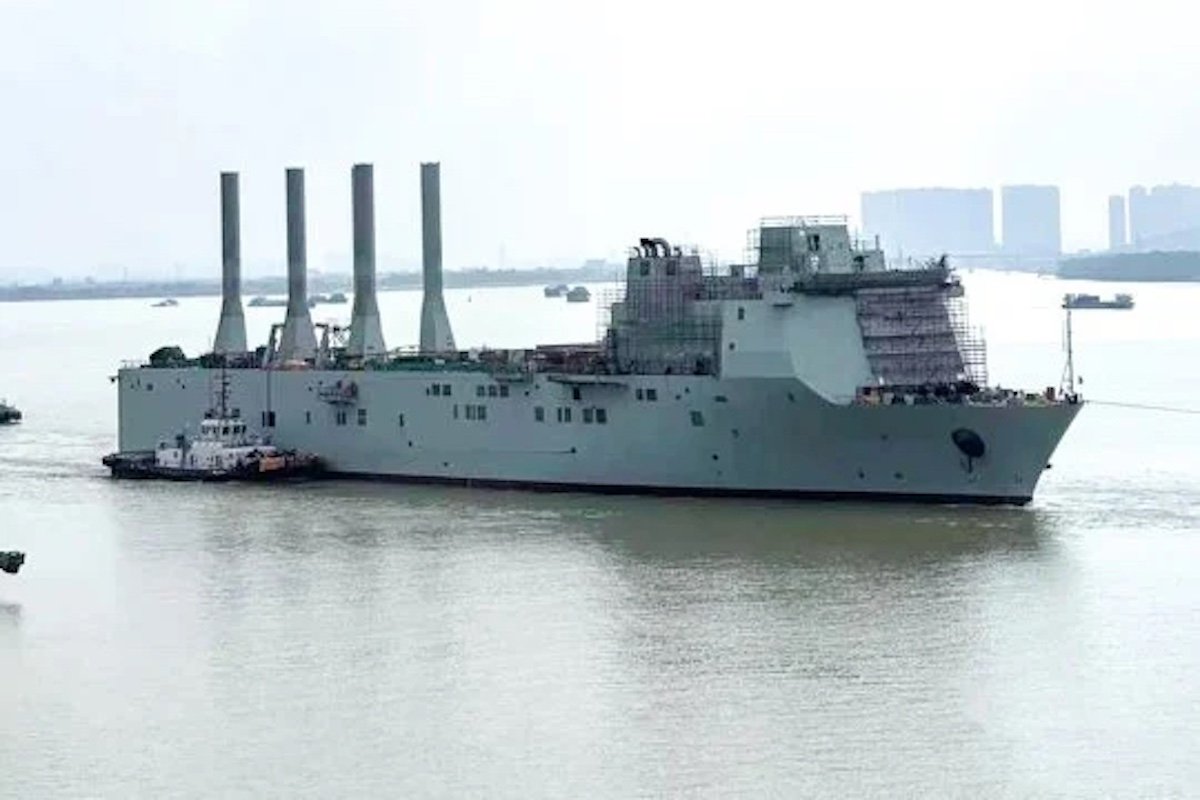
China is expanding its ability to project autonomous undersea power far beyond its coastal waters, with new evidence showing a second dedicated mothership for submarine-sized uncrewed underwater vehicles (UUVs). The vessel, spotted under tow along the Pearl River near Guangzhou’s Panyu district, was built at Guangzhou Shipyard International on Longxue Island. At roughly 150 meters long, it is a scaled-down variant of a 205-meter ship launched earlier at Shanghai’s Hudong-Zhonghua yard, featuring six lifting towers instead of the larger vessel’s configuration.
The platform is designed to transport, launch, and recover autonomous submarines in the 35-to-45-meter range, displacing 400 to 700 tons. Stern cradles and internal hangars allow maintenance and operations directly at sea, addressing a critical logistical bottleneck: ferrying heavy drones across long distances—such as through Southeast Asian chokepoints into the Indian Ocean—without draining their endurance or relying on permanent foreign bases.
Extending reach, but with a visible cost
While this mobile infrastructure extends China’s underwater reach for missions like seabed surveillance or minelaying, it introduces a conspicuous surface signature. A large mothership is easy to track by satellites, aircraft, and radar, potentially revealing the location of otherwise concealed undersea drones. This trade-off is central to the strategic calculus behind the program.
China’s steady introduction of unmanned underwater warfare capabilities suggests it is considering these assets for both offensive and defensive roles. Offensively, Beijing could use its extra-large UUVs (XLUUVs) to disable US and allied underwater sensors in the First Island Chain. Destroying those sensors could enable Chinese submarines to cross critical chokepoints such as the Miyako Strait and Bashi Channel, establishing forward presence against US naval forces intervening in a potential conflict over Taiwan.
The US and Japan operate the “Fish Hook” underwater sensor network, spanning Japan, Taiwan, the Philippines, and Indonesia, designed to detect any Chinese submarine attempting to break into the open Pacific. However, Ryan Martinson, in a June 2025 article for the Center for International Maritime Security (CIMSEC), notes that such a breakout carries staggering detection risks, severely compromising operational stealth and strategic nuclear deterrence. Citing People’s Liberation Army Navy (PLAN) sources, Martinson says the US Navy’s integrated surveillance architecture—fixed seabed sonar, ocean surveillance ships, aircraft, and orbital satellites—creates an “extremely high” probability of tracking Chinese submarines directly upon leaving port. He adds that PLAN sources acknowledge a “fairly high” probability of detection and interception while navigating Near Seas transit corridors, with US acoustic nets blanketing critical chokepoints.
Still, Martinson notes that according to PLAN sources, the US lacks sufficient forces to cover the East and South China Seas, and that nodes in the US sensor network could be destroyed. This vulnerability is central to China’s strategy.
Offensive and defensive applications
Chris O’Flaherty, writing in a July 2025 article for The Strategist, outlines how China could destroy US undersea sensors. Options include overtly deploying a drone mothership to launch UUVs that sever underwater cables, or covertly planting explosive charges near cables long before hostilities begin, to be detonated later by a coded acoustic signal. O’Flaherty also notes that cable repair ships such as the USNS Zeus—the only one the US operates—are easy targets.
David Axe, in the same article, points out that while the US could deploy the USS Jimmy Carter special mission submarine to repair damaged cables, the Navy would still be stretched thin protecting the underwater network that gives it one of its greatest wartime advantages. Private companies have cable repair ships, but fewer than 10 exist out of a required global fleet of 20, and private firms may be unwilling to risk their vessels in a conflict zone.
Defensively, Chinese planners are considering how XLUUVs integrated into a wider maritime sensor network can systematically erode longstanding US advantages in submarine stealth. Peter Sullivan, in a July 2026 report from the National Security Data and Policy Institute (NSDPI), argues that China is fielding an unmatched fleet of XLUUVs as part of its emerging “Transparent Ocean” strategy. Tye Graham and Peter Singer, in an October 2025 Defense One article, describe this strategy as an integrated, five-layer sensor architecture spanning seabed to space, designed to eliminate hiding spots for US and allied submarines across the Western Pacific.
Graham and Singer explain that the strategy centers on constructing a resilient, automated “kill web” linking orbital lidar and radar satellites with surface buoys, water-column gliders, and cabled seafloor observatories that power and dock autonomous submersibles. Oceanographic and acoustic data are synchronized through the “Deep Blue Brain” fusion hub to compute dynamic strike routes in real time. This architecture, if realized, would fundamentally alter the undersea balance in the region.
The implications extend beyond the US-China rivalry. Japan, the Philippines, and other Southeast Asian nations that host sensor networks or chokepoints would be directly affected. As China’s drone mothership program matures, the ability of the US and its allies to maintain undersea awareness will face new challenges. The question is not whether China is building these capabilities, but how quickly it can operationalize them and what countermeasures the US and its partners will develop in response.