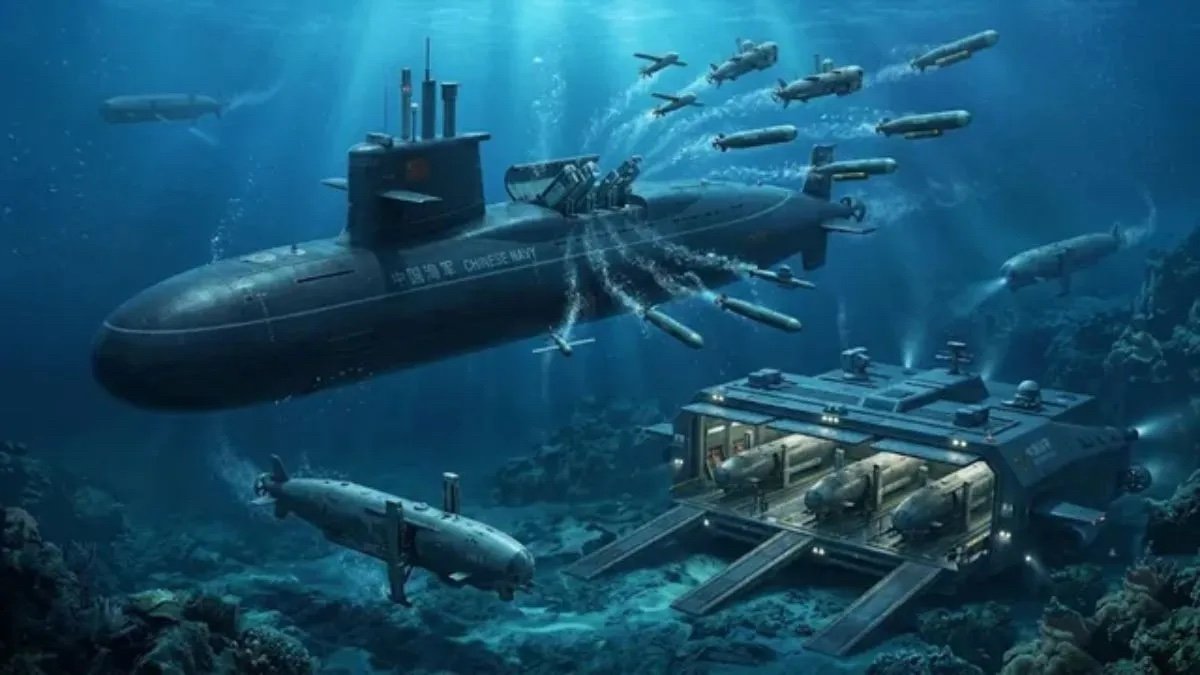
Satellite imagery and shipyard reports indicate that China is building what could be the world's first dedicated mothership for extra-extra-large uncrewed underwater vehicles (XXLUUVs) at the Hudong-Zhonghua shipyard in Shanghai. The roughly 200-meter hull features a large internal hangar, likely capable of stowing up to four autonomous submersibles, and an open-bottom stern well-deck equipped with a specialized cradle for launching and recovering the drones directly into the sea.
The vessel is designed to act as a mobile tender and forward-support base, providing maintenance, rearmament, and extended logistical endurance for China's 35-to-45-meter underwater drones far beyond its coastline. While this platform could significantly enhance China's ability to conduct sustained reconnaissance or strike missions across the First and Second Island Chains, experts caution that its large footprint makes it highly vulnerable to adversary interception in open conflict.
Chinese military authorities have not officially commented on the project, and civilian or research applications have not been fully ruled out. The XXLUUV carrier may be the latest in China's "drone mothership" concepts to project power and conduct massed drone warfare across the Indo-Pacific.
Beyond the sea: a triad of drone carriers
In December 2025, China test-flew the Jiutian drone carrier, a 16-ton unmanned mothership with a 7,000-kilometer range designed to deploy swarms of more than 100 loitering munitions to overwhelm Taiwan's air defenses and target exposed US Pacific airbases. At sea, the People's Liberation Army Navy (PLAN) has the Type 076 amphibious assault ship, a vessel featuring electromagnetic catapults to launch uncrewed combat air vehicles alongside troops and aircraft.
Looking at the possible deployment of China's XXLUUV drone mothership, Daniel Shats and other writers, in a report for the Institute for the Study of War (ISW) this month, note that China could deploy its XXLUUVs from dedicated surface motherships during a Taiwan conflict to conduct undersea reconnaissance, lay mines, and attack adversary vessels. Shats and others mention that these XXLUUVs, possibly capable of sailing up to 7,400 kilometers autonomously, can be deployed from surface ships, significantly extending their operational range toward US territories and strategic maritime chokepoints for pre-conflict positioning.
Yet Shats and others point out that forward posture introduces a severe operational tradeoff: deploying drone motherships into contested waters inevitably swaps acoustic stealth for logistical endurance. A 200-meter surface vessel presents significant radar and thermal signatures, converting an otherwise covert undersea asset into an aggregated, high-value target.
Toward multidomain swarms
Despite these physical vulnerabilities, China's synchronized development of the Jiutian aerial carrier, the Type 076 amphibious assault ship, and the new XXLUUV tender marks a broader operational shift. China may be moving past single-domain drone formations toward multidomain drone swarms capable of dynamic sensor-to-shooter tasking, electromagnetic suppression, and precision strikes across the First and Second Island Chains.
On what such a multidomain drone swarm may evolve into, Sorin Adam Matei says in a RealClearDefense article this month that drone swarms are shifting from crude, single-purpose numerical mass toward adaptive, multicellular "synthetic organisms" defined by behavioral plasticity rather than sheer quantity. Matei rejects linear projections of flying explosive swarms, arguing that future swarms will function like biological systems, with interconnected platforms dynamically swapping roles under fire. He notes that software-defined payload-enabled swarms with self-reconstituting architecture can instantly assume navigation, sensor, or electronic-warfare tasks if command nodes are destroyed, and they degrade gracefully under attrition rather than collapsing catastrophically.
However, Zachary Kallenborn mentions in an October 2024 Observer Research Foundation (ORF) report that as drone swarms grow larger, human operators cannot plausibly maintain direct control, necessitating AI and autonomy, which in turn creates multiple reliability concerns. Kallenborn points out that AI target detection and identification is unlikely to be reliable – as shown by the February 2026 US strike on a girls' school in Iran that killed 123 children. He also adds that an error made by one drone can cascade throughout the entire swarm – one drone executing a wrong attack could trigger succeeding unintended follow-up attacks. Kallenborn states that drone swarms, despite each drone's accurate data collection, can produce collective errors. He says the swarm's distributed intelligence may lead to wrong conclusions, such as failing to distinguish combatants from non-combatants, due to a lack of context.
To overcome these tactical friction points and bind autonomous systems into a coherent force, China relies on overarching concepts—principally Multidomain Precision Warfare and Systems Destruction Warfare. Multidomain Precision Warfare is an operational concept that uses AI and machine learning to integrate data across multiple domains. It orchestrates coordinated cyberattacks, electronic warfare, space control, unmanned systems, and long-range fires to disrupt an adversary's key operational nodes. This concept applies China's overarching Systems Destruction Warfare doctrine, which seeks to paralyze an opponent not by destroying individual platforms, but by systematically disrupting the critical networks, communication links, data flows, and sensing architectures that enable its forces to function coherently.
Furthermore, a March 2023 RAND report mentions that China's theory of victory prioritizes the systemic paralysis of an adversary over traditional kinetic attrition. Through the lenses of Multidomain Precision Warfare and Systems Destruction Warfare, the report says that China views the phenomenon of war as a complex adaptive system, where the key is to collapse the adversary's decision-making loops rather than to grind down its forces.
As China pushes forward with these drone carrier concepts, the region watches closely. The development of the XXLUUV mothership, alongside the Jiutian and Type 076, signals a clear intent to dominate the undersea and aerial battlespace. Yet the inherent vulnerabilities of such large platforms and the reliability challenges of autonomous swarms remain significant hurdles. The coming years will test whether China can translate these ambitious concepts into effective combat power, or whether the physical and technological constraints will blunt their impact.