China's rapidly expanding nuclear industry is emerging as a new instrument of strategic influence across Southeast Asia, as governments from Hanoi to Jakarta reconsider atomic power to meet soaring electricity demand. A decade ago, nuclear energy seemed politically unviable in much of the region; today, it is central to energy planning from Vietnam to Indonesia.
Vietnam and Russia signed an agreement in March 2026 for the Ninh Thuan 1 plant, while the Philippines and Indonesia aim to operationalize reactors by the early 2030s. Malaysia, Thailand, and Singapore are studying small modular reactors. At the center of this shift stands China, which combines financing, industrial scale, and state-backed delivery capacity that few rivals can match.
China's Nuclear Industrial Rise
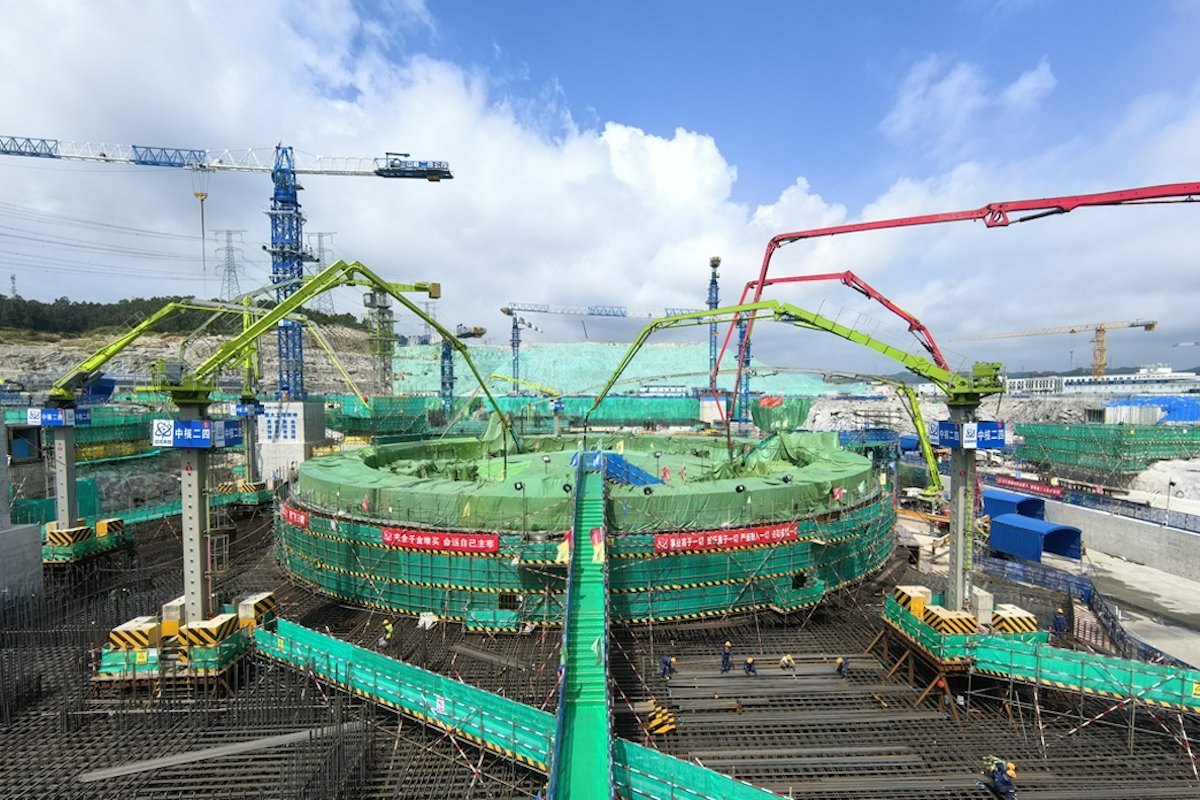
China operates 61 reactors as of 2026, with another 36 under construction, giving it the world's third-largest fleet while leading global nuclear construction. Sustained investment over decades has allowed Beijing to localize roughly 90% of reactor components, reducing supply-chain vulnerabilities and lowering costs. Chinese firms now offer comprehensive turnkey packages covering engineering, procurement, construction, financing, training, and long-term fuel supply.
The centerpiece of this strategy is the Hualong One (HPR1000), a third-generation pressurized-water reactor jointly developed by China National Nuclear Corporation and China General Nuclear Power Group. With more than 40 units operational or under construction, it has become one of the world's most actively deployed designs, generating around 1,100 megawatts per unit—enough for roughly one million homes.
China's appeal also lies in speed. Western nuclear projects frequently suffer cost overruns and delays; Russia faces mounting geopolitical constraints; South Korea lacks China's financing scale. Beijing offers rapid deployment and integrated implementation simultaneously. It has reportedly set a target of exporting 30 reactors to Belt and Road Initiative countries by 2030, a push potentially worth 1 trillion yuan (US$145 billion). Projects already extend across Pakistan, Argentina, Kenya, Kazakhstan, and Saudi Arabia.
Strategic Risks Behind the Opportunity
Yet the attraction of Chinese nuclear technology comes with strategic consequences. Nuclear infrastructure creates unusually deep, long-term dependency. Reactor lifespans often exceed 40 years, while fuel supply, technical upgrades, and spent-fuel management remain tied to the original vendor for decades. Only a limited number of states possess industrial-scale uranium enrichment capability; China is rapidly expanding its own fuel-cycle infrastructure to support future reactor exports.
Technology lock-in may prove even more consequential than fuel dependency. Unlike ports or industrial parks, nuclear ecosystems are exceptionally difficult to unwind once institutional and technological dependence becomes embedded. Maintenance systems, engineering standards, and regulatory adaptation usually remain linked to the original supplier, gradually shaping industrial priorities and strategic alignment over time.
China therefore exports more than power-generation infrastructure—it exports long-term strategic influence. This does not necessarily imply malign intent; all major nuclear exporters create similar dependencies. But China combines reactor exports with Belt and Road financing, industrial integration, and broader geopolitical influence mechanisms, making the strategic implications especially significant.
For Southeast Asian states seeking to preserve strategic autonomy amid intensifying US-China rivalry, that matters. Washington increasingly views critical infrastructure competition in maritime Southeast Asia through a strategic lens as Chinese-backed energy, port, and digital projects expand across the region. Chinese reactor diplomacy could therefore become another dimension of Indo-Pacific competition over influence, standards, and long-term regional alignment.
ASEAN governments are consequently likely to hedge rather than align exclusively with any single supplier. Maritime Southeast Asian states such as Indonesia and the Philippines may pursue more diversified technology partnerships, while mainland Southeast Asian countries like Vietnam and Laos may lean toward Chinese or Russian options. The nuclear race in Southeast Asia is not just about power—it is about the future balance of influence in the region.
For more on China's strategic ambitions, see China's Type 004 Nuclear Carrier Signals Shift to Blue-Water Power. The broader competition with the US also extends to technology; read US-China AI Race: Frontier vs. Deployment Defines the Next Phase.