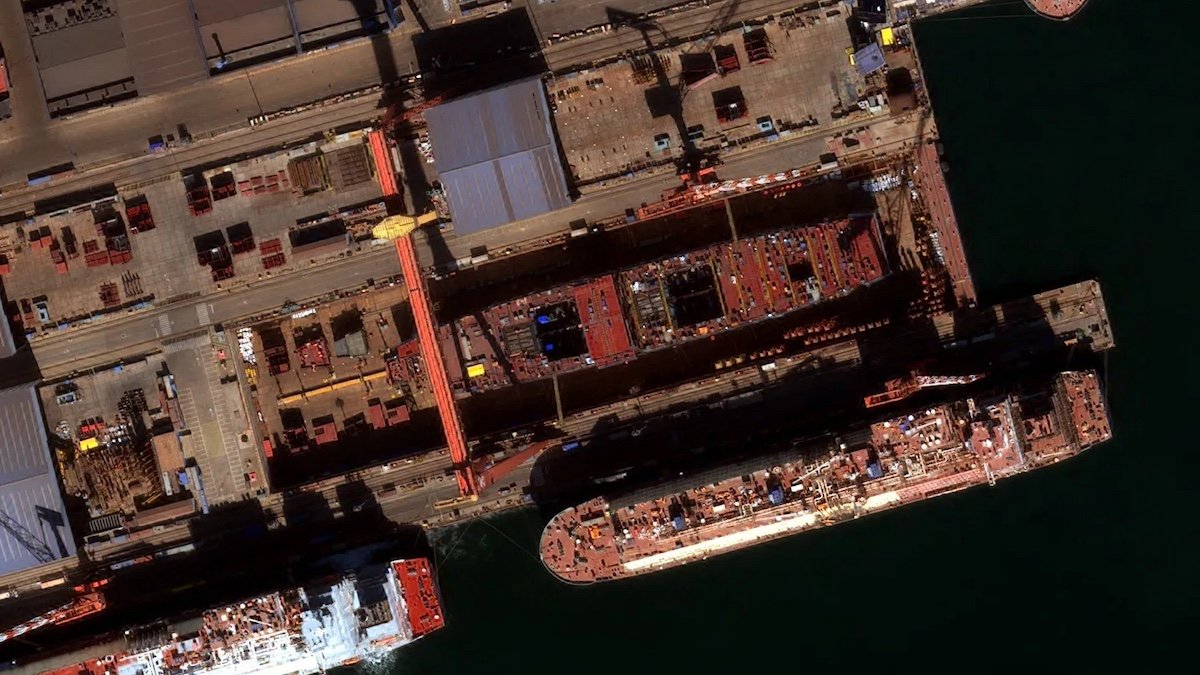
China is building its largest and potentially first nuclear-powered aircraft carrier, the Type 004, at the Dalian Shipyard in northern China. A recent report from the Center for Strategic and International Studies (CSIS), based on commercial satellite imagery and open-source intelligence, reveals that prefabricated hull blocks first appeared in early 2025 and have since evolved into a recognizable carrier hull within less than a year. This pace underscores the scale and speed of China's shipbuilding industry.
Satellite images from May 2026 show a hull measuring approximately 286 meters long and 46 meters wide, larger than China's existing Fujian carrier at a comparable stage. Analysts suggest the ship could eventually rival or exceed the US Navy's 337-meter Gerald R. Ford-class supercarriers. The evidence strongly indicates nuclear propulsion, with two large compartments believed to house reactor containment systems, and earlier findings linking China's 701st Research Institute to a land-based naval reactor prototype. The carrier will likely feature electromagnetic catapults—possibly four instead of three—enabling higher aircraft launch rates and greater blue-water power projection.
Iterative Evolution of China's Carrier Program
The Type 004 marks a major milestone in China's military modernization and ambition to field a nine-carrier fleet by 2035. Its development reflects an iterative evolution: from refurbishing the former Soviet ski-ramp carrier Varyag into the Liaoning, to building the Shandong as an improved copy, then to a conventionally powered catapult design in the Fujian, and now to a nuclear-powered design. Eric Wertheim notes in a March 2026 Proceedings article that the Fujian was laid down in 2016 and launched in 2022, indicating a six-year build time. Taking that as a precedent, the Type 004 could be launched in 2032. The carrier would also require a substantial number of escorts, suggesting parallel naval construction.
In a July 2024 report for the China Maritime Studies Institute (CMSI), Daniel Rice outlines that China's carrier battle groups are arranged into three concentric defense zones. The outer zone, spanning 185–400 kilometers from the carrier, relies on carrier-borne J-15 fighter aircraft and submarines for surveillance, tracking, anti-aircraft, anti-ship, and surprise-attack missions. The middle zone, extending 45–185 kilometers outward, is defended by large surface combatants including the Type 052D destroyer and Type 054A frigate, which provide anti-air, anti-ship, and anti-submarine warfare capabilities. The inner zone, from 100 meters to 45 kilometers, depends on point-defense and close-range air defense systems aboard the carrier and escort ships.
Missile Shield and Submarine Screen
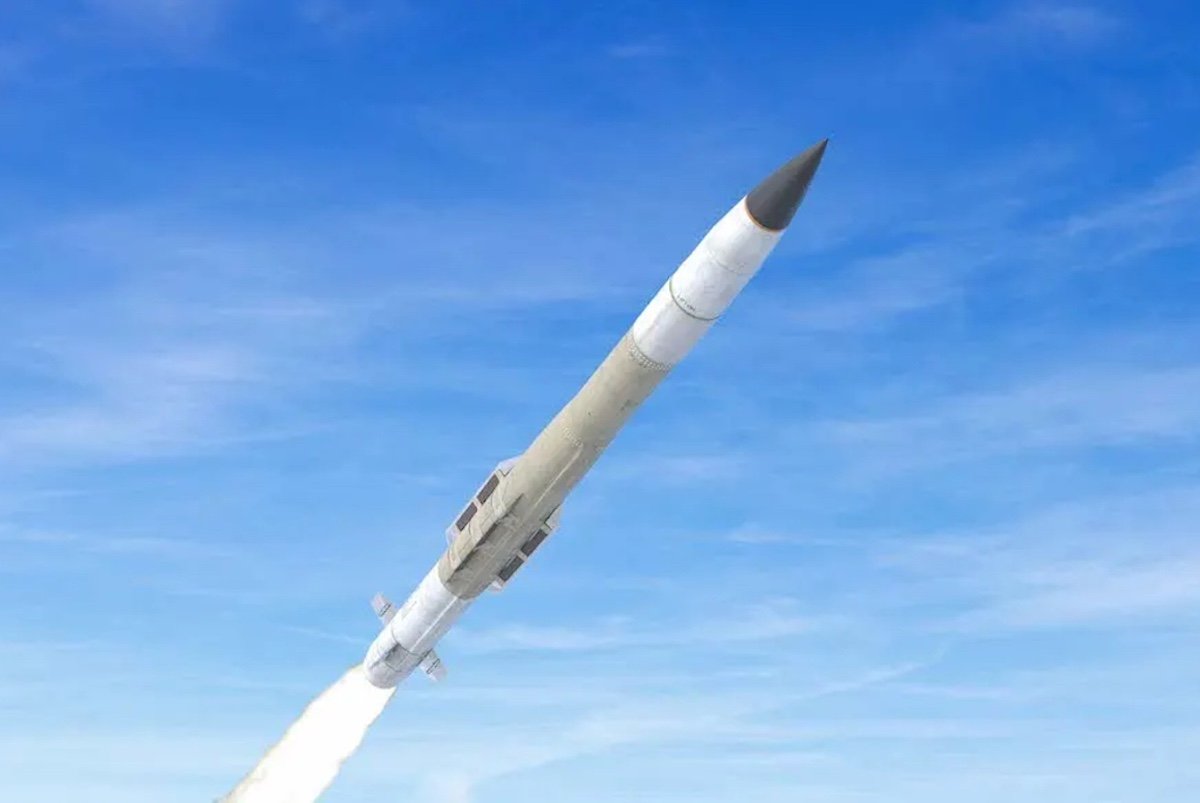
China's emerging carrier doctrine may place its carrier groups under a “missile shield” of ballistic missiles capable of striking US bases and carriers across much of the Pacific. These include the DF-21 medium-range ballistic missile (MRBM) and the DF-26 intermediate-range ballistic missile (IRBM), often dubbed “Guam killers” or “carrier killers.” According to Missile Threat, the DF-21 MRBM has a range of 2,150 kilometers and can be equipped with a nuclear or conventional warhead. The anti-ship variant, the DF-21D, has an estimated range of 1,450 to 1,550 kilometers and was tested in 2013 in the Gobi Desert against a static mockup simulating a US carrier. The DF-26 IRBM, with a range of 4,000 kilometers, is China's first conventional ballistic missile capable of hitting Guam, and its DF-26B variant has an active terminal seeker designed to engage moving targets such as enemy carriers.
Beyond a missile shield, China could employ a submarine screen in the Pacific to secure its carriers. In a March 2026 testimony to the US-China Economic and Security Review Commission (USCC), Rear Admiral Mike Brookes stated that the People's Liberation Army Navy (PLAN) is accelerating nuclear submarine production from less than one a year to much higher rates, upgrading three key facilities to sustain this push. Chinese nuclear submarines could operate far out into the Pacific ahead of carrier strike groups, gathering intelligence or engaging enemy forces that could threaten the main fleet.
Strategic Implications for the Indo-Pacific
Under that missile shield and submarine screen, China's carriers may operate in a high-low force mix. Nuclear-powered carriers such as the Type 004 would be deployed further out into the Pacific to deter US and allied intervention in a conflict over Taiwan. At the same time, China's conventional carriers would form part of a blockade force against the self-governing island, contributing to local air dominance. Beyond a Taiwan scenario, China's conventional carrier force could pose a significant overmatch to rival navies in the South China Sea.
Chinese carrier operations farther out in the Pacific and into other regions, such as the Indian Ocean, would require corresponding sustainment capabilities. While a lack of foreign supporting infrastructure may have hampered China's power projection efforts, particularly in the Indian Ocean, the Type 004's nuclear propulsion could extend its operational range and endurance. This development comes as the US and its allies, including Japan and Australia, bolster their own naval capabilities in the region. For more on related strategic dynamics, see our analysis on Australia balancing US alliance and China ties in rare earths push and South Korea increasingly seen as US logistics hub for potential China conflict.