The United States' ongoing military campaign in Iran has depleted critical munitions stockpiles, but analysts caution that this does not make a Chinese invasion of Taiwan any less risky for Beijing. While Washington's ability to resupply its arsenal is under scrutiny, the People's Liberation Army (PLA) still faces formidable obstacles in any cross-strait operation.
On Sunday, the US launched multiple airstrikes against over 140 military sites inside Iran, following an Iranian attack on a Cyprus-flagged container ship in the Strait of Hormuz. Iran retaliated with drones and missiles targeting US bases and Gulf Arab allies, including Bahrain, Kuwait, Qatar, Jordan, and Oman, pushing a fragile ceasefire to the brink. The escalation has raised concerns about US deterrence capacity in other theaters, particularly the Pacific.
According to an April 2026 report from the Center for Strategic and International Studies (CSIS) by Mark Cancian and Chris Park, the US has expended roughly 32% of its pre-war inventory of 3,100 Tomahawk missiles. The report also estimates that between 53% and 80% of the 360 Terminal High Altitude Area Defense (THAAD) interceptors and 41% to 61% of the 2,330 Patriot interceptors have been used. Rebuilding these stocks is a slow process: Seth Jones noted in a January 2023 CSIS report that producing a Patriot PAC-2 or PAC-3 interceptor takes 15-20 months, while replacing a Tomahawk cruise missile requires about 25 months.
Military Constraints on Both Sides
Cancian and Park warn that a conflict with China over Taiwan would consume substantially more US munitions, as penetrating China's extensive air defenses would require large numbers of standoff weapons, while defending against its missile forces would demand many interceptors. However, Michael O'Hanlon and Michael Poznansky argue in a June 2026 Brookings Institution article that the US retains largely untouched stocks of anti-ship missiles, submarine-launched torpedoes, and stealth-delivered precision weapons capable of devastating Chinese maritime infrastructure.
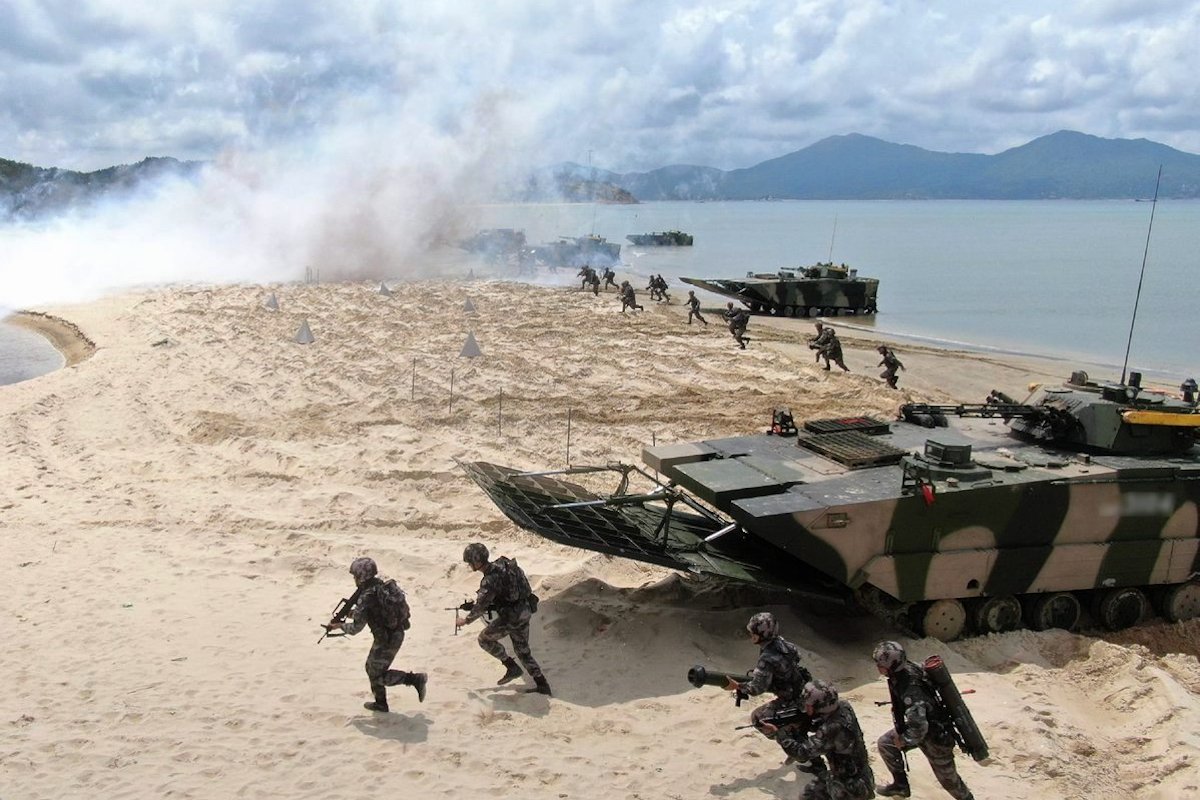
The PLA's own limitations are significant. Jason Wang and his co-authors note in a June 2026 Center for International Maritime Security (CIMSEC) article that China's principal sealift weakness is a critical shortage of dedicated gray-hull amphibious ships. A November 2025 Institute for the Study of War (ISW) assessment estimates that the PLA could deploy about 20,000 troops in an initial landing wave—far fewer than required for an invasion. Civilian roll-on/roll-off ferries and cargo ships could raise that figure to about 60,000, but those vessels lack the protection and rough-weather capabilities of dedicated amphibious warships.
Taiwan's defenses are substantial. Timothy Heath and his co-authors note in a June 2023 RAND report that Taiwan has 88,000 troops and 800 tanks available to resist an invasion—far more combat power than China could carry across the strait in an initial assault wave. A March 2026 Academia Sinica poll, cited by the Taipei Times, found that 58% of respondents would resist at all costs, even without US military assistance.
The US also possesses capabilities to disrupt Chinese command and control. Kevin Pollpeter and his co-authors note in a May 2025 China Aerospace Studies Institute (CASI) report that the US Space Force could use its Counter Communications System (CCS) to block hostile satellite transmissions completely and reversibly. The CCS, first deployed in 2020, is a dedicated satellite-communications jammer capable of targeting link, ground, and on-orbit segments, potentially severing the network architecture underpinning China's regional military power projection.
Economic and Political Traps
Economic costs further strengthen deterrence. Dan Grazier and his co-authors warn in an August 2025 Stimson report that an invasion of Taiwan would disrupt shipping through the Taiwan Strait and Strait of Malacca, threatening China's US$3.41 trillion in exports and its access to Taiwanese integrated circuits. Redirecting domestic resources toward war would undermine China's efforts to address existing economic problems, such as the real estate bust detailed in China's Economic Crash: The Real Estate Bust That Beijing Couldn't Dodge. Sanctions against high-technology industries and disruptions to staple imports such as soybeans could intensify industrial and food-security pressures.
This is the Taiwan trap for China: even an initially successful assault could leave the country facing a prolonged war, economic isolation, military escalation, and a domestic political crisis. A failed invasion could also threaten the Chinese Communist Party's (CCP) hold on power. Joel Wuthnow warns in an October 2024 Institute for National Strategic Studies (INSS) report that a severe military defeat could fracture the CCP elite and trigger domestic instability. Leaders blamed for failure could be branded “national traitors” by a public mobilized for victory.
The broader US deterrence posture in the Pacific is also under strain, as highlighted in US Deterrence Plan Against China Strained by Industrial and Political Gaps. While depleted stockpiles do not automatically mean deterrence has collapsed, they underscore the high stakes for both Washington and Beijing in any Taiwan contingency.