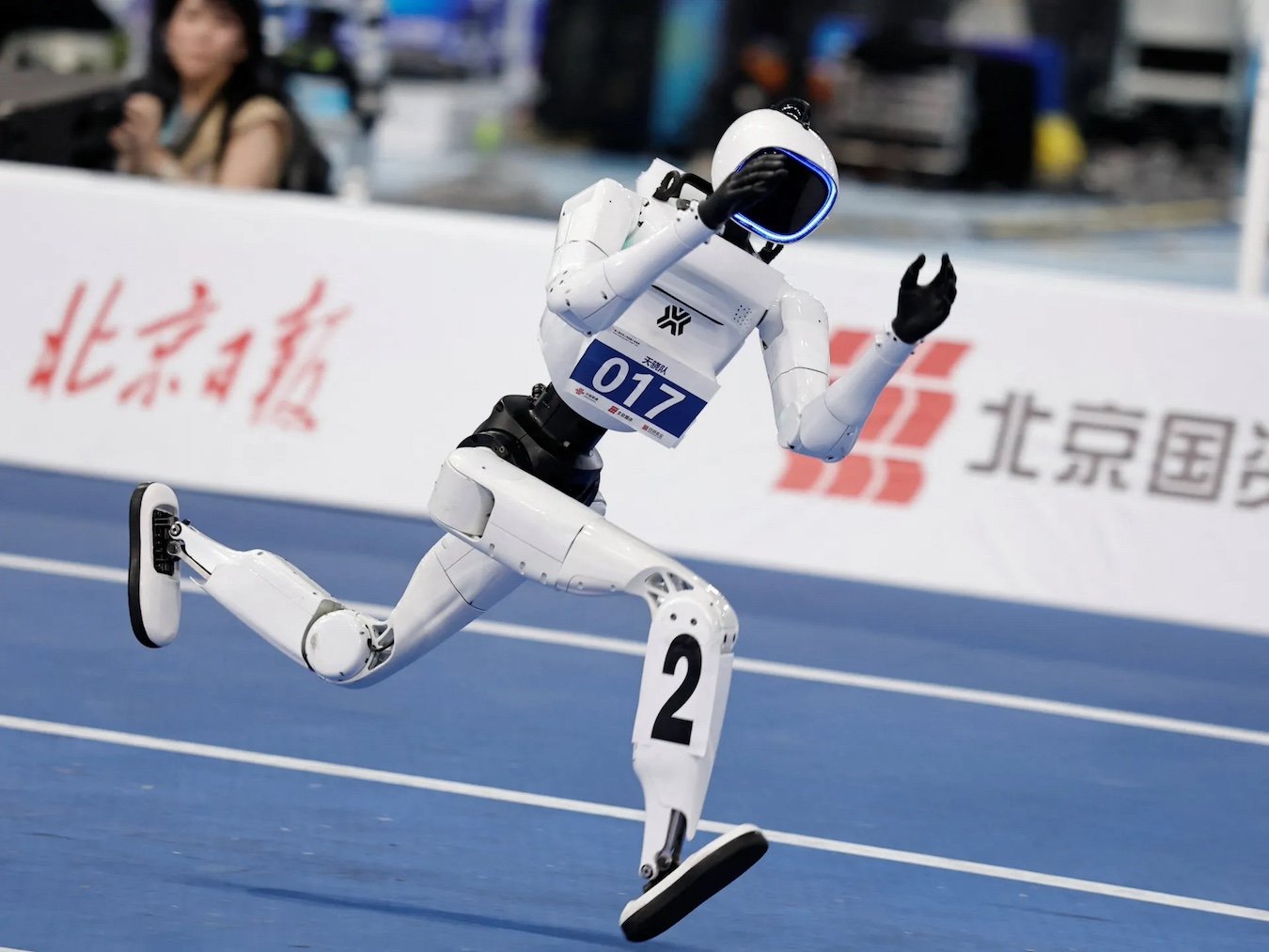
Beijing, August 26 – Two races were decided on the same track. In one, a humanoid robot named Tiangong Ultra sprinted 100 meters in 8.64 seconds, shaving nearly a full second off Usain Bolt's world record. In the other, the same machine failed to stop and crashed into the padded barrier at the end of the lane.
Global headlines celebrated the new speed benchmark, but the collision was arguably the more telling outcome. It illustrates a fundamental gap between what these machines can do in controlled conditions and what they can be trusted to do in the messy reality of a warehouse, a factory floor, or a hospital corridor.
From 21 seconds to 8.64 in a year
At last year's inaugural World Humanoid Robot Games, the winning 100-meter time was 21.50 seconds. This year, the record fell three times in five days: 9.39 seconds, then 8.86, then 8.64 – all set by Tiangong Ultra, built by Beijing-based X-Humanoid. The improvement is staggering: sprint times more than halved in just 12 months.
Yet a machine that can run at record speed but cannot stop is not a finished product. The crash was a vivid reminder that raw performance metrics, however impressive, do not translate automatically into practical utility.
Medicine offers a useful analogy. Efficacy measures what a drug achieves under ideal conditions – a clean trial, a controlled dose, careful monitoring. Effectiveness measures what it achieves in everyday use, when patients miss doses, have other conditions, or are treated by doctors who did not run the trial. The first tells you little about the second, which is why regulators require post-market surveillance and adverse-event reporting.
Chinese robotics is producing efficacy at a record-breaking clip, but effectiveness remains scarce. An 8.64-second sprint tells a warehouse manager nothing about how a robot will behave after eleven months of heavy use, or – more critically – when a worker steps into its path.
Jonathan Hurst, a robotics professor at Oregon State University, put it plainly at the Beijing Games: progress will be measured when humanoids “do work autonomously for hours and generate real economic value.” By that standard, Tiangong Ultra's run is a laboratory triumph, not yet a commercial one.
The broader context matters. China is pouring resources into humanoid robotics as part of its industrial strategy, aiming to deploy them in manufacturing, logistics, and elder care. The country's approach to technology often emphasizes speed and scale, as seen in other sectors – for instance, China's pharma strategy has shifted from manufacturing to owning drug assets, a similar pattern of moving up the value chain. But in robotics, the leap from prototype to reliable product is proving harder than the leap from one record to another.
The crash also raises safety questions. If a robot cannot reliably stop at the end of a track, how will it handle a sudden obstacle in a crowded environment? The answer, for now, is that it won't – not without significant advances in perception, planning, and fail-safe mechanisms.
Some observers note that the race itself is a publicity exercise, designed to showcase Chinese technological ambition. The World Humanoid Robot Games, held in Beijing, are as much about signaling national prowess as about measuring capability. But the signal is mixed: a record that ends in a crash is a metaphor for a field that is moving fast but still stumbling.
For the industry, the lesson is clear. Speed records are fun, but reliability is the real prize. Until humanoids can work for hours without supervision, adapt to unexpected situations, and stop when they need to, they will remain curiosities rather than workforce staples. The next milestone will not be a faster sprint, but a robot that can finish a shift without hitting a wall.