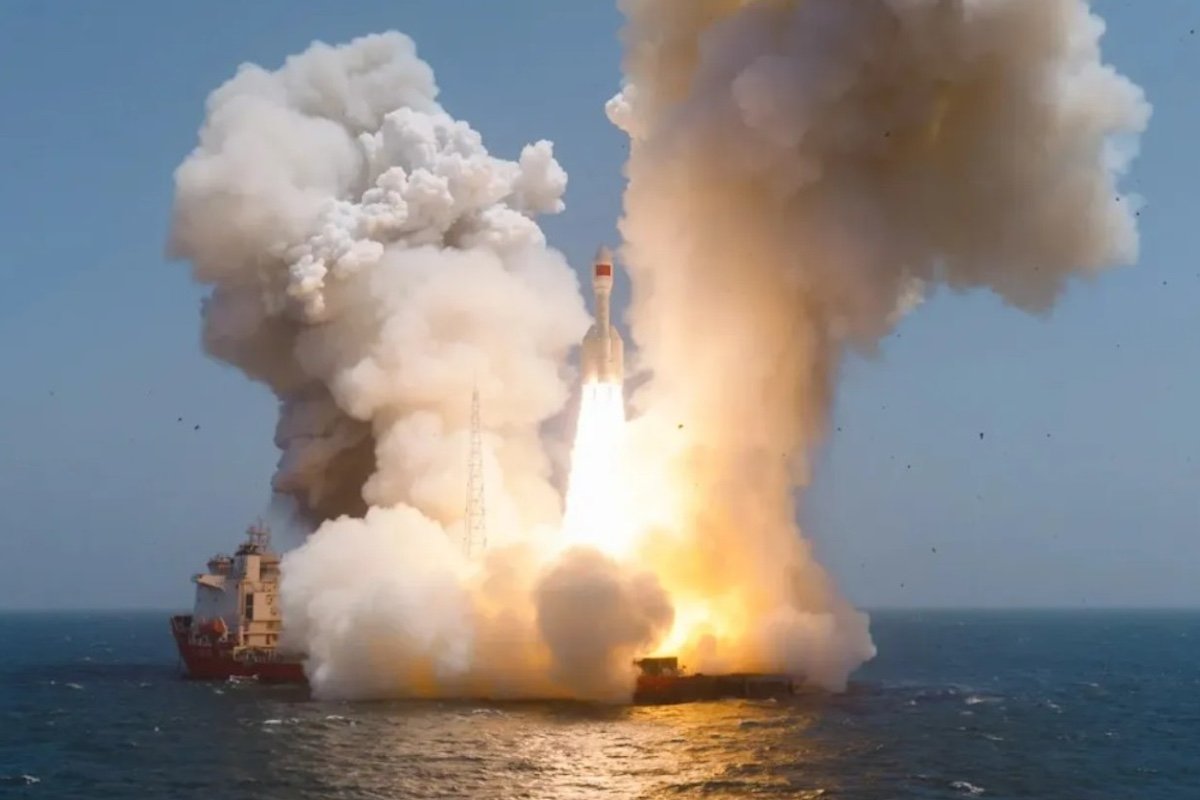
China's latest sea-based rocket launch, conducted by commercial provider Orienspace from a mobile vessel in the East China Sea off Shanghai, marks a significant step in Beijing's strategy to combine mobile launch platforms, onboard artificial intelligence, and expanding commercial satellite constellations. The mission deployed nine payloads into low Earth orbit, including six Dongpo-series optical and synthetic aperture radar (SAR) satellites for regional mapping and emergency response, alongside two Earth observation satellites—Xiguang-2 01 and Tianyi-49—and the Lilac-3 technical demonstration platform.
The Gravity-1 rocket, standing 30 meters tall and weighing 405 tons, is recognized as the world's most powerful solid-fuel launcher, generating 600 tons of liftoff thrust. This third successful orbital flight demonstrates China's capacity to conduct high-capacity offshore launches in support of ambitious commercial satellite networks. Notably, Xiguang-2 01 is China's first satellite equipped with onboard AI capable of processing spatial imagery directly in orbit, potentially enabling near-real-time data analysis and distribution, as reported by Marine Insight.
Strategic Advantages of Sea-Based Launch
Sea-based launches offer several advantages over traditional land-based spaceports. Mobile platforms bypass congested land-based facilities and allow fuel-optimal trajectories, maximizing payload capacity per flight. They also support the recovery of first-stage boosters at sea through net-capture systems, eliminating heavy landing legs, reducing rocket weight, and improving fuel efficiency for reusable vehicles. Managed in coordination with the Oriental Aerospace Port and the Taiyuan Satellite Launch Center, the long-range sea launch proved that solid-fuel rockets can be safely stored aboard vessels under far-sea conditions, establishing an agile alternative to fixed infrastructure.
Examining the military implications, Corey Crowell and Sam Bresnick noted in a June 2023 report for the Center for Security and Emerging Technology (CSET) that China uses small, mobile, solid-fuel launch vehicles to reduce reliance on vulnerable fixed spaceports and provide tactically responsive space launch capability. These advances increase China's operational resilience by enabling rapid replenishment of degraded satellite constellations, essential for maintaining command-and-control and precision-targeting during high-intensity conflict. Crowell and Bresnick argue that China has surpassed the US in its ability to deploy or replace critical mission-supporting satellites rapidly during emergencies or wartime.
The inclusion of onboard AI processing could lessen China's dependence on ground-based image-processing facilities, reducing delays in transmitting, processing, and distributing raw imagery to tactical units. This addresses a longstanding limitation of space-based intelligence, surveillance, and reconnaissance (ISR) capabilities when targeting time-sensitive objects. Satellite imagery only a few hours old may be useless against moving targets such as warships, aircraft, and mobile missile launchers, restricting conventional imagery to fixed installations like naval bases and airfields. AI-enabled satellites could detect movement and conduct preliminary analysis in orbit, though findings would still require cross-checking with unmanned aerial vehicles (UAVs), over-the-horizon (OTH) radar, and other sensors before generating reliable weapons-quality tracks.
Such technology may become increasingly important in countering the US Agile Combat Employment (ACE) strategy in the Pacific, which disperses aircraft across austere island airfields and regional bases to complicate enemy targeting. Although dispersed US fighters may be prepared for another mission within three hours, faster satellite surveillance, onboard AI processing, and automated imagery analysis could shorten China's targeting cycle substantially to less than 24 hours, potentially allowing Chinese forces to locate and threaten scattered aircraft before they relocate again.
However, Simon Gwozdz pointed out in a June 2026 Think China article that China remains far behind the US in overall orbital scale, with the US operating 78% of satellites in orbit compared to China's 8%. The imbalance is even greater in low Earth orbit, where the US operates 86% of satellites and China just 4%. Gwozdz attributes this partly to the US's extensive use of commercial rocket companies like SpaceX, while China still relies predominantly on state-run space agencies. He notes that expanding launch capacity is more difficult than satellite production due to geographic constraints, airspace-management requirements, and limited suitable launchpads.
Although the US retains a clear advantage in scale, Andy Yang argued in an April 2026 Center for Strategic and International Studies (CSIS) article that US launch capacity depends predominantly on SpaceX. This reliance creates a single point of failure, while China's state-led approach, though slower, is diversifying its launch infrastructure. The convergence of mobile sea-based platforms, AI satellites, and commercial constellations positions China to narrow the gap, particularly in contested scenarios where rapid satellite replenishment and real-time targeting are critical. As the orbital domain becomes increasingly contested, China's sea-based launch capability represents a strategic hedge against vulnerabilities in fixed infrastructure and a tool for competing for economic and military influence in space.