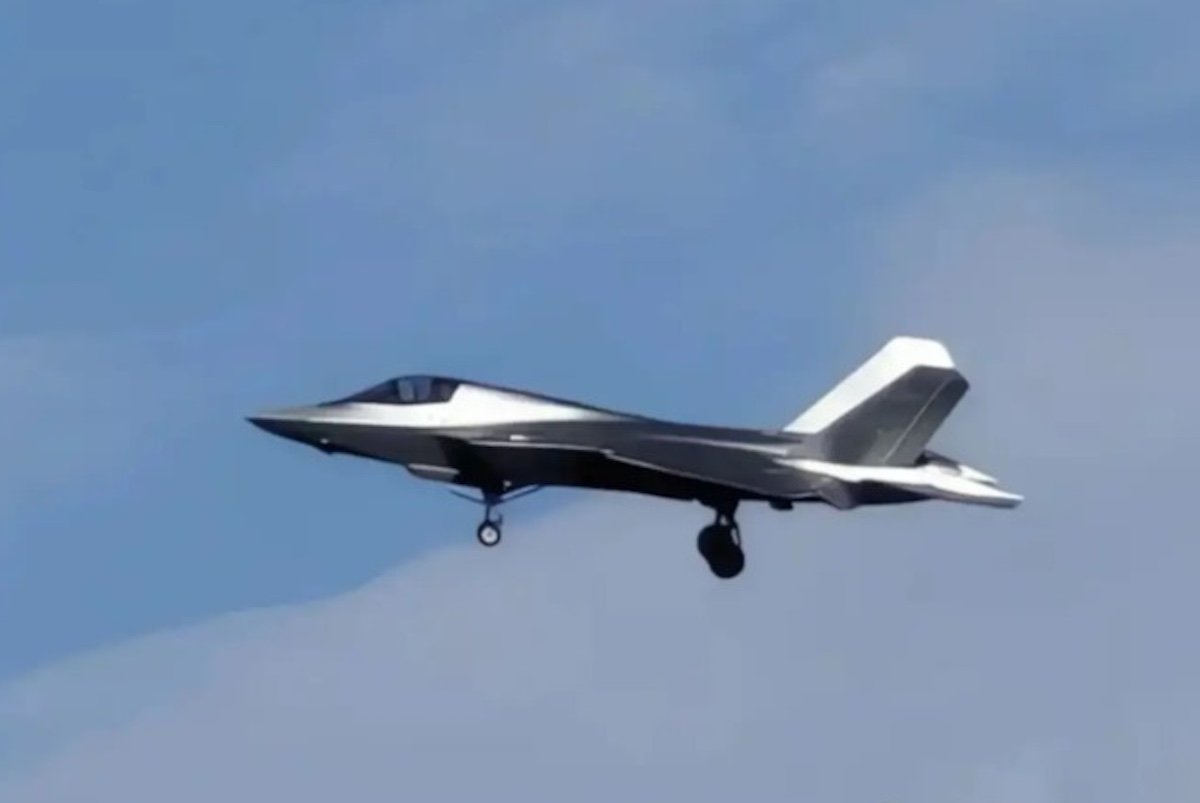
New laboratory research from China suggests that the stealth coatings protecting its most advanced fighter jets are more fragile than often assumed, raising questions about how long the People's Liberation Army can sustain a low-observable edge as it expands its fleet and moves operations to sea.
In a study published in October in the Chinese Journal of Inorganic Materials, researchers Zheng Xuan and Qing Yuchang of Northwestern Polytechnical University, with Zheng also affiliated with AECC's Shenyang Engine Research Institute, tested a 1-millimeter carbonyl iron-silicone resin composite sprayed onto titanium alloy plates. They simulated scratches, wear, and detachment, then measured microwave reflections from 2 to 18 gigahertz. The results, reported by the South China Morning Post, showed that removing just 10% of the coating in one test raised minimum reflection from minus 12.73 decibels to minus 9.78 decibels—an increase of about 1.97 times the reflected power. Central or strip detachment proved worst, exposing conductive metal and causing scattering.
The study did not confirm whether the tested material matches operational fighter coatings, and the researchers noted that scratches covering up to 50% of the surface and mild wear of up to 20% and 0.4 millimeters had limited effect. But the findings underscore a persistent vulnerability: stealth is not a permanent property but a perishable one, dependent on meticulous upkeep.
Fleet expansion meets sustainment reality
China's stealth fleet is growing rapidly. According to The War Zone, roughly 500 Chengdu J-20 stealth fighters had likely been delivered by mid-2026, spread across 14 frontline units and three flight test and training bases, including four frontline units operating the upgraded J-20A. Production has accelerated sharply—from about 50 built by late 2019 to an estimated 150–200 by 2022–2023, and roughly 300 by late 2025, a milestone marked by serial number 63106.
Yet large airframe numbers do not automatically translate into combat readiness. Lockheed Martin has stated that 50% of F-22 maintenance is devoted to preserving stealth coatings, and a July 2018 Government Accountability Office report identified low-observable coating upkeep as the primary reason F-22s were unavailable or not mission-capable. The GAO found that the coating requires diligent, time-consuming application, curing, and repairs whenever damage exceeds thresholds, and that technicians spend extra hours stripping and restoring coatings during routine component replacements. High heat, humidity, and salinity shorten the coating's eight-to-ten-year lifespan by two to three years, a problem worsened by a lack of climate-controlled hangars at three of the four operational locations.
US Air Force data cited by Air & Space Forces Magazine in February 2025 showed the F-22's mission-capable rate dropped from 52% to 40.19%, down from 57.4% two years earlier. While limited production (187 units), aging airframes, and spare-parts bottlenecks also weigh on readiness, coating upkeep remains a critical constraint.
Maritime operations compound the challenge
China's push to deploy stealth fighters at sea threatens to intensify these pressures. In a March 2026 Proceedings article, Eric Wertheim wrote that China's third aircraft carrier, the Fujian, is expected to embark a 50-to-60-aircraft air wing featuring J-35 stealth fighters alongside J-15T and J-15D jets, KJ-600 early warning aircraft, Z-20 helicopters, and unmanned systems.
US carrier operations illustrate how harshly maritime environments degrade low-observable skins. The War Zone reported in January 2022 that after roughly six months at sea aboard the USS Carl Vinson, F-35C stealth fighters of VFA-147 developed reddish-brown streaks and splotches across their radar-absorbent surfaces from saltwater spray, humidity, heat, jet exhaust, hydraulic fluid, and flight-deck traffic. Oxidation—possibly involving iron-bearing radar-absorbent material—may not immediately compromise stealth, but prolonged shipboard exposure complicates maintenance amid scarce parts, cramped hangars, and laborious chemical masking and panel work.
China's airpower doctrine, however, still leans heavily on hardware metrics. In a June 2026 report for the China Aerospace Studies Institute, Derek Ecklebe observed that China views stealth primarily through engineering specifications and coatings rather than dynamic tactics, prioritizing production scale, physical low-observability features, and networked integration. Ecklebe wrote that China characterizes its stealth aircraft as a replicable, hardware-driven capability central to multi-domain warfare and “counter-intervention” around the First Island Chain.
That approach may prove brittle. As counter-stealth sensors—such as longer-range airborne early warning radar—evolve, and as China's fleet operates from austere forward bases and carriers, the gap between laboratory performance and operational reality could widen. The J-20's numbers are impressive, but if its coatings cannot survive the rigors of sustained operations, its edge may be more theoretical than real.
For now, Beijing shows no sign of slowing its buildup. The question is whether it can adapt its sustainment practices—and its doctrine—to match the ambition of its hardware. The answer will shape the balance of air power in the Indo-Pacific for years to come.