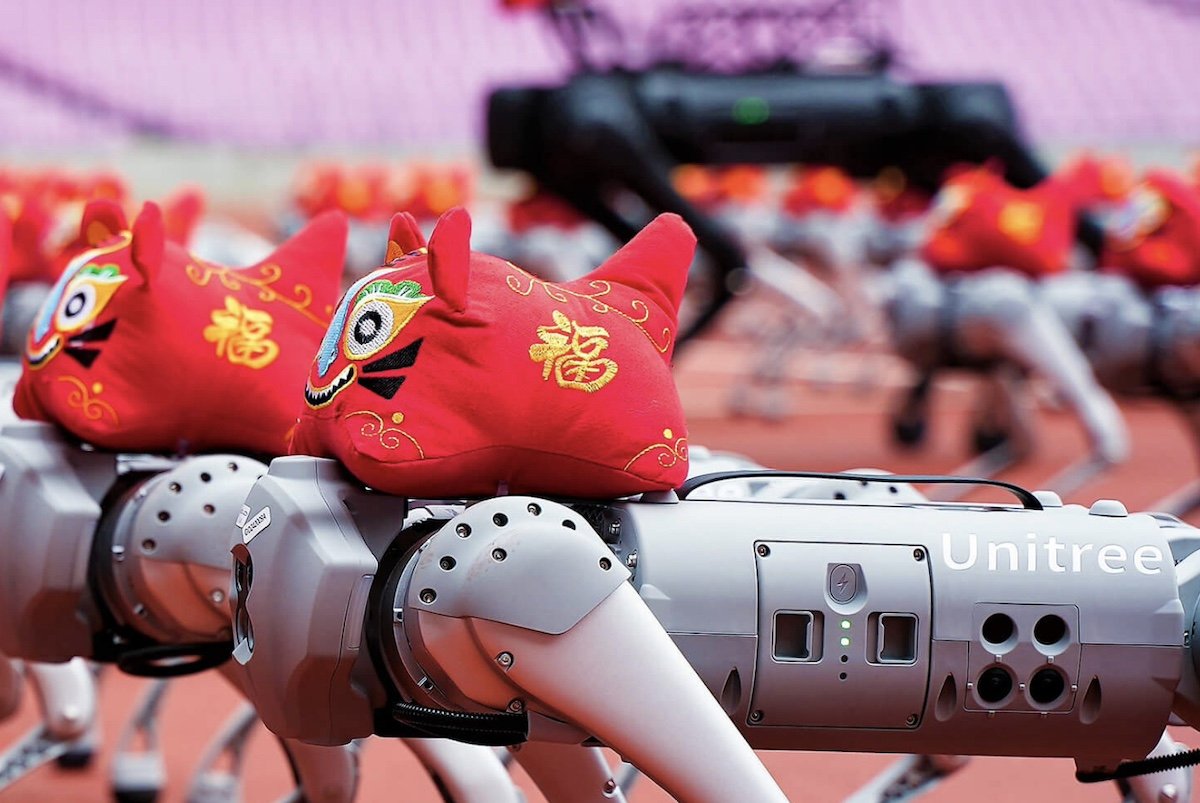
On October 28, 2026, Unitree, China's leading robotics firm, reported its first quarterly earnings since its Shanghai listing. Third-quarter profit fell 17.4%, yet the stock trades at over 465 times earnings. That disconnect explains why founder Wang Xingxing looked grim at the listing ceremony two months earlier.
On August 19, Wang struck the gong on Shanghai's STAR Market as Unitree debuted at 445 billion yuan (US$66 billion), but the new billionaire did not smile. The next day, Xu Jiayin, founder of property giant Evergrande and once China's richest man, stood white-haired in court, sentenced to life in prison.
A Chinese proverb says the waves behind drive the waves ahead, and the waves ahead die on the shore. Most commentary saw a handover from the old economy to the new. But the state made both men rich in the same way, two decades apart. Xu's career was an attempt to turn state authorization into private property, converting land quotas and bank loans—revocable at any time—into balance-sheet assets and offshore trusts. His imprisonment shows that authorization can be withdrawn in full. Wang's 445 billion yuan valuation rests on similar state backing. Permission to list has become today's version of the land permit, as Beijing swaps land for equity shares.
From land finance to equity finance
For three decades, local governments funded China's expansion by selling land to developers, an engine that is stalling as the property market shrinks. Its replacement is what Chinese analysts call “equity finance,” raising public money from shares the state holds rather than land sales. Both models spend tomorrow's money today. While land was a bet on urbanization, the new bet is that tech companies will one day earn what investors have already paid.
Equity finance remains small beside land finance. In 2025, local governments collected 4.15 trillion yuan from land sales and 464.4 billion yuan from companies they own. Land-sale revenue dropped another 27.9% in the first nine months of 2026. Since dividends alone cannot plug that gap, local governments incubate high-tech firms, secure listing permission, and households buy shares with savings.
Consider ChangXin Memory Technologies, a chipmaker on the STAR Market. It had accumulated losses of 36.65 billion yuan, yet was worth over 3 trillion yuan on its first trading day. Hefei, an inland city known for betting public money on technology, invested 24.8 billion yuan in ChangXin over 10 years; its municipal platform now holds shares worth nearly 900 billion yuan on paper. This is the Hefei model: once a company lists, the platform pledges shares to banks for cash to fund the next venture. Shares have replaced land as collateral, and borrowing continues as before.
In 2020, Jack Ma criticized Chinese banks for a “pawnshop mentality.” Days later, Ant Group's planned $37 billion listing was suspended. Six years on, the pawnshop still stands; only the collateral has changed. Regulators now fast-track state-picked firms. More than 40 robotics companies are reportedly queuing to list; Unitree won approval in a record 104 days.
Beijing has long struggled to boost consumer spending, and this listing wave aims to put idle bank savings to work. Bank deposits earn about 1% annually, and capital controls keep savings out of foreign markets. The stock market is the only open door, but the STAR Market requires at least 500,000 yuan in stocks and funds and two years of trading experience, so most households cannot buy directly. Even for those who qualify, the odds of securing Unitree shares were one in 5,500. Stamp duty on share trading jumped 57.8% in 2025 and rose another 65.1% in the first nine months of 2026, so savers are helping pay the state's bills.
The approach may produce a few world-class companies. But if the state were good at running businesses, China would not have spent 40 years building a market economy. Under land finance, a city took the cash and moved on. With equity finance, the city stays as a shareholder and pledges stock for loans, so a rival from another province that hurts the share price also shrinks the city's collateral. Once local governments live off their own companies, they will likely protect them, erecting hidden trade barriers that undermine Beijing's goal of a unified national market.
Wang's grim face on listing day answered the question of where wealth comes from in China today: from proximity to those who write the rules. Unitree earned 278 million yuan in 2025; at that pace, earning back its debut valuation would take 1,600 years—a calculation Wang, an engineer, can surely make. Households paid for the property boom with mortgages; they are now paying for China's tech boom with their savings.