Financial markets in recent weeks have resembled a protest march against artificial intelligence—a broad coalition united more by what they oppose than by any shared vision. The pacifist walks beside the man with the pitchfork; some joined for the cause, others for the spectacle, and a few simply because the march passed their door. The chant is the same, but the reasons behind it could hardly be more divergent.
Marches end, and the crowd disperses. What remains is the damage and the question of what comes next. That question depends on which of the burning issues get picked up for servicing. Right now, we are dealing with slogans that fit on placards; the genuine reasons fill a library. The march is a ladder of gloom, and to know what survives, one must attempt to parse the pessimism.
The Ladder of Gloom
The ladder starts with those who see gloom in whatever happens and ends with those who see gloom in anything that keeps money away from what they already hold. In between are those who think AI does nothing and those who think it does too much. Then come the worriers over jobs, cyberattacks, and power lines; the auditors of spending and egos; and two quieter breeds of market bears: those who doubt the profits and those who doubt the prices.
The stakes are real. In their zeal, pessimists could push the United States into outsourcing its compute, much as it once outsourced manufacturing and then software development. That road ends with the frontier in other hands and another Sputnik moment. Much of the gloom rests on bad data, fast-moving data, and numbers hallucinated by accident or on purpose. That does not make the fear harmless—fear needs no accuracy to move markets. In an era this dependent on confidence, its effect on mood, financing, and prices can be enormous, whatever started it. Parsing pessimism, camp by camp, is the only way to tell the dangers apart.
The Doom Collectors
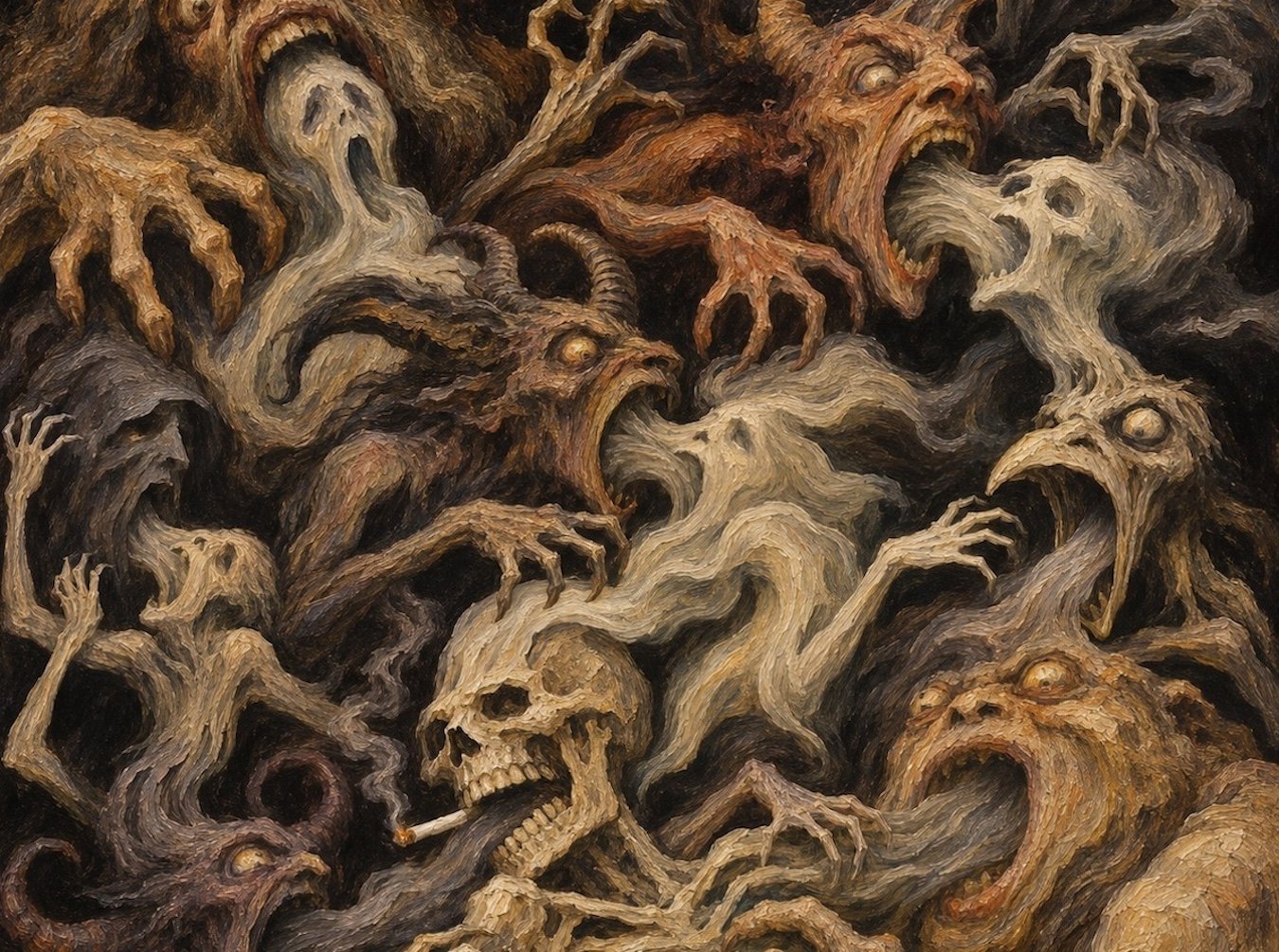
Some pessimists have been waiting for World War III since before the Berlin Wall fell. They have warned about government debt-to-GDP and financial repression for three decades. Now the collection has a fresh piece: AI ending humanity. Every path they examine ends in a vicious cycle. Every short-term fix only stores up longer-term pain. If they expect bond yields to reach 5.5%, they will happily add that 5.5% solves nothing, so 6.5% must follow, then 8.5% or 20.5%. Ask them to find a single hopeful route through their interlinked gloom, and they struggle in earnest. Some hold portfolios that match their forecasts, including a bunker.
For the waverers, there is little to watch. Their arguments are time-invariant and event-invariant. If doom has not arrived today, it will only be more brutal when it does. No data point can confirm the thesis early or refute it late. With no date attached, the forecast becomes a hobby wearing the costume of a prediction. Optimists can trim a position or two if signs of the end appear, but beyond that, the scenario sets them no useful homework. If hellfire is coming to burn everything, no asset, country, or bunker will offer shelter. For the devotees, logic says the true believer should pray for delay. Every year the fire holds off is one more year of ordinary life, which their own thesis says is the best they can get. Yet most in this camp seem to want the show to start at once, on the grounds that anything later will only hurt more. Of all the camps, it is the only one whose happiest ending is the worst one for everyone, its members included.
The Parrot Purists
For them, the technology has no utility, or so little that the difference hardly matters. It is a statistical parrot repeating what it has read, with no new intelligence anywhere. They may accept every ROI argument higher up the chain—for chipmakers, memory makers, and cloud operators—but none of it survives at the final user. The company or household paying the bill gets a higher cost and no return. In their eyes, the industry is selling lemons, pure and simple.
The waverer should keep a tally of the moments that jar. Work across codebases running to millions of lines counts. So do tasks that once took whole teams and now take an afternoon. Buyers who taste the lemon and then order a crate count most of all. Plenty of people, ourselves included, find genuine utility in almost every dollar spent on AI. Some keep raising that spending at the cost of everything else in their budgets. The real exercise is to multiply such users across hundreds of millions of people and companies worldwide. The total may or may not justify the buildout, but it should at least retire the claim that end users find nothing of value.
The optimist's real work is steady observation, statistical and anecdotal, of whether people keep taking AI into new tasks. Today that means agents handling multi-step work. Tomorrow it should mean the physical world. The question is whether the range of uses keeps widening or starts to stall. Anecdotes can glow while the aggregate sags; the aggregate is the test that counts. Suppose the purist is entirely right: AI spending is digging holes and filling them up again. The money still pays engineers, electricians, and data center workers across the region—from Seoul's tech sector to Indonesia's digital infrastructure. The waste may be real, but it still circulates through the economy.
As the march continues, the differences between these camps are hard to see. Afterward, which fears prevail decides the course ahead, with its own unique set of opportunities and threats. For investors in Asia and beyond, understanding these factions is not an academic exercise—it is the key to navigating the next phase of the AI cycle. The pessimists may be wrong in their details, but they are right that the stakes are enormous. The question is not whether the march will end, but which banners will be carried forward.