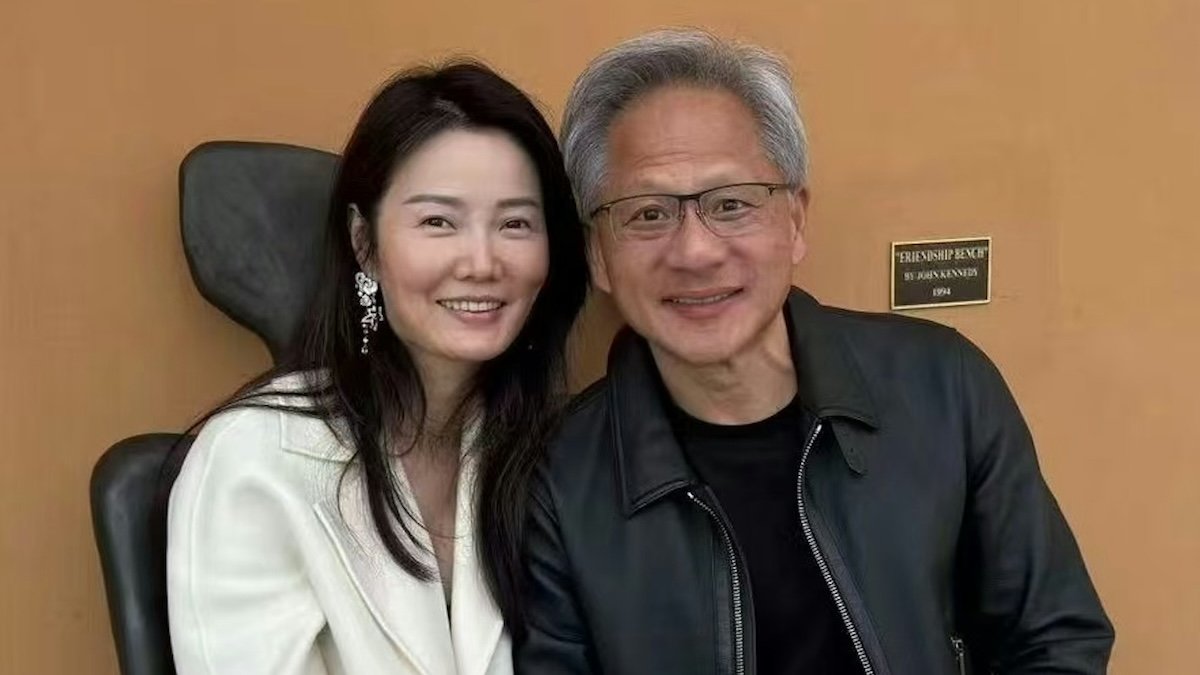
Nvidia chief executive Jensen Huang's admission of an extramarital relationship with a businesswoman suspected of spying for Beijing could give fresh momentum to Washington's efforts to prevent Chinese companies from accessing advanced artificial intelligence chips through cloud services in third countries.
The revelation, which surfaced in a New York Times report and was confirmed by Huang on November 8, has sparked a board-level investigation at Nvidia and drawn scrutiny from Republican lawmakers. Alice Huang, a former executive at Singapore-based Megaspeed, is suspected by US authorities of gathering intelligence on Nvidia and US chip policy for China. Chinese media have been quick to probe her background, though her past remains murky.
The political climate in Washington has shifted sharply since the November 3 midterm elections, which handed control of both chambers of Congress to the Democrats. President Donald Trump responded by naming Stephen Miller, a hardliner known for his anti-China stance, as White House chief of staff. Miller, who in 2018 proposed halting student visas for Chinese nationals to counter espionage, is expected to push for tougher measures.
Analysts believe the scandal could accelerate passage of the Remote Access Security Act (RASA), a bill that would extend US export controls from physical chips to cloud computing. If enacted, it would bar Chinese firms from remotely renting servers powered by advanced Nvidia chips in countries like Malaysia and Norway. The bill passed the House in January and is now pending Senate review.
Even before RASA becomes law, the midterm outcome—driven in part by public backlash against unregulated AI data centers—has rattled the chip and data center industries. On November 4, the Republican chairs of three House committees requested a closed-door briefing with Jensen Huang on November 18 to discuss his interactions with Alice Huang and whether Beijing had influenced Nvidia's decisions or US export policy.
That same day, Nvidia tightened rules for cloud customers, requiring them to sell at least 51% of their computing capacity to companies outside China—a condition applying only to new contracts. The company also mandated that clients in Southeast Asia join its “fleet intelligence” system, which tracks the location of AI accelerators, before they can become official Nvidia Cloud Partners.
Meanwhile, Oracle scrapped a five-year, US$7 billion deal to lease up to 100,000 advanced AI chips to Tencent in Southeast Asian data centers, after US officials objected, according to the Financial Times. Chinese authorities had also questioned the arrangement and urged Tencent to use domestic chips. Oracle continues to operate data centers in Malaysia for ByteDance.
Chinese Foreign Ministry spokesperson Guo Jiakun dismissed the espionage report as “unsubstantiated” and “nothing but smears against China.”
Political crossfire
Chinese commentators see the scandal as likely to harden US policy. A Shandong-based columnist writing under the pen name “Fen Mu” argues that Nvidia is caught between Washington's demand for strict export curbs and the lucrative Chinese market. “When Jensen Huang says losing China would be a huge loss for Nvidia, hawkish US politicians hear it as siding with the Communists,” he wrote.
He added that the Alice Huang report has fueled skeptics, and as US-China tech decoupling intensifies—with chips, AI, and quantum computing as main battlefields—companies like Nvidia face mounting pressure from both the administration and Congress. “Jensen Huang may not be the last tech executive to be called in by lawmakers,” he predicted.
Another commentator, financial columnist Xiaobai, noted that Huang's position is uniquely exposed: he controls computing power vital to the global AI industry, maintains close ties with the US government, and participates directly in policy debates. “When his personal relationships are so closely intertwined with Nvidia's business interests and America's technology strategy, a private scandal can trigger wider political and commercial fallout,” Xiaobai wrote.
The tension reflects a broader dilemma in US tech policy toward China. The Trump administration views Nvidia as essential to maintaining America's AI edge, while Congress argues that as Nvidia's influence grows, so must oversight of its overseas customers and internal security. This dynamic is likely to intensify as both parties compete to appear tough on China.
For the region, the implications are significant. Southeast Asian nations like Malaysia and Singapore, which have become hubs for AI data centers, could see investment flows shift as US restrictions tighten. The recent volatility in data center stocks underscores the sector's sensitivity to policy changes. Meanwhile, China's push for self-reliance in chips continues, as seen in its rising research output in AI and semiconductors.
As the investigation unfolds, Nvidia's next moves will be closely watched—not just in Silicon Valley, but in boardrooms from Tokyo to Bengaluru. The scandal has made clear that in the era of AI competition, personal conduct can have geopolitical consequences.