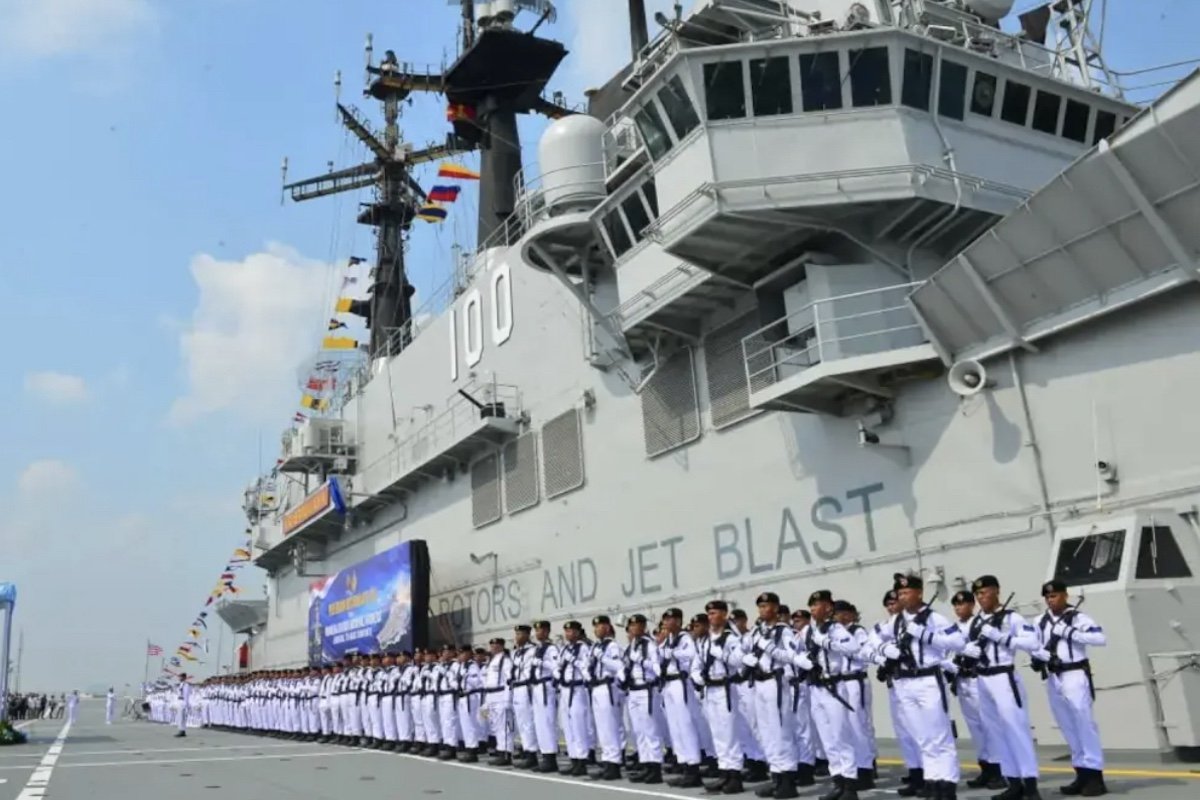
Indonesia is acquiring the tools of a modern military at a pace not seen in decades. Rafale fighter jets are entering service, and Jakarta has contracted for 48 KAAN fighters from Turkey. The navy has taken delivery of two Italian PPA warships and commissioned the former Italian aircraft carrier Giuseppe Garibaldi as the KRI Sriwijaya. Two Scorpene submarines are being built domestically with French technology transfer, BrahMos cruise missiles are in the procurement pipeline, Turkish drones are expanding the unmanned fleet, and an A400M airlifter and new air-defense radar have arrived.
The financial commitment has climbed just as steeply. Indonesia's defense spending rose from 125.8 trillion rupiah (about $7 billion) in 2021 to 190.3 trillion in 2024, was projected at 245.2 trillion for 2025, and is budgeted at 337.4 trillion for 2026. The government says the money is meant for more than procurement: maintenance, infrastructure, the domestic defense industry, and the wider development of the armed forces.
From hardware to capability
On paper, Indonesia is assembling the pieces of a far more capable military. But owning sophisticated weapons is different from generating sophisticated military effects. The new platforms must be knitted into a coherent force that can sense, decide, communicate, strike, maneuver, and sustain operations together. In September, the Defense Ministry and the National Defense Council effectively acknowledged this by convening a forum on interoperability, network-centric warfare, and C6ISR, including the standardization of communications and data links. Officials stressed that modern warfare is no longer decided by the number of platforms or the destructive power of individual weapons.
The procurement drive is more than an arms-shopping spree. The Rafale gives the Air Force a modern multirole fighter with advanced sensors and long-range weapons. The A400M expands its airlift. The 48-aircraft KAAN program could offer Indonesia a path into fifth-generation fighter technology and a chance for domestic industry to participate. The naval picture is similar. The PPA ships, the KRI Brawijaya and the KRI Prabu Siliwangi, are 143-meter combatants armed with surface-to-surface and surface-to-air missiles, naval guns, and torpedoes—a leap beyond many older vessels in the fleet.
The two Scorpene submarines may matter more over the long run. They are being built at PT PAL, Indonesia's state-owned shipbuilder, with French technology transfer and training for more than 400 Indonesian engineers. The same is true of drones. Indonesia has accelerated purchases of Turkish systems, including the ANKA-S, TB3, Akıncı, and Kızılelma, a marked shift toward unmanned surveillance and strike. According to the Singapore-based S. Rajaratnam School of International Studies, Indonesia signed just one contract for armed Chinese CH-4B drones between 2012 and 2022. Since 2023, it has contracted for several types of Turkish unmanned aircraft.
Every new platform creates a second requirement: the architecture around it. Modern military power is a system of systems. Sensors must feed command networks, which must pass targeting data to weapons quickly enough to matter. Aircraft, ships, submarines, drones, and ground units must work from a common operational picture, and all of them must be supplied, repaired, and crewed. The relevant question is no longer how many weapons Indonesia has bought, but whether they can operate as one force.
The price of diversification
Diversification has given Indonesia a geopolitical advantage. It is acquiring capabilities from France, Italy, Turkey, India, the United States, South Korea, and its own defense industry, which gives Jakarta more room to maneuver than reliance on a single supplier would. The approach suits the country's long tradition of strategic autonomy and hedging among major powers. But diversity has a military cost. Each supplier brings its own communications architecture, software, maintenance regime, weapons interfaces, training systems, and logistics. A force drawn from so many technological ecosystems can gain political independence while becoming harder to integrate in battle. Strategic diversification can breed tactical fragmentation.
Indonesia's defense establishment seems increasingly aware of the tension. September's forum drew the Defense Ministry, the armed forces headquarters, the three services, the digital ministry, the national research agency BRIN, the cyber agency BSSN, and domestic defense companies. The agenda covered C6ISR, network-centric warfare, communications standards, and data links. Officials' definition of interoperability was telling: it reached beyond communications to personnel, doctrine, procedures, data, networks, sensors, command-and-control systems, and weapons platforms.
That is where modernization must become transformation. Take the Rafale. Its effectiveness depends not just on the aircraft but on the radar picture available to pilots, the intelligence behind each mission, the weapons built into doctrine, and the ability to sustain a high rate of sorties. During the 2026 PEGASE exercise with France, Indonesian Rafales flew alongside French Rafales and an A330 MRTT tanker, a glimpse of the value interoperability can create. The same logic applies to the BrahMos, the Scorpene, the PPA warships, and unmanned aircraft: a weapon is worth far more as part of a reliable kill chain. Without one, even advanced platforms operate alone.
The Sriwijaya may be the clearest test of whether Indonesia can turn procurement into institutional capability. The former Italian carrier Giuseppe Garibaldi was commissioned in September as Indonesia's first aircraft carrier. Officials describe it chiefly as a command center for maritime operations, a platform for defense diplomacy, and a vehicle for humanitarian aid. It can operate helicopters and short-takeoff aircraft, but its true value will depend on how well it integrates with the rest of the fleet. If Indonesia can master the art of interoperability, its military modernization could become a model for the region. If not, it risks owning a collection of impressive but disconnected weapons. The coming years will show which path Jakarta takes.