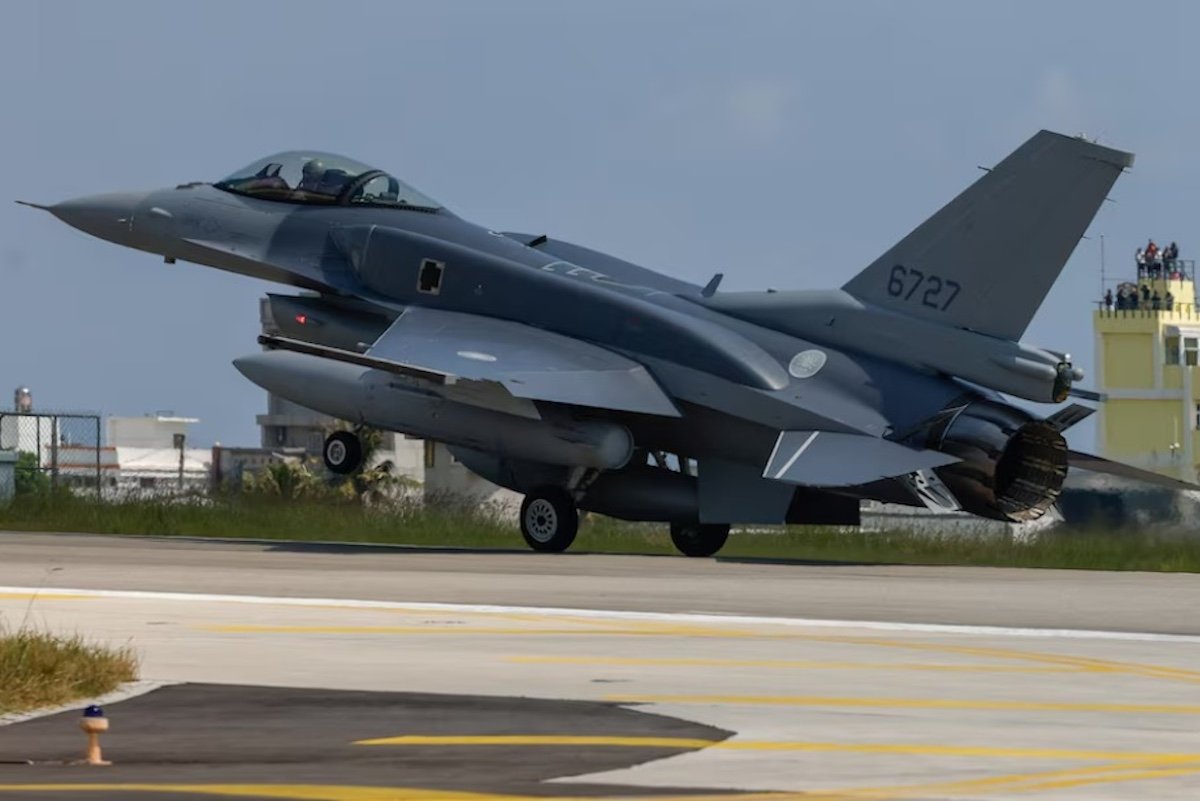
Taiwan's air force took delivery of its first two new-build F-16V Block 70 fighters on October 2, touching down at Chihhang Air Base in Taitung after a trans-Pacific ferry flight via Hawaii and Guam. The arrival marks the start of a US$8 billion, 66-jet procurement approved by Washington in 2019, aimed at modernizing the Republic of China Air Force (ROCAF) and bolstering deterrence against Beijing's escalating military pressure.
The handover ends years of delays caused by production-line relocations, supply-chain bottlenecks, and integration issues with the AN/ALQ-254(V)1 Viper Shield electronic warfare suite. The new aircraft, powered by General Electric F110 engines and equipped with APG-83 AESA radars and conformal fuel tanks, are Taiwan's first factory-new combat jets in 25 years. They will replace retired F-5 fighters in the 7th Tactical Fighter Wing, enhancing Taiwan's ability to project air power over the strategically vital Bashi Channel and respond to near-daily Chinese incursions.
Taiwanese defense officials expect further deliveries later this year, which will expand the island's active F-16 fleet to more than 200 jets. But the procurement has sparked debate about its role in defending the self-governing, democratic island. While the F-16Vs are needed to counter China's airspace intrusions, their survivability in a full-scale invasion remains uncertain.
Record incursions strain Taiwan's air force
China's military conducted a record 3,764 air incursions into Taiwan's de facto air defense identification zone (ADIZ) in 2025, a 22.4% increase over 2024, according to a February 2026 China Power report by Bonny Lin and colleagues. The report notes that Beijing sustained an escalated operational baseline after Taiwanese President William Lai's May 2024 inauguration, with monthly sorties never falling below 209 and averaging 319 through late 2025—a 129% jump compared to the January 2022 to April 2024 period. Although operations dipped 5.4% between May and December 2025 relative to the prior year, annual activity reached unprecedented highs.
The ROCAF must intercept these incursions to demonstrate resolve and prevent China from normalizing its operations. However, this response risks falling into a Chinese attrition strategy that burns flight hours, exhausts maintenance crews and pilots, and strains defense budgets. Over time, attrition depletes readiness, degrades crisis-response capacity, and heightens the risk of pilot error or miscalculation that could trigger accidental conflict.
The new F-16Vs provide vital relief. With a 12,000-hour structural lifespan—over 50% longer than older models—they allow the ROCAF to shadow intrusions and contest airspace without prematurely exhausting its fleet. They can also respond visibly to coercive air activities by patrolling air corridors, escorting intruding aircraft, and contesting China's attempts to assert control over Taiwan's airspace.
Stealth gap and wartime limitations
Yet peacetime air policing does not ensure wartime survival against modern threats. Royal Air Force Air Vice-Marshal James Beck argued in an October 2025 Business Insider article that fifth-generation fighters like the F-35 are now the baseline because modern peer adversaries have neutralized the decisive edge once provided by stealth and early sensor fusion. Beck notes that advances in integrated air defense networks, widespread drone proliferation, and AI-enabled sensing have dramatically compressed air dominance into fleeting bursts. Drawing on the Ukraine conflict, he emphasizes that failing to contest the skies early leads to costly attritional warfare, making fifth-generation capabilities the minimum entry standard to counter basic peer-level threats.
Taiwan has no fifth-generation fighters, while China is rapidly expanding its stealth fleet. The War Zone (TWZ) reported in July 2026 that around 500 J-20 airframes may have been delivered to the People's Liberation Army as of mid-2026, with annual production reaching approximately 120 jets. China has stealth fighters deployed across 14 frontline air brigades and three test bases, and could field 1,000 J-20s across all variants by 2030.
The United States is unlikely to supply Taiwan with the F-35, possibly because it believes the F-16Vs already fulfill Taiwan's defense requirements, or due to concerns that China could capture F-35 technology if Taiwan capitulated. This leaves Taiwan reliant on fourth-generation aircraft against a numerically superior and technologically advanced adversary.
Jimmy Chien, in a March 2026 Global Taiwan Institute article, describes Taiwan's F-16s as conventional-asymmetric assets that would not engage initially in a conflict. Instead, Taiwan would shelter its jets in mountain bunkers to protect them from continuous Chinese missile strikes, while waiting for low-cost, runway-independent unmanned systems and ground-based air defenses to blunt the assault and disrupt adversary air superiority. Once temporary windows open, Taiwan plans to rapidly repair damaged runways, scramble F-16 sorties from hardened shelters, and launch coordinated air-delivered strikes alongside ground fires to saturate Chinese air defenses and relieve frontline units.
This strategy underscores the F-16Vs' role as a hedge—buying time and space for Taiwan's layered defenses, but not a silver bullet. As China's air coercion intensifies, Taiwan's ability to sustain its air force and adapt to new warfare domains will be critical. The island's broader security posture, including hedging strategies across the region, reflects a delicate balance between deterrence and survival.