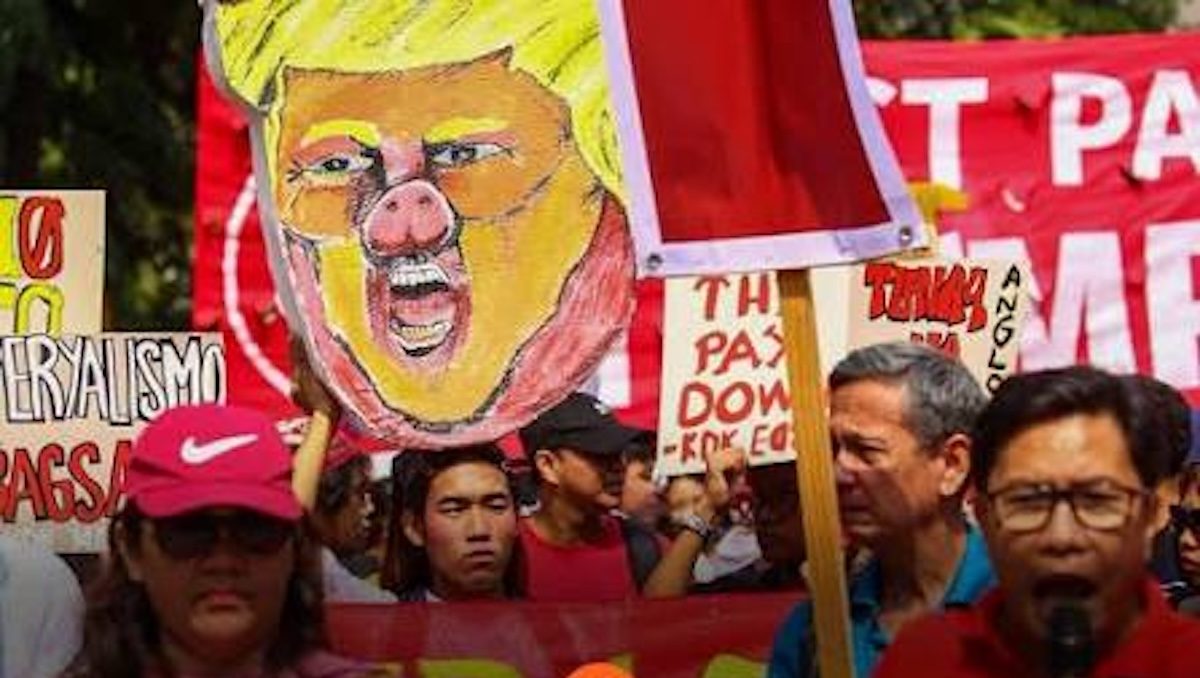
Thousands of Filipinos have taken to the streets in protest ahead of President Donald Trump's arrival in Manila for the 49th ASEAN summit, voicing strong opposition to the proposed "Pax Silica" industrial hub on the island of Luzon. The protests, which began days before the summit, reflect deep-seated concerns over the project's environmental, social, and geopolitical implications.
Demonstrations have occurred across the country, including in Ilocos Norte, the home province of President Ferdinand Marcos Jr., where banners read "Trump Out! Reject Pax Silica!" and condemned the initiative as "imperialist plunder." In Manila, protesters carried signs declaring "Get off our lands, we are not for sale."
According to The Diplomat, about a dozen protesters were arrested on Sunday after clashing with police while attempting to march toward the Philippine International Convention Center, the summit venue. Another 276 were detained in nearby Muntinlupa as they tried to join the protests.
The Pax Silica project, announced last year, is part of Washington's strategy to counter China's influence over minerals critical to artificial intelligence development. The proposed 4,000-acre "economic security zone" would include a semiconductor hub and is expected to consume up to 90 million liters of water per day—three times the area's dry-season supply—and use as much electricity as one-fifth of the Philippines' total consumption in 2024, according to The New York Times.
Activists demand halt, citing human and environmental costs
More than 80 human rights, anti-war, faith, and community groups, including the American Friends Service Committee and Just Foreign Policy, have called on the US Congress to halt the project. In a letter obtained by Common Dreams, they warned that the hub "raises serious concerns about labor rights, human rights, environmental protections, and the lack of genuine consultation with impacted Filipino communities."
Human Rights Watch has highlighted that the project would displace hundreds of indigenous people and farmers who have lived on the land for generations. Activists argue that the Philippines already suffers from power outages and water shortages, and Pax Silica would exacerbate these problems, leading to a higher cost of living for Luzon's population.
"The past 50 years of foreign investment in the country have not led to genuine industrialization," the activists wrote. "History shows that the supposed economic benefits of Pax Silica are more likely to benefit foreign firms producing in and exporting from the country than Filipino companies."
President Marcos has touted the project as a boon for foreign investment and job creation, but critics say he has provided no evidence to support these claims. The framework agreement remains unsigned, with Philippine Ambassador Jose Manuel Romualdez stating that key terms still need negotiation and that the pact would not be discussed during Trump's summit meetings.
The activists also questioned the benefits for US consumers, noting that the project would fuel AI data centers, which Americans rejected in the recent midterm elections. They expressed solidarity with Filipinos, saying, "As Americans, we do not want the Filipino people to experience that same environmental degradation in their communities at the hands of US-funded data centers and AI initiatives."
Beyond environmental concerns, the initiative is seen as deepening US-China rivalry and militarization in the region. The Philippines hosts at least nine military sites accessible to US forces, and earlier this year, the US Army fired a Tomahawk missile from the country for the first time, demonstrating its potential as a launchpad for strikes on mainland China.
"While Washington presents its expanding military presence as necessary to deter China, these deployments risk a security dilemma that intensifies the very tensions they are intended to prevent," the activists wrote. They also noted that the American public has never been meaningfully consulted about the prospect of war with China over the Philippines.
The protests highlight a growing divide between the Philippine government's embrace of US investment and the concerns of civil society, which fears that Pax Silica could turn the country into a frontline state in a superpower conflict. As the summit concludes, the future of the project remains uncertain, but the voices of opposition are unlikely to fade.