The world economy stands at a crossroads. International trade is decelerating, economic uncertainty is mounting, and the commercial relationship between the United States and China—the planet's two largest economies—is fraying. It is not just trade flows that are shrinking; cross-border investment between Washington and Beijing has also declined sharply from levels seen just a few years ago.
What is driving this reconfiguration? For several large economies, including the United States under President Donald Trump, a push for greater self-sufficiency is central. Between 2017 and 2023, American imports fell most steeply in precisely the product categories where the US had been most dependent on China: industrial machinery, computers and computer parts, and other electronic equipment such as monitors.
This shift has profound implications for global value chains (GVCs), the intricate networks that underpin international trade. In a typical GVC, production activities—from research and product design to final assembly—are distributed across multiple locations, with value added at each stage. Multinational firms coordinate these cross-border operations. As the reconfiguration of GVCs accelerates, industrialized economies now face two broad strategic options.
Reshoring vs. Friendshoring
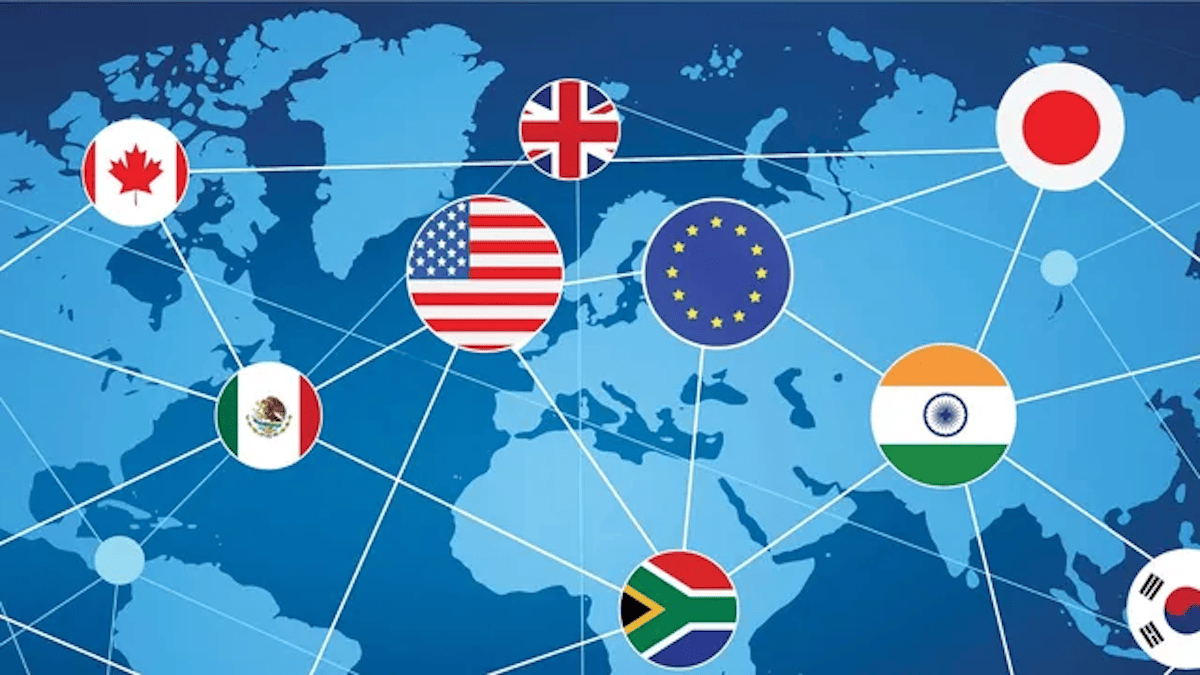
The first option is reshoring: bringing manufacturing back to the home country, a stated priority for the current US administration. The second is friendshoring: shifting imports and investments toward economies that are either geographically closer or with which the importing country has long-standing diplomatic and economic ties.
For developing countries, the balance between these two strategies is critical. If advanced economies reshore a substantial share of production, poorer nations could suffer from lost investment and employment. Automation and digitization now make it more convenient for advanced countries to produce goods at home, amplifying this risk compared with a decade ago. For consumers, however, reshoring could mean higher prices for everyday goods—at least in the short term—because of the higher costs of manufacturing in more developed economies, though the empirical evidence for this remains limited.
Friendshoring offers a more benign alternative. Early signals from countries such as Mexico and Vietnam—which have recently seen increased investment and factory expansions from multinational firms—suggest that friendshoring can create opportunities. When paired with supportive government policies, such as investment incentives or technology-upgrade programs, these shifts can ensure that more production takes place domestically, leading to greater technology spillovers and learning.
To understand the risks and opportunities, analysts have examined the specific product categories where US-China decoupling is most pronounced. Two broad clusters emerge, each with different implications for developing economies.
Group One: Products the US Can Reshore
The first group consists mainly of relatively complex goods—consumer electronics, vehicle components, chemicals, and machinery. In these categories, the United States is diversifying its imports rapidly and is already producing these goods competitively at home. Such products can be reshored relatively easily, particularly if automation lowers costs. Semiconductors, for instance, are already the focus of major US reshoring efforts. Yet the risk to current producers appears limited for now: while the US has reduced imports of these products from China, other developing regions have not experienced a similar decline.
Group Two: Products Where the US Is Not Competitive Enough to Reshore
The second group comprises products where the United States is diversifying but is not competitive enough to bring production home. This group accounted for just over 6 percent of finished products that the US imported in 2023—roughly US$181 billion. While a small share overall, it is economically significant. Within this group, two types of opportunity emerge. Technologically complex goods, such as electrical equipment, computers, and car parts, offer the greatest potential for middle-income economies with strong manufacturing experience to win contracts and investments. Lower-tech goods like textiles and furniture are better suited to lower-income countries. In both cases, governments need to negotiate carefully to ensure investments add value locally, support skills development, and avoid social or environmental harm.
For consumers worldwide, friendshoring offers a more favorable outlook than reshoring or tariffs. Goods may simply be made in different countries, with prices remaining broadly stable.
Who Stands to Gain?
So far, East and Southeast Asia—including Vietnam, Thailand, Malaysia, and Indonesia—have captured the largest share of these friendshoring opportunities, particularly in high-tech sectors like computers. Their exports to China have also risen, reinforcing their central role in Asian manufacturing networks. Whether this momentum continues will depend on tariffs, production costs, and the pace of automation.
Other beneficiaries could include Latin America and the Caribbean, led by Mexico, where the automotive sector dominates export growth. South Asia could also benefit: India is expanding in both high- and low-tech products, while Bangladesh is gaining at the lower-tech end. In contrast, Africa and Western Asia remain largely absent from the emerging friendshoring landscape. The risk of large-scale reshoring to these countries remains limited for now but cannot be ignored amid shifting global trade and investment patterns.
Friendshoring could offset or even exceed potential losses, offering new pathways for industrialization. As economic uncertainty and technology reshape global value chains, developing economies that invest in production capabilities—and implement smart industrial policies—will be best placed to harness opportunities. In some cases, friendshoring may also help stabilize global supply chains for critical resources, such as those affected by tensions in the Strait of Hormuz or the overcapacity in Chinese industries.