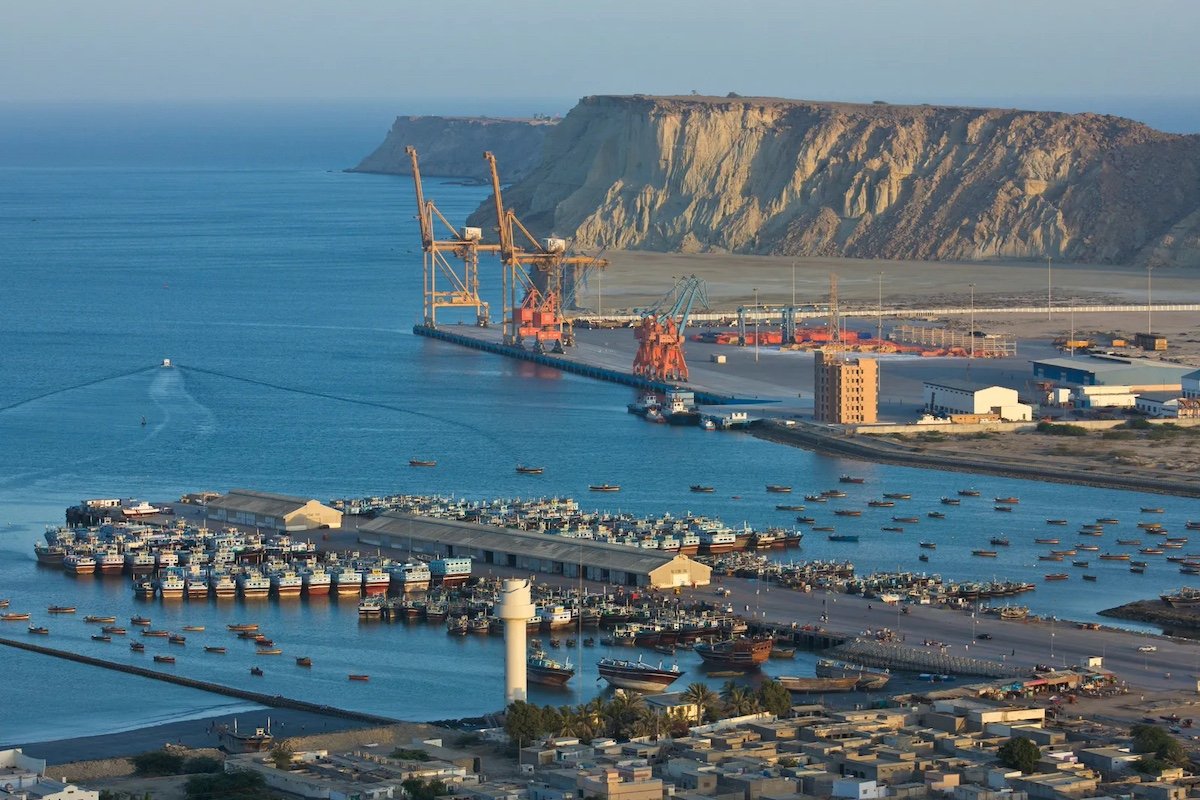
In April 2026, Gwadar Port on Pakistan's southwestern coast processed approximately 11,000 standard shipping containers—more than the 8,300 it handled during all of 2025. This is not a marginal increase but a structural leap, driven by disruptions in the Strait of Hormuz, through which nearly 20% of the world's oil and LNG transits. As freight operators seek alternatives, Gwadar's deep natural harbor, located roughly 400 kilometers from the strait, has emerged as a viable option.
The port's eastern bay is one of the deepest in the region, capable of accommodating large cargo vessels that shallower ports cannot. Unlike partial solutions such as the UAE's Fujairah bypass pipeline or Saudi Arabia's East-West link to Yanbu on the Red Sea, Gwadar offers a complete alternative corridor connecting the Arabian Sea to Central Asia and western China via the China-Pakistan Economic Corridor (CPEC).
Infrastructure Payoff
Gwadar's recent performance is the dividend of a decade of infrastructure investment under CPEC. The New Gwadar International Airport, inaugurated in January 2025 with a $230 million Chinese grant, spans 4,300 acres and can handle Airbus A380s. The Eastbay Expressway Phase-I, the Khuzdar-Basima Road, and the M-8 motorway have cut travel time between Quetta and Gwadar from over 24 hours to roughly eight. CPEC Phase II is now pivoting toward Special Economic Zones, agriculture, minerals, and IT, aiming to deepen economic integration.
For fiscal year 2025-26, the federal government allocated a record 205.99 billion rupees ($739 million) to Balochistan under the Public Sector Development Program, nearly 68% of the combined PSDP for Balochistan, Federal/ICT, and AJK. By March 2026, 73.5 billion rupees had been disbursed across 148 active projects in roads, water, power, and education. In Gwadar specifically, 22 projects worth 184 billion rupees are underway, including the Pak-China Friendship Hospital, which treated 43,000 patients from poor communities for free in 2025, and a Chinese-funded desalination plant providing eight million gallons of drinking water daily.
The Balochistan Special Development Initiative, launched with the Pakistan Armed Forces, allocated 5 billion rupees toward 137 projects in rural districts like Kech, Khuzdar, Washuk, Chagai, Panjgur, and Kalat. By end-2025, 13 projects were completed, including solar installations in rural health centers and street lighting. The provincial government also launched its first Balochistan Youth Policy, targeting overseas jobs for 30,000 young people; over 6,000 skilled youth have already secured employment abroad. The Balochistan Education Endowment Fund disbursed roughly 4 billion rupees in scholarships in 2025 alone.
Long-Term Bets
The Asian Development Bank approved an additional $48 million for water resource development in Balochistan in November 2025, co-financed by Japan, focusing on the Zhob and Mula river basins. Meanwhile, 27,000 agricultural tube wells are being solarized at a cost of 55 billion rupees. Perhaps the most consequential project is Reko Diq, one of the world's largest undeveloped copper-gold deposits, located in Balochistan. In late 2025, it secured $3.5 billion in international financing from the ADB, the US Export-Import Bank, and other partners, moving from planning to construction. First copper exports are projected for 2029, with full production expected to employ 7,500 to 13,500 workers and generate $75 billion over 35 years.
Gwadar's rise also offers Pakistan new geopolitical leverage. Gulf states dependent on the Strait of Hormuz have a direct stake in a stable Pakistan with a functional western port. Saudi Arabia transferred $2 billion to Pakistan in April 2026, with a further $3 billion pledged, reflecting this calculus. As Pakistan's diplomatic pivot continues, Gwadar's moment may prove enduring—provided Islamabad works urgently to make the current surge permanent.