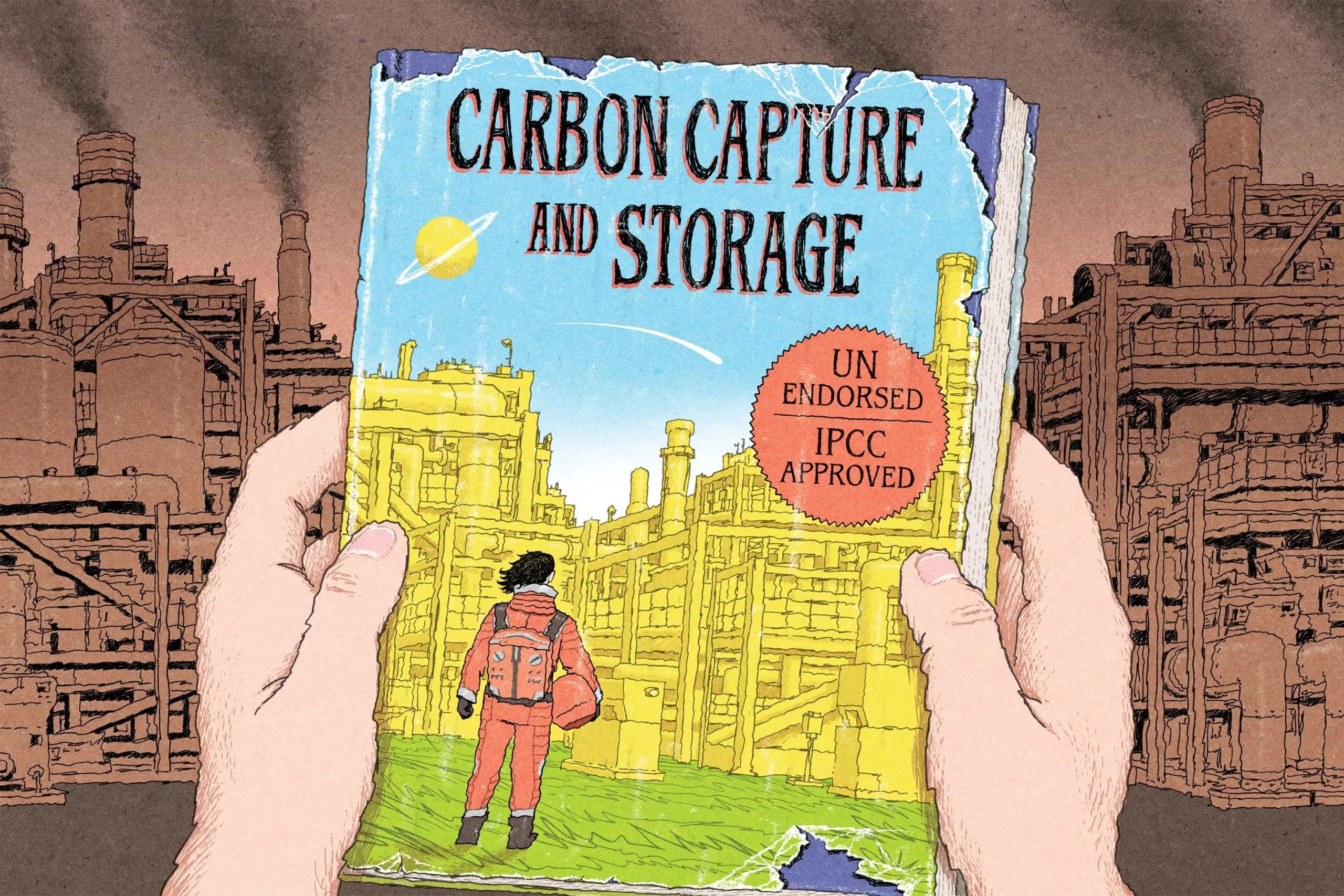
In the spring of 2005, more than 100 of the world's leading climate scientists gathered in the medieval Spanish town of Oviedo. Their task: finalize a landmark report on carbon capture and storage (CCS), a technology that promised to let the world keep burning fossil fuels while burying the resulting carbon dioxide underground. To mark the occasion, hosts handed out bottles of cava with labels that read, "Open only if you truly believe."
Belief was indeed required. CCS had barely been tested at scale. The concept was straightforward: strip CO2 from industrial smokestacks, compress it, and inject it deep into porous rock formations, where it would remain for millennia. But major uncertainties loomed—how much storage capacity existed, how to monitor leaks, and whether the gas would stay put.
Leading the report's chapter on underground storage was Sally Benson, a geoscientist from Lawrence Berkeley National Laboratory. With 25 years of experience studying subsurface fluid dynamics, she was an authoritative figure, but also a diplomatic one, skilled at managing a room of strong-willed experts. The scientists had clashed for years over what to write, meeting in Canada, Norway, Australia, and Brazil. Only one large-scale project—a Norwegian operation in the North Sea—had rigorously tested permanent storage, and even that had surprised engineers when the injected CO2 rose 700 feet before hitting a shale caprock.
The report's origins were political. Saudi Arabia and other oil-exporting nations had pushed the UN's Intergovernmental Panel on Climate Change (IPCC) to produce it, despite the lack of evidence. The fossil fuel industry, which had long cast doubt on climate science, saw CCS as a way to prolong the use of their products. A UN endorsement would bring the technology into the mainstream. The UN, in turn, hoped the report would bring oil producers into the climate fold. So, over objections from some nations and environmental groups, the IPCC proceeded, inviting industry researchers from Shell, Chevron, and Saudi Aramco to co-author chapters.
The secret survey
As the Oviedo meeting progressed, Bert Metz, a senior UN official, pressed for hard numbers—how many gigatons of storage capacity existed, how long would a well-designed reservoir hold CO2? But the scientific literature was thin. To bridge the gap, Canadian physicist David Keith proposed an "expert elicitation": an anonymous survey of the scientists' own expectations. Some balked, fearing that educated guesses would mislead the public. Benson and Metz argued that informed advice was better than nothing.
The group agreed to take the survey, but on one condition: it would be off the record. "We'll burn it afterward," Keith recalled. No mention would appear in the official report. When the meeting ended, the scientists popped their cava bottles in celebration.
Five months later, the IPCC published its special report on CCS. The 431-page document portrayed the technology as a potential savior, stating it could lower the cost of stabilizing CO2 concentrations by at least 30% and contribute up to 55% of global mitigation efforts by 2100. It acknowledged gaps in research, but the overall message was clear: CCS was a viable tool.
The report's impact was profound. It legitimized CCS for a generation, influencing policy from Washington to Beijing. Governments and companies poured billions into CCS projects, often as a justification for continued fossil fuel use. Critics argue that this focus on end-of-pipe solutions has distracted from the more urgent task of phasing out coal, oil, and gas.
Benson later defended the process, saying that on such a critical issue, expert judgment was necessary. But the secret survey remains a controversial footnote in climate history. As the world grapples with rising emissions, the legacy of that 2005 report is still felt—both in the technologies it promoted and in the questions it left unanswered.
For Asia, the stakes are high. Countries like China, India, and Indonesia are investing heavily in CCS as they balance economic growth with climate commitments. The IPCC's endorsement gave these efforts a veneer of scientific certainty that was, at best, premature. As climate adaptation costs soar, the debate over CCS's role is more relevant than ever.
The story of the Oviedo meeting is a reminder that climate policy is not always built on solid ground. Sometimes, it's built on a shared belief—and a bottle of sparkling wine.