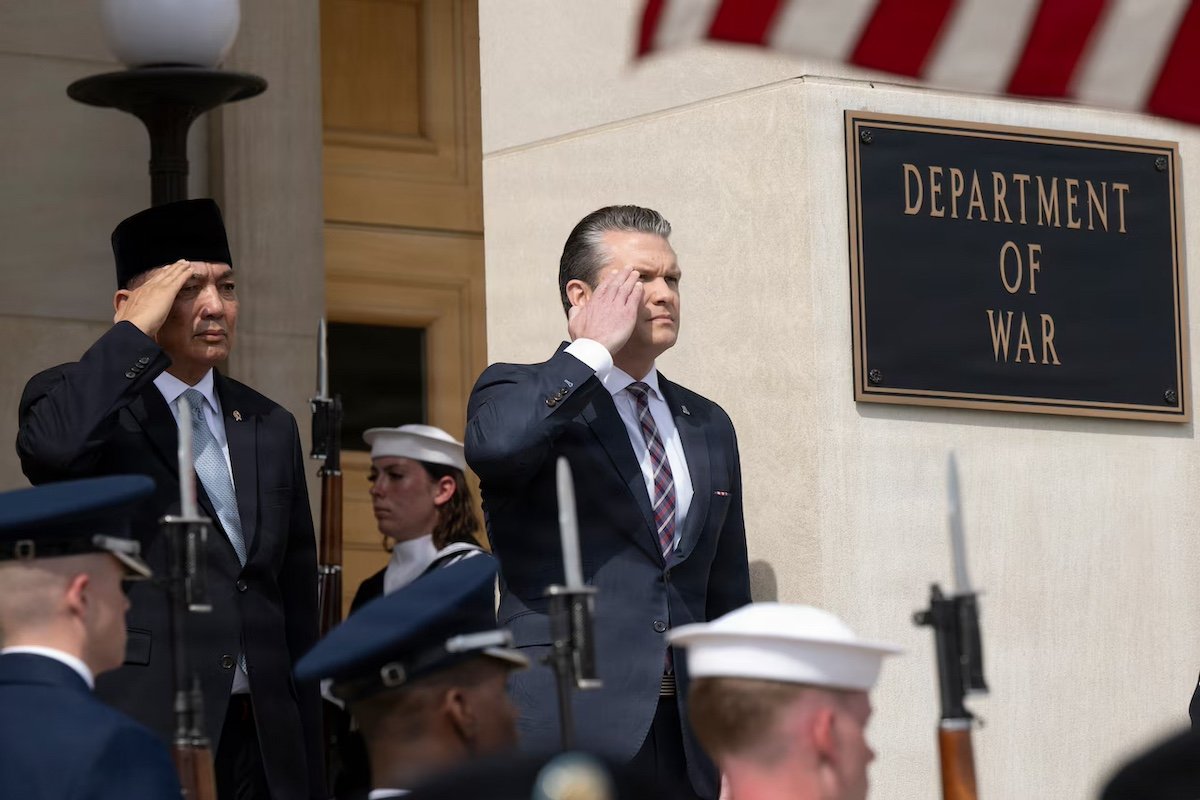
On April 13, 2026, Indonesia pulled off a rare piece of high-stakes diplomatic choreography. Defense Minister Sjafrie Sjamsoeddin signed the Major Defense Cooperation Partnership (MDCP) with US Secretary of War Pete Hegseth at the Pentagon. At the same time, President Prabowo Subianto held a five-hour meeting with Russian President Vladimir Putin in Moscow.
The synchronized events were no coincidence. They were a deliberate expression of Indonesia's multi-alignment doctrine, designed to protect national interests amid a global energy crisis triggered by the closure of the Strait of Hormuz. The Moscow visit was driven by cold pragmatism: securing Russian crude oil at an estimated US$59 a barrel to shield Indonesia's economy from acute energy inflation.
Buying Russian energy carries the risk of US sanctions under the Countering America's Adversaries Through Sanctions Act (CAATSA). The new MDCP functions as a diplomatic shield. By offering Washington a high-level security commitment, Indonesia executed a strategic trade-off, compelling the US to grant sanctions waivers in the interest of global energy supply stability.
A Sharper Defense Partnership
Where previous US-Indonesia cooperation was broad and often vague, the 2026 MDCP is a sharper, functional instrument. The agreement grants Indonesia access to sensitive domains including subsurface technology, autonomous systems, and advanced asymmetric capabilities—privileges typically reserved for America's closest treaty allies.
The economic foundation for this military modernization was laid weeks earlier during Prabowo's visits to Japan and South Korea, which yielded 575 trillion rupiah (US$33 billion) in investment commitments. This gives Indonesia the fiscal space to finance procurement of advanced defense hardware compatible with Western technological ecosystems.
However, a sharp friction has emerged: the US demand for blanket overflight rights, meaning automatic military transit through Indonesian airspace. A classified document titled "Operationalizing US Overflight" revealed the Pentagon's desire for rapid transit corridors from the Pacific to the Indian Ocean to respond to Middle East crises. The Defense Ministry maintains that airspace sovereignty remains absolute and that permissions are granted case by case, but the issue has sparked internal tension. The Foreign Ministry voiced concerns about an "alliance trap," while the military focused on the need to enhance operational capacity and interoperability.
This debate echoes broader regional dynamics, as the Strait of Malacca emerges as a potential flashpoint in great-power rivalry, underscoring the strategic importance of Indonesian airspace.
Three Strategic Pillars
The 2026 MDCP rests on three primary pillars: military modernization, professional training, and increasingly complex joint operational exercises. Its fundamental difference from the 2023 Comprehensive Strategic Partnership lies in its commitment to high-end technology transfer and joint defense industry development. Indonesia now has the opportunity to build domestic self-reliance in maintenance, repair, and overhaul (MRO), reducing dependence on global supply chains vulnerable to political disruption.
That capacity is critical amid threats from China in the North Natuna Sea, demanding that Indonesia develop force multipliers such as underwater sensor networks and autonomous drones to guard its exclusive economic zone without relying solely on a large and prohibitively expensive surface fleet.
Indonesia's decision to integrate its military more closely with the US is a calculated move following recent strategic visits to Tokyo and Seoul. By securing cooperation in shipbuilding and the co-development of the KF-21 fighter jet with Seoul, Jakarta is building a defense ecosystem that is technically integrated with pro-Western partners while remaining anchored in an "independent and active" foreign policy.
This transactional approach aligns with the diplomatic style of US President Donald Trump, which emphasizes security burden-sharing. Indonesia is leveraging its geographic position as gatekeeper of the Strait of Malacca to extract technological concessions that were once blocked by decades of bureaucratic resistance in Washington.
However, US pressure for blanket overflight rights remains a constitutionally sensitive issue. For Washington, Indonesian airspace is the vital link connecting Pacific bases to conflict theaters in South Asia and the Middle East. For Jakarta, granting such access risks turning Indonesian territory into a target for third-party retaliation in any major conflict, including a possible US-China clash over Taiwan.
Indonesian diplomacy has intentionally structured the MDCP without a mutual defense clause to preserve strategic autonomy—allowing Indonesia to pursue membership in economic blocs like BRICS while simultaneously serving as one of America's primary security partners in Southeast Asia.
At the same time, Indonesia's choice to deepen cooperation with the US does not signal an abandonment of strategic ties with Russia or China. Rather, it is an effort to forge a new equilibrium in which Indonesia is no longer an object of great-power competition but an actor that dictates the terms of its own engagement. By securing energy from Russia and technology from the West, Jakarta is constructing a position it hopes will make it the pivot of stability in the Indo-Pacific by 2045.
The deepening of US-Indonesia ties through the MDCP has inevitably raised alarms in Beijing. China traditionally views any strengthening of the US military presence in Southeast Asia as part of a regional containment strategy. The official Chinese response, conveyed through Foreign Ministry spokesperson Mao Ning, was carefully worded but emphasized that military cooperation between nations must not target third parties.
Indonesia's balancing act reflects a broader trend in the region. As Singapore's AI neutrality model cracks under US-China pressure, Jakarta's multi-alignment approach offers an alternative path for Southeast Asian nations navigating great-power rivalry.