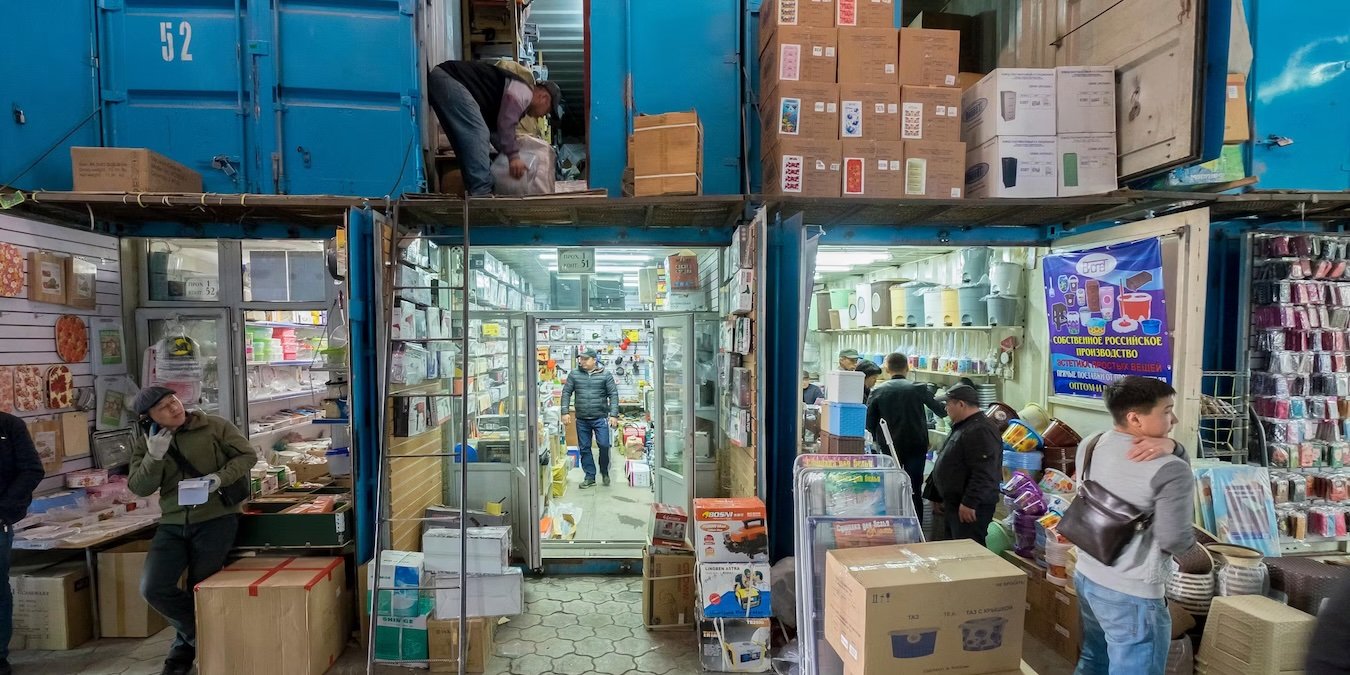
As I stepped out of Ainura's container-shop at the Dordoi Bazaar in Bishkek, the capital of Kyrgyzstan, the market was settling into an eerie quiet. I hadn't noticed the time passing while she shared her life story. Walking toward the minibus stop, the sounds of the day's end surrounded me: the heavy slam of metal doors and the resonant clang of padlocks clicking into place. Soon, only stray plastic wrappings stirred by the last vendors hinted at the day's bustle.
Ainura, like thousands of others, found a new livelihood at Dordoi after life took an unexpected turn. When I asked why she works here, she explained: "Here in Kyrgyzstan, we can't rely on the state. Dordoi feeds the country. It feeds our families; and it allowed me to start a new life after I had left my husband."
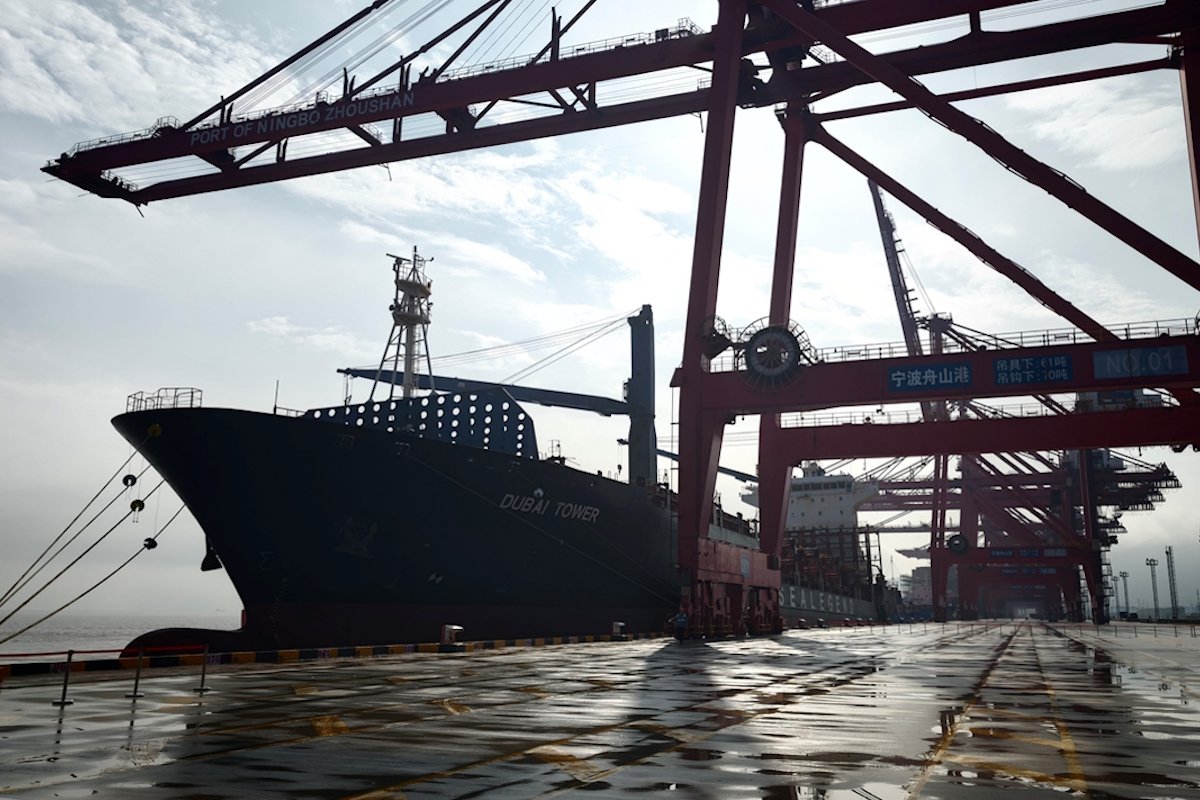
Dordoi is more than a trading center; it's a city within a city. Spanning over 100 hectares and built from up to 60,000 double- and triple-stacked shipping containers, it houses not only shops and storage but also currency exchanges, medical centers, a fire station, hotels, a gym, beauty salons, and a mosque. The languages spoken along its aisles reflect its reach: Russian and Kyrgyz dominate, but Dungan, Uyghur, Uzbek, Tajik, and Chinese also echo, revealing trading networks that converge from across Central Asia and beyond.
An economic engine born from crisis
Dordoi's origins lie in the collapse of the Soviet Union in 1991. As factories closed and rapid market reforms pushed millions into uncertainty, newly unemployed workers turned to retail. "Shuttle trading"—small-scale cross-border commerce, often led by women—became a lifeline. Today, estimates of people working at Dordoi range from 30,000 to 150,000, depending on whether auxiliary jobs like food hawkers, drivers, and carriers are included. In 2025, these activities generated roughly US$7.9 million in tax revenue, a substantial contribution to Bishkek's public finances.
Clothing remains Dordoi's lifeblood. Textiles, knitwear, and ready-made garments dominate, arriving chiefly from China and Turkey alongside a growing volume of locally produced apparel. The central passageway serves as both a shopping boulevard and the market's main artery. Cart pushers weave through crowded aisles, shouting "Jol, jol, jol, jooool, daroga!"—"Make way!" in Kyrgyz and Russian—as they maneuver heavily laden carts. They deliver goods to packing stations near the long-distance bus terminal, where workers compress merchandise into tightly packed bales, every centimeter mattering to minimize shipping costs.
By midday, the pace slows, and the air fills with the scent of roasting meat and fresh dough. Food stalls offer a culinary map of Central Asia: Dungan laghman, Uzbek plov, Uyghur samsa. Tea vendors, coffee sellers, and fruit merchants weave through the crowds, and a growing number of barista coffee shops have become part of the market landscape.
My research on market biographies began in 2018, focusing on the emotions of losing a career after the Soviet collapse and the trauma of the post-Soviet period. In 2019, I extended it to Dordoi, returning for extended fieldwork in 2021-22, 2024, and 2026. My dissertation compared Dordoi with the remarkably similar container-built 7th Km Market in Odesa, Ukraine. I'm now turning that research into a book, Lived Geopolitics, tracing both markets from their rise after the Soviet collapse to the consequences of Russia's full-scale invasion of Ukraine in 2022.
From above, both markets appear as vast expanses of corrugated metal. At ground level, however, every container opens onto its own distinct social world. That tension between scale and intimacy is what keeps drawing me back. These markets offer a unique vantage point to explore how personal histories, aspirations, and moral commitments intersect with abstract forces of markets, logistics, and global power. My research examines how people make lives and livelihoods within these forces, creating pockets of stability despite recurring crises.
Dordoi is neither an anomaly nor a continuation of ancient bazaars. It is a product of its time—a testament to resilience and entrepreneurship in the face of upheaval. As Kyrgyzstan navigates its post-Soviet path, Dordoi remains a symbol of how ordinary people build futures against the odds. Its significance extends beyond economics, reflecting the broader geopolitical shifts reshaping Central Asia, as seen in Kyrgyzstan's growing international role.