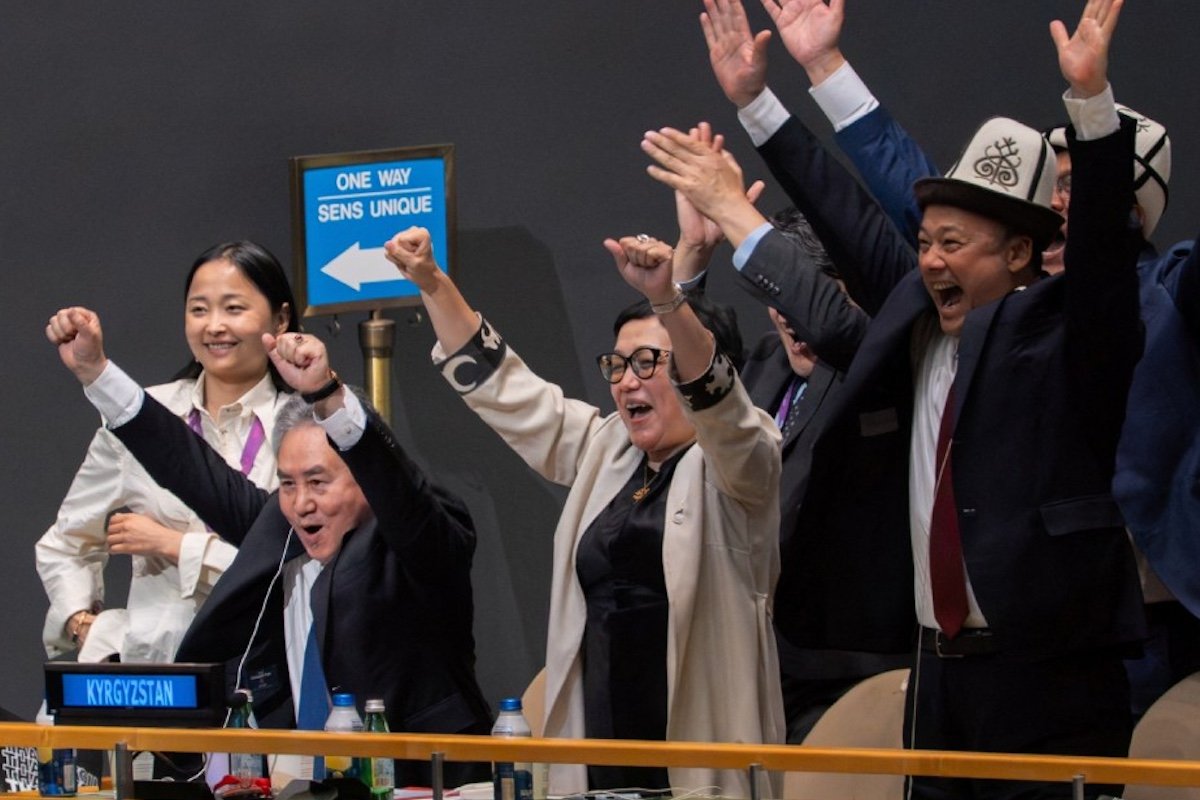
On June 3, Kyrgyzstan secured an upset victory over the Philippines to claim a non-permanent seat on the United Nations Security Council for the 2027-2028 term. The Central Asian nation, which had never served on the Council before, won decisively in the fourth round of voting, 142-49, after leading 105-85 in the first ballot. Kyrgyzstan is only the second Central Asian country to hold a seat, following Kazakhstan in 2017-2018.
An elated Kyrgyz delegation, some wearing traditional ak-kalpak hats, celebrated in the General Assembly Hall, exchanging handshakes and smiles with a long line of well-wishers. The scale of the final vote was striking: such a decisive margin favoring a Central Asian candidate over a US-aligned Indo-Pacific one challenges conventional assumptions about where the center of global geopolitical gravity is shifting.
Why the Philippines Was the Expected Choice
On paper, the Philippines appeared the obvious candidate. A US treaty ally and founding member of ASEAN, it has deep diplomatic ties across the Global South and has served on the Security Council four times. Its strategic location—on the front lines of tensions with China and near Taiwan—only reinforced its relevance. In April, the United States and the Philippines held their largest-ever “Balikatan” joint military drills, including in areas near Taiwan, with more than 17,000 troops from seven countries participating. At the Shangri-La Dialogue in Singapore on May 30, US Secretary of Defense Pete Hegseth praised President Ferdinand Marcos Jr for boosting defense spending by 12% this year, highlighting Manila’s push to build a “modern, technologically advanced and interoperable force.”
Yet Wednesday’s vote suggested that many countries in the Global South gave a collective shrug to this US-centric narrative. Rather than lining up behind alliance structures or strategic alignments, many General Assembly members appeared willing to back a different kind of candidate. Kyrgyzstan’s campaign leaned into that contrast, with messaging such as “The voice of Central Asia,” “Mountain nation, global vision,” and “Landlocked, ocean-minded”—emphasizing representation and perspective over power politics.
Ahead of the vote, a senior Philippine diplomat expressed confidence that countries such as the US and Japan would support Manila’s bid. The diplomat noted Kyrgyzstan’s backing from China and Russia, and argued it was clear which candidate stood on “the right side of history.” The outcome, however, suggests that framing did not resonate.
Eurasia’s Quiet Rise
For years, the dominant narrative in global strategy has been the rise of the Indo-Pacific—a framework centered on maritime trade, naval power, and US-China competition at sea. By that logic, a country like the Philippines should have been the natural choice. But the General Assembly chose differently. Kyrgyzstan’s victory suggests that another map is beginning to matter: the Eurasian interior.
This region is increasingly a theater of strategic competition. Russia’s influence in Central Asia and the South Caucasus is waning as it remains consumed by the war in Ukraine. China, meanwhile, is expanding overland energy and infrastructure networks across Eurasia, as it seeks to reduce reliance on maritime routes vulnerable to disruption, particularly in the event of an armed conflict with the US. At the same time, countries such as Kazakhstan, Uzbekistan, and Azerbaijan have pursued multivector foreign policies, avoiding overdependence on any single power—a balancing act that has kept them engaged with multiple partners, including the US.
Washington has always struggled to categorize Central Asia—variously grouping it with Europe, the Middle East, or Asia. Often treated as a space between more important regions, it is now emerging as a geopolitical arena in its own right, defined not by sea lanes, but by corridors, energy routes, and common Turkic heritage. This shift is part of a broader trend: as Xi Jinping's new US-China formula signals Beijing's self-confident shift in terms, the Eurasian landmass is gaining prominence.
None of this means that countries are necessarily siding with Russia and China over the US. Nor does it diminish the importance of the Indo-Pacific. The Philippines will obviously remain central to US strategy vis-à-vis China. But the vote does suggest something more subtle: a growing appetite for new narratives and a recognition that military buildup may not be the only path to credible deterrence. It also reflects an emerging new geopolitical map with Eurasia increasingly at its center.
For further context on the dynamics of this race, see our earlier analysis: UN Security Council Race: Philippines vs Kyrgyzstan Reflects Geopolitical Shift.