While hypersonic missiles, drones, and other flashy weapons systems dominate headlines about Japan's military buildup, the government is quietly investing in a less glamorous but equally critical area: combat casualty care. In a worst-case scenario, Tokyo and the Japan Self-Defense Forces (JSDF) want to be ready for the kind of severe injuries and psychological trauma seen in Ukraine.
The initiative has not exactly captured public attention. Although Akahata, the newspaper of the Japanese Communist Party, recently reported on the government's plan to ask universities to research mass-casualty treatment, mainstream media have largely ignored the story. Yet the implications are significant for Japan's defense posture and for the wider Indo-Pacific security environment.
Funding trauma research
The proposed research themes are sobering: penetrating and blunt trauma, brain damage, long-term storable artificial blood, artificial organs, AI-powered prosthetics, vision restoration, bone regeneration, and post-traumatic stress disorder (PTSD). Under the Security Technology Research Promotion Program, run by the Acquisition, Technology & Logistics Agency (ATLA) of Japan's Ministry of Defense, medical and biomedical engineering will be added to the list of eligible topics. Each project could receive up to ¥2 billion ($12.5 million).
That level of funding is a strong incentive for university medical schools, and it may help overcome the traditional reluctance in Japanese academia to engage in military-related research. As one government source, speaking anonymously, put it, the effort is still a work in progress.
The dual-use nature of this research is a key selling point. Treatments for PTSD, brain injuries, and severe trauma—including blast injuries and amputations—have clear civilian applications, such as in cases of sexual assault or serious traffic accidents.
From neglect to urgency
Historically, the JSDF paid little attention to combat casualty care, reflecting its limited exposure to high-risk missions. That changed after the December 2022 revision of Japan's Three Security Documents—the National Security Strategy, National Defense Strategy, and Defense Build-up Program. The revised National Defense Strategy explicitly called for “fundamental reforms to improve combat trauma care capabilities.” A combat injury treatment center was subsequently established at the National Defense Medical College Hospital.
The war in Ukraine has accelerated the shift. As Prime Minister Sanae Takaichi said in January, “Learning from Russia's aggression against Ukraine, countries are now urgently preparing for new forms of warfare, including the mass deployment of unmanned drones, and furthermore preparing for extended periods of fighting, under the assumption that once such conditions arise, there is a high likelihood of the situation becoming prolonged.”
In April, Japan's Ministry of Defense issued a policy statement warning that in a contingency, the incidence of acute stress disorder and PTSD is expected to rise. It also noted that modern weapons' increased lethality would likely produce more traumatic brain injuries and musculoskeletal impairments, driving up demand for physical rehabilitation. The ministry pledged to consolidate medical functions across the Self-Defense Forces and mobilize the full strength of SDF medical services, including the National Defense Medical College.
Closer US-Japan military medical ties
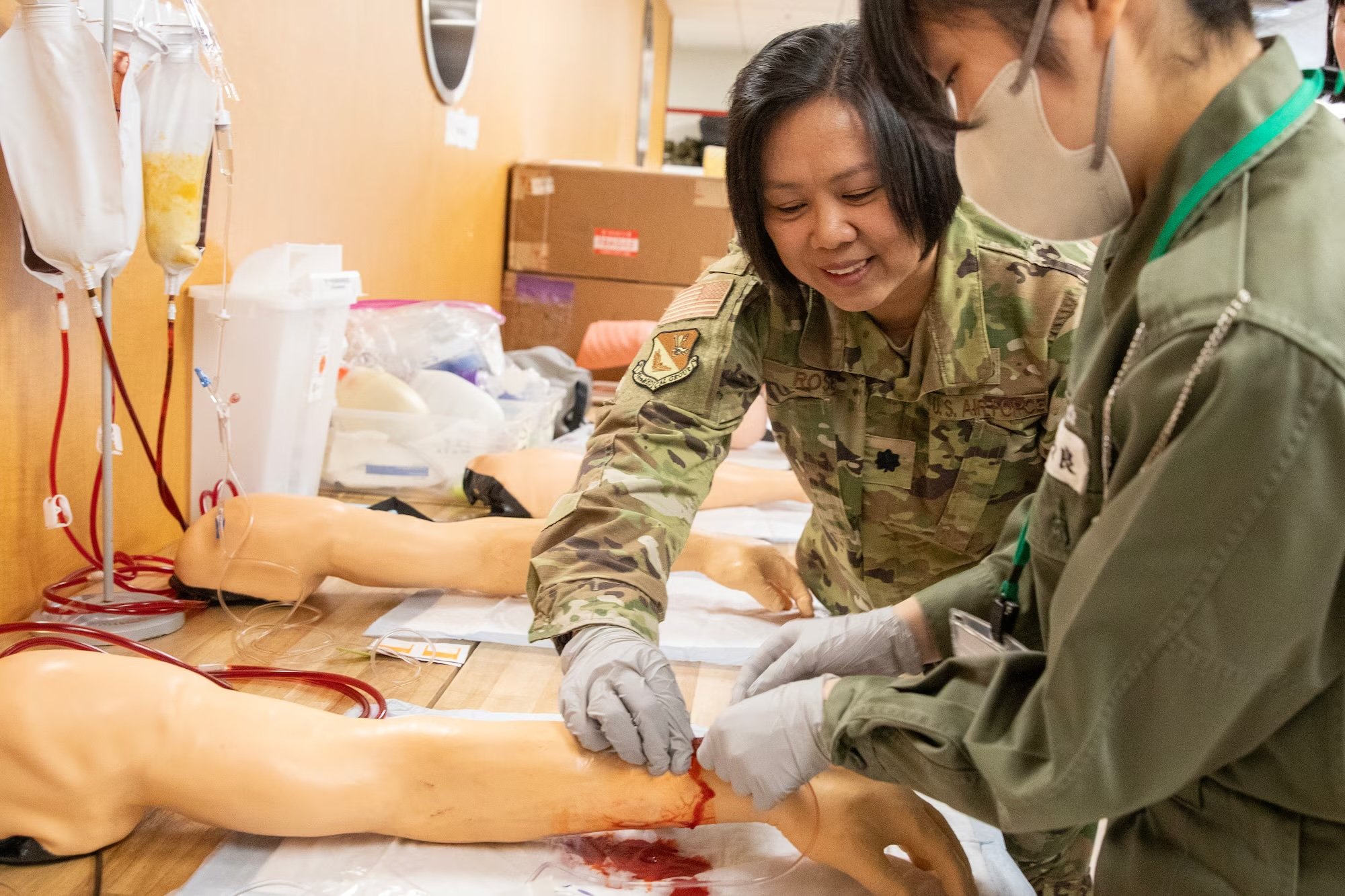
Japan is working closely with the US military in this area. The US Air Force's 374th Medical Group at Yokota Air Base, west of Tokyo, hosts an annual tour for Japanese nursing students from the National Defense Medical College, located just 12 miles away in Tokorozawa City. The most recent tour was held in March.
“The purpose of this tour,” said US Air Force Major Moshood Yinusa, “is to showcase the life and work of US active-duty nurses and foster engagement between Japanese nursing students and US culture and military medicine.”
JSDF personnel also participate in Tactical Combat Casualty Care (TCCC) training with US forces. In January, at Camp Hansen in Okinawa, the Expeditionary Operations Training Group of III Marine Expeditionary Force ran JSDF cadets through trauma medicine scenarios, teaching them to provide medical care under battlefield pressure. III MEF is the nucleus of a joint and coalition force operating within the First Island Chain and across the Indo-Pacific.
This deepening cooperation reflects a broader strategic shift. Until recently, Japan was careful to avoid being dragged into American wars. Now, with China's growing assertiveness and tensions from Korea to Taiwan and the South China Sea, Tokyo is more concerned with keeping the US engaged in East Asia while building its own capabilities. The India-Japan strategic convergence is another example of this regional realignment.
Whether Ukraine is a perfect model for Japan's security challenges is debatable, but the investment in combat casualty care is a clear acknowledgment that serious armed conflict is no longer unthinkable. The psychological and social effects of PTSD, long ignored, are now part of the official planning calculus.
In August 2024, Japan's Ministry of Health launched its first comprehensive survey of PTSD among Japanese soldiers from World War II, a belated recognition of the long-term costs of war. As Japan prepares for the possibility of future conflicts, it is also learning from the past.