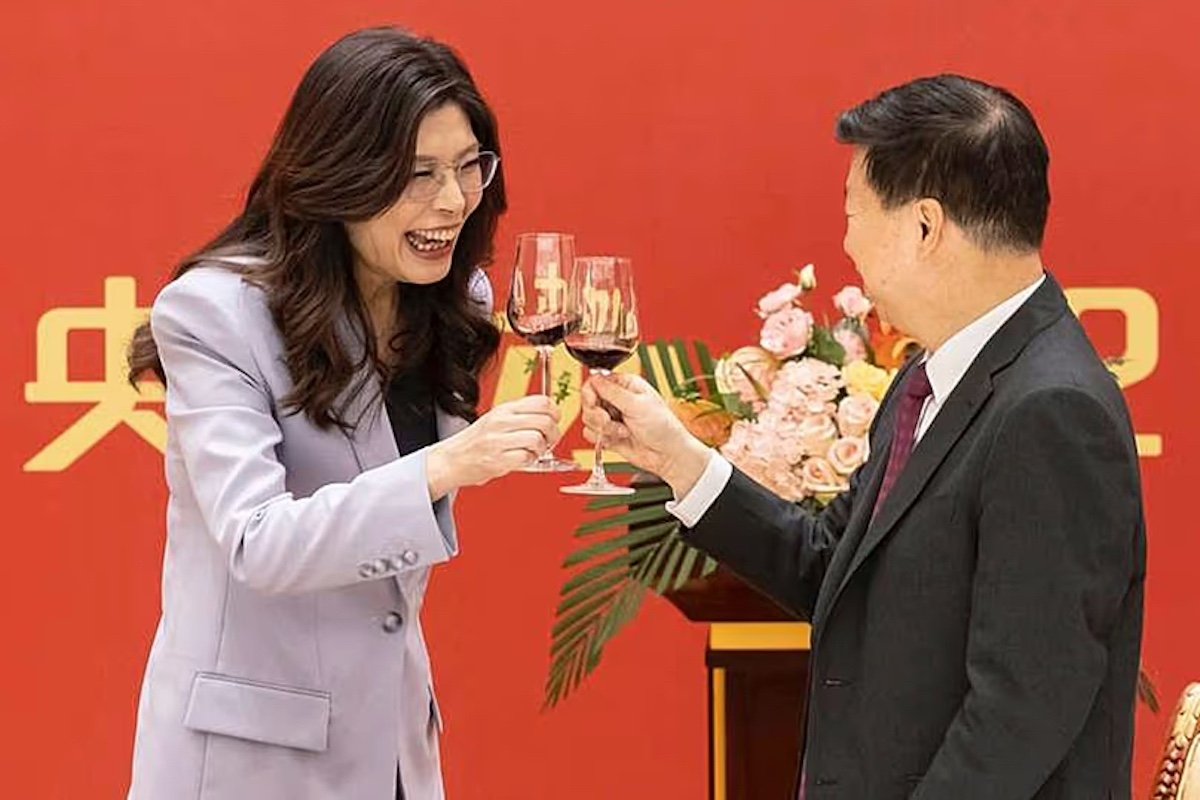
In the precise world of cross-strait diplomacy, terminology carries immense weight. Each word is scrutinized, each silence interpreted. The recent visit to China by Kuomintang (KMT) Chairwoman Cheng Li-wun has triggered a political tremor in Taipei, not merely due to the trip itself, but because of the specific language she employed. By attributing Taiwan's separation from the mainland to 'imperialist forces,' Cheng adopted a core tenet of Chinese Communist Party (CCP) historiography, signaling a potential reorientation of Taiwan's main opposition party.
A Departure from Ambiguity
This represents a notable departure from the KMT's traditional stance of strategic ambiguity. Previous chairs, like Eric Chu, maintained the framework of the '1992 Consensus' while emphasizing 'different interpretations'—a formulation that preserved conceptual space for the Republic of China. When CCP General Secretary Xi Jinping congratulated Cheng on her election last November, her reply notably omitted this clause, an omission Beijing quickly codified as the new basis for party-to-party relations.
The term 'imperialist' is particularly loaded. Within the CCP's Marxist-Leninist lexicon, it explicitly refers to the United States and its allies, casting them as external obstructors of China's national rejuvenation and reunification. By using this language, Cheng reframes Taiwan's robust security partnership with the U.S. not as a democratic alliance but as a form of subjugation. It also narratively removes agency from the Taiwanese people, depicting the island's post-1949 trajectory as a consequence of foreign interference rather than the complex outcome of civil war and subsequent local democratic development.
Policy Implications and Internal Rifts
The rhetorical shift has immediate policy consequences. The KMT, leveraging its legislative majority formed with the Taiwan People's Party (TPP), is currently blocking a special defense budget of NT$1.25 trillion (US$39.3 billion). Cheng has framed this spending as turning Taiwan into an American 'ATM.' This stance is not unanimous within her own party; figures like Eric Chu and Taichung Mayor Lu Shiow-yen have publicly supported stronger defense investments than Cheng advocates, revealing a significant internal fault line.
The situation transcends a typical policy dispute between engagement and sovereignty. When the leader of a major democratic opposition party begins to echo the historical narrative and strategic lexicon of an authoritarian neighbor that claims sovereignty over its territory—while simultaneously working to constrain its defense capabilities—the nature of political competition changes fundamentally. It raises the stakes of electoral alternation from a debate over policy direction to a question concerning the foundational principles of the democratic system itself.
Parallels can be drawn with political dynamics in Europe, where parties like Hungary's Fidesz maintained close ties with Moscow, with erosion often beginning with vocabulary before affecting institutions. Taiwan's case is uniquely perilous, however, as China not only presents an ideological challenge but also asserts a territorial claim and regularly conducts military exercises simulating an invasion. A KMT return to power under Cheng's ideological framework could impact the very conditions that sustain Taiwan's democracy: credible self-defense, reliable alliances, and the principle that the island's future must be determined by its 23 million residents.
President Lai Ching-te represents a contrasting pole, maintaining a pragmatic but clear position that Taiwan is already a sovereign, independent country. The gap between these worldviews has widened beyond a policy debate into what appears to be a foundational choice about Taiwan's identity and destiny. This comes as Taiwan cultivates space and drone tech for a layered defense strategy, highlighting the acute security context.
Taiwanese society has shown consistent trends, rejecting the KMT in three consecutive presidential elections and with a growing majority identifying solely as 'Taiwanese.' The risk, therefore, is not a societal shift toward Beijing, but a growing disconnect between the party system and public sentiment. The KMT's institutional power, particularly through its legislative alliance, allows it to pursue a path that may not reflect the median voter's preference on core issues of sovereignty and security.
Cheng Li-wun's use of the word 'imperialist' should resonate as an alarm—not for its offensiveness, but for its provenance. When a democratic opposition's rhetoric converges with that of the authoritarian power that threatens its homeland, it indicates a movement in the democratic fault line. The integrity of Taiwan's political system may depend on recognizing where that line now runs. This internal political shift occurs against a backdrop of regional military developments, including analysis that China's drone-launched mines could encircle Taiwan and entangle US forces, underscoring the high-stakes environment.