Chinese military strategists are refining a plan to deploy advanced, autonomous underwater drones for offensive minelaying, a tactic designed to enforce a blockade around Taiwan by targeting vital maritime corridors far from the island's immediate shores. This approach shifts focus from directly sealing off Taiwanese ports to controlling the external arteries that sustain it, aiming to trap potential intervening forces and inflict severe economic pressure.
A Strategy of Distant Isolation
According to an analysis published in the Chinese military magazine Shipborne Weapons and reported by the South China Morning Post, the People's Liberation Army (PLA) could deploy extra-large unmanned underwater vehicles (XLUUVs) in a Taiwan contingency. The reported mission: "offensive minelaying" targeting key passages along the First Island Chain, including waters near Japan's Ryukyu Islands and the Philippines. The objective is to disrupt supply routes from potential interveners like the United States and Japan, effectively isolating Taiwan through coordinated operations involving missiles, aircraft, and naval groups.
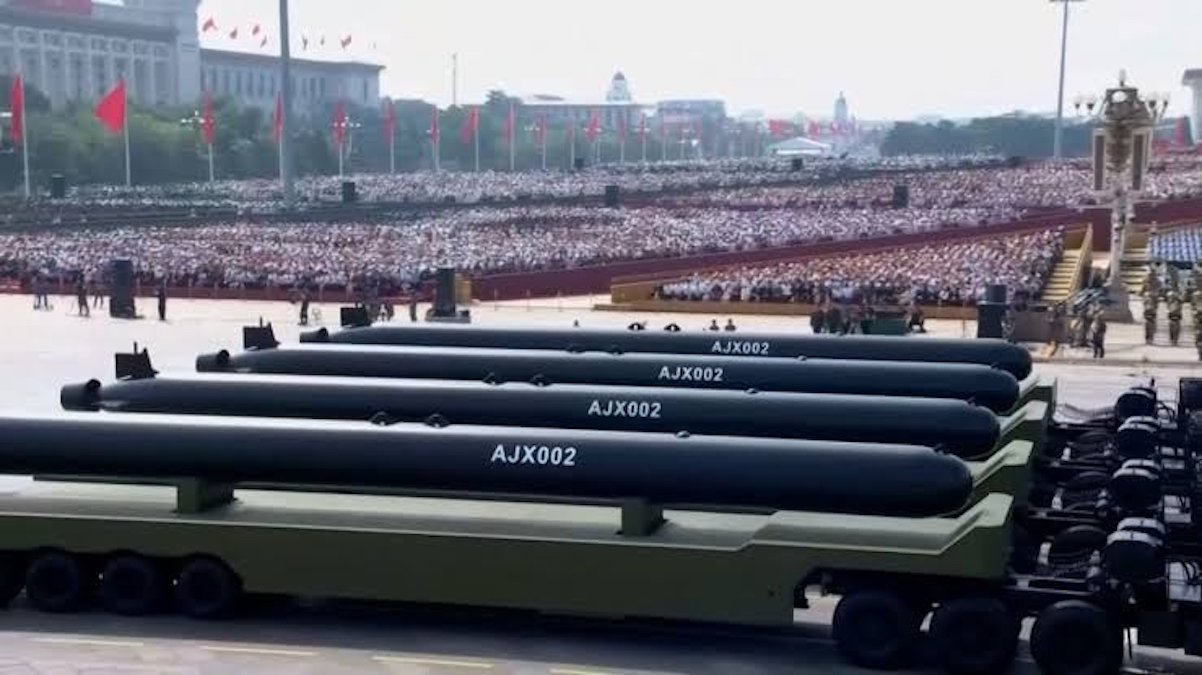
The AJX002 XLUUV, unveiled in Beijing in 2025, is central to this concept. With an estimated range of 1,000 nautical miles and the capacity to carry up to 20 naval mines per mission, it represents a stealthy, autonomous tool for laying persistent barriers. The goal is not merely to deny entry to blockade zones but to trap adversary vessels in port, severing supply lines as part of a broader coercive campaign.
Layered Coercion in the Gray Zone
This mining strategy functions as a force multiplier within China's established anti-access/area denial (A2/AD) framework. As noted in a 2024 Center for Strategic and International Studies (CSIS) report by Bonny Lin and others, China could combine covert minelaying with overt signaling like live-fire exercises. A "joint blockade campaign" would likely involve PLA Navy surface groups around Taiwan, supported by China Coast Guard and Maritime Safety Administration vessels to interdict ships under a law-enforcement pretext. Mines would extend the physical reach of this enforcement screen.
Analysts Cheng-kun Ma and K. Tristan Tang, writing for the Jamestown Foundation in 2024, observed that PLA exercise zones have been positioned outside major Taiwanese ports including Keelung, Taipei, Taichung, and Kaohsiung. Deployments in eastern waters similarly demonstrate an intent to compress Taiwan's operational space, threatening force preservation areas and limiting its ability to redistribute assets or sustain maritime traffic under pressure.
The persistence and ambiguity of sea mines make them ideal for gray-zone tactics. Retired US Colonel Thomas Hammes, in a 2025 Atlantic Council report, notes mines are easily transported and can be covertly deployed by commercial or fishing vessels—even from China's naval reserve. Cleared areas "can easily be reseeded," making clearance efforts temporary and enabling sustained disruption. This creates a passive but potent layer of coercion that shapes the battlespace without triggering open conflict.
Regional Entanglement and Escalation Risks
The strategy deliberately risks pulling other regional actors into the crisis. Yasuhiro Kawakami of the Sasakawa Peace Foundation has warned that moored mines laid in a Taiwan contingency could drift into Japanese waters if their moorings break, endangering shipping and complicating Japan Coast Guard and Maritime Self-Defense Force operations, particularly around the disputed Senkaku Islands. This effectively draws Japanese territory and forces into the operational envelope of the conflict.
Beyond Taiwan, such mining could reinforce China's South China Sea bastion, creating a defensive envelope around its nuclear ballistic missile submarines and complicating US submarine access. The broader strategic effect is to shape escalation dynamics. A July 2025 CSIS report by Mark Cancian and co-authors found that in war-game scenarios, Chinese submarines and mines destroyed 40% of inbound ships to Taiwan even without US intervention, imposing heavy attrition and accelerating escalation pressures.
As Todd Helmus and authors noted in a 2024 RAND report, China layers its naval, coast guard, and maritime militia forces to "overwhelm opponents and make US or allied responses difficult," using gradual escalation to prepare the battlespace. Sea mines add a critical, persistent layer to this model. This evolving threat comes as regional security calculations are in flux, with some Indo-Pacific nations reassessing their security postures in response to global instability, and as the US re-evaluates its counterterrorism strategy amid broader Asian security concerns.
Ultimately, China's development of drone-launched mining capabilities points to a sophisticated, multi-domain strategy for a Taiwan blockade. It aims not just to control waters around the island, but to manipulate the decisions of the United States and its allies by raising the cost and complexity of intervention to prohibitive levels, all while operating in the ambiguous space below the threshold of open war.