On April 17, the first day of the Myanmar New Year, Win Myint walked out of Taungoo Prison. He had been arrested in the early hours of February 1, 2021, the morning the military seized power from the government he led. He is Myanmar's last democratically elected president.
State television announced his release as part of a traditional Thingyan amnesty covering more than 4,500 prisoners. Aung San Suu Kyi, now 80, had her 27-year sentence reduced by one-sixth and was reportedly transferred to house arrest, according to a senior military officer who spoke anonymously to the Associated Press.
The announcement was delivered not by the State Administration Council, the junta's formal governing body since the coup, but by the Office of the President — a title Senior General Min Aung Hlaing awarded himself on April 10.
That detail matters most. This was not a prison release – it was a performance. Win Myint's freedom is worth marking, but before it is mistaken for a thaw — or, worse, a concession — it is worth reading the rest of the script Min Aung Hlaing and his patrons in Beijing appear to be working from.
A Laundering, Not a Thaw
Min Aung Hlaing's inauguration speech on April 10 promised amnesties that would “support social welfare, reconciliation, justice and peace.” Seven days later, he delivered one. The sequencing is the point.
The release was not reluctantly granted in response to international demand — it was confidently bestowed, as if from a legitimate civilian presidency making good on a campaign pledge. The regime needs the world to read a single sentence — the new president freed the old president — and stop reading there.
It needs this because the presidency that made the release possible is itself the product of what the European Union called an election “not free, fair, inclusive, or credible,” what ASEAN refused to recognize, and what the UN Office of the High Commissioner for Human Rights branded a “charade.”
ANFREL and the Special Advisory Council for Myanmar found that voting in the December 2025–January 2026 staggered polls took place in only 42% of Myanmar's territory. The military-proxy Union Solidarity Development Party (USDP) won 88% of contested seats in a parliament from which the dissolved and banned National League for Democracy was excluded by law. A pardon granted by that foundation does not legitimize it. It indicts it.
The release will now be wielded as evidence of progress on ASEAN's Five-Point Consensus — a single name pulled from a list of 22,170 political detainees maintained by the Assistance Association for Political Prisoners. The Institute for Strategy and Policy Myanmar has documented that fewer than 14% of post-coup amnesty releases have been political prisoners.
Nearly 8,000 civilians have been killed since the coup, more than 3.5 million displaced, and the UN has recorded over 1,022 airstrikes on civilian targets. The Thingyan amnesty did not touch those numbers. Thailand and Cambodia sent congratulations. Malaysia, which chairs ASEAN this year, did not. Nor did the Philippines or Indonesia.
China Behind the Curtain
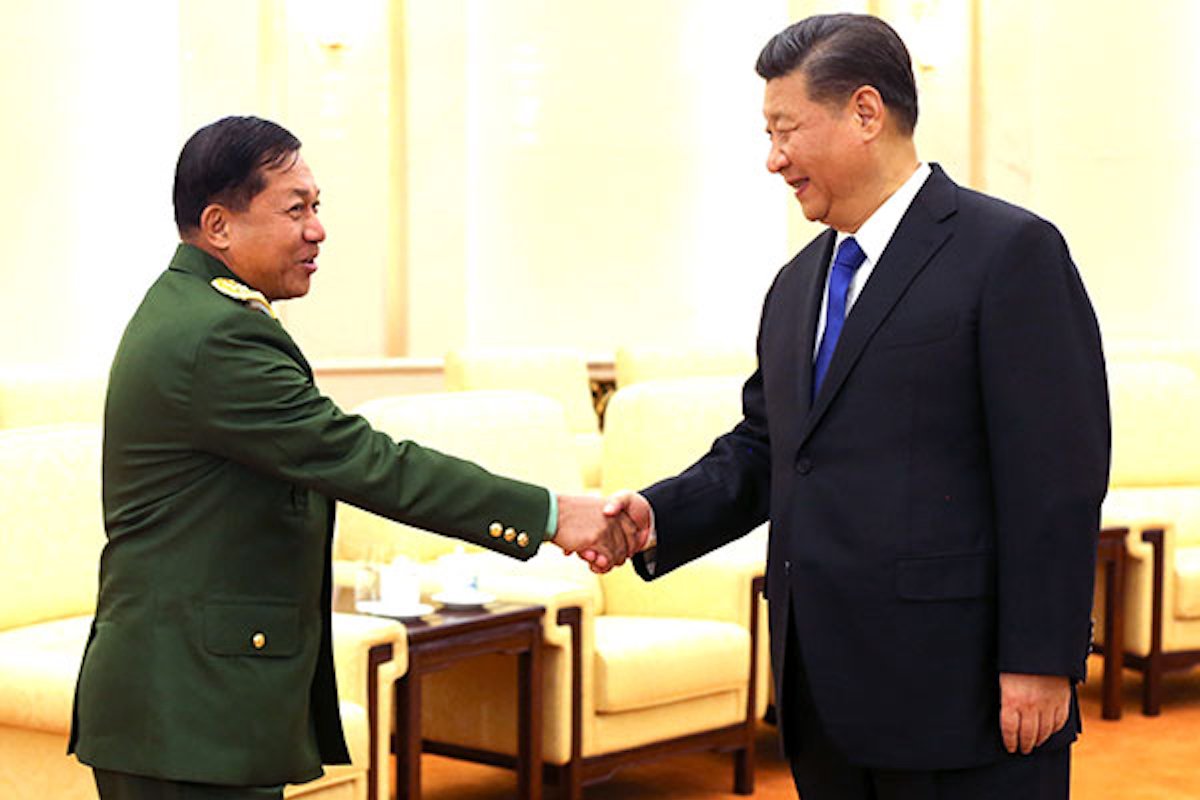
China was the first country to formally acknowledge Min Aung Hlaing's presidency. Ambassador Ma Jia called on him in Naypyidaw on April 6, days before the inauguration. Xi Jinping was among the first heads of state to send congratulations. Beijing's special envoy Deng Xijun has spent the last 18 months dismantling the conditions that made Operation 1027 possible.
He pressured the United Wa State Army to sever weapons supplies to the resistance, placed Myanmar National Democratic Alliance Army (MNDAA) leader Peng Daxun under house arrest in Kunming, China, and engineered the April 2025 return of Lashio — captured by rebel forces in August 2024 — to military control.
The Three Brotherhood Alliance, comprised of the MNDAA, Arakan Army, and Ta'ang National Liberation Army, is now fractured along the fault lines Beijing drew through it.
The release of Win Myint fits the next act. Expect televised ceremonies presenting the former president as a “civilian interlocutor” blessing Chinese-brokered talks. Expect state media to pose, in a tone of reasonable bewilderment, the question “if even Win Myint is ready to talk — why aren't the PDFs?”
Expect Beijing to amplify the narrative through ASEAN, through the UN Security Council, where it holds a veto, and through the pro-regime commentary already surfacing in international media such as Forbes, The Hill, and Eurasia Review.
The Steering Council for the Emergence of a Federal Democratic Union, formed on March 30 by the National Unity Government (NUG), Kachin Independence Organization, the Karen National Union, the Chin National Front, and the Karenni National Progressive will be the target of this pressure. It must answer with a position agreed before the first camera turns on: no dialogue without a nationwide cessation of airstrikes, verified unconditional release of all political detainees, and acceptance of a federal democratic framework.
Hostage on a Short Leash
Read the fine print. According to The Irrawaddy's reporting, Win Myint was freed under Section 401, Subsection 1 of the Code of Criminal Procedure — the clause that returns any pardoned individual to prison, for the remainder of the original sentence plus any new penalty, on re-offense.
This is not freedom. It is a longer leash. Every statement Win Myint makes from this point forward will be composed in the shadow of a re-arrest clause. The same leash will be extended to Aung San Suu Kyi if and when her full release becomes useful to Beijing's timing.
She remains the most valuable hostage the regime holds, and the card Beijing is likeliest to play at the moment of maximum leverage — when disarmament, acceptance of the 2008 Constitution, or recognition of the election is the price demanded of the resistance. The opposition must refuse tiered concessions.
For more on the broader context, see our coverage of Myanmar's Resistance Forges Unified Alliance and Myanmar's Competing Councils.