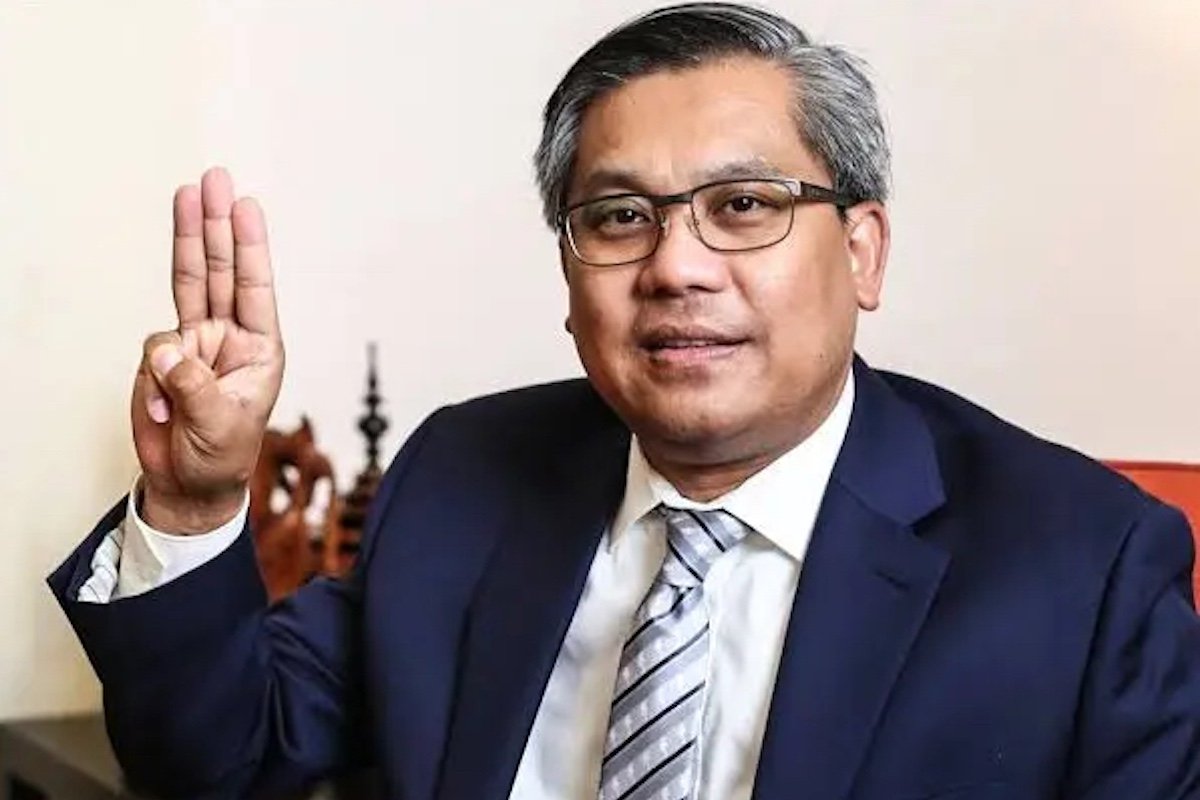
When asked in New York this weekend to respond to Naypyitaw's September 12 statement branding him a traitor, Myanmar's UN ambassador Kyaw Moe Tun did not flinch. Instead, he offered a diagnosis: the junta's move, he told the diaspora outlet People's Spring, shows "how much desperation the junta is now in." He used the English word—desperation—and returned to his work.
That assessment is accurate. On September 12, Myanmar's military-run Foreign Ministry declared that Kyaw Moe Tun's status as ambassador had been "revoked and withdrawn," and named him a "proclaimed offender" on charges including high treason. The ministry also said it would coordinate with American law enforcement through Interpol and the US National Central Bureau to pursue him.
Reuters and other outlets carried the story, but the crucial detail was buried: Kyaw Moe Tun's UN status "remained unchanged because the UN Credentials Committee deferred a decision on Myanmar's representation." The junta's statement, in other words, is a legal notice that carries no legal weight at the UN.
Three audiences, one message
The junta's statement is aimed at three audiences, and it treats all three with contempt. The first is the Myanmar public. The intended effect at home is discouragement: the man you have counted on as your voice at the UN is now branded a common criminal, hunted by Interpol and on his way out. It is a psychological operation dressed as a legal notice—the same reflex seen in the junta's diplomatic split between condemnation in Geneva and red carpets in Hanoi.
The second audience is the international policy community, and the intent is to confuse, not inform. The regime has been running versions of this line since 2021—Case No. 32/2021 against Kyaw Moe Tun's position is over four years old—but this is the first time it has broken on English-language wires. That is not because the story got stronger; it is because the junta is paying dearly to propagate its propaganda. Naypyitaw has put various Washington and London lobbyists on retainers for exactly this purpose: a press release reheated as a wire story stripped of its qualifiers.
Third, the statement reveals how the regime really sees its readers. Its central claims collapse in an afternoon of checking. The ministry published it anyway, apparently believing that its five-year assault on Myanmar's schools has left the domestic public unable to fact-check and that international policymakers are too rushed or too polite to do so. Both assumptions underestimate the audience. This is a nasty document, filled with outright lies, written in complete disregard for the intelligence of the people it addresses.
Buried on the second page of the ministry's text is a sentence its own lawyers should have cut. The military's diplomats write that the ambassador's continued representation "does not constitute formal recognition of his legitimacy," but is "merely a temporary arrangement, with the Credentials Committee's decision deferred annually." Translated: we know we cannot get the seat, and we know why. The Credentials Committee has deferred a decision on Myanmar's seat every year since 2021, and was most recently endorsed by the General Assembly in Resolution 80/114. Rule 29 keeps a challenged representative in his seat until the plenary rules. The September 12 statement is what an angry lawyer files when he cannot win the case.
Can a UN seat be left empty?
Yes, a UN seat can be left empty, but it has rarely happened—though the current Committee could try. The two precedents cited are worth reading carefully, because neither maps neatly onto Myanmar's situation.
In South Africa, from 1974 to 1994, the UN General Assembly under President Abdelaziz Bouteflika refused the apartheid regime's credentials and, in practice, excluded its delegation for 20 years. No rival government of South Africa claimed the chair; the African National Congress was a liberation movement in exile with observer status, not a competing state.
Cambodia in 1990 is often described as a two-delegations problem, but at the moment the seat was declared vacant it had reduced to one contender: the Khmer Rouge held it, the Vietnamese-backed government in Phnom Penh had been refused it every year and the seat was emptied only on the runway to the 1991 Paris Peace Agreements, which produced a transitional authority to fill it. In that case, the empty seat lasted less than a year.
Myanmar in 2026 fits neither mold. The National Unity Government, the Committee Representing the Pyidaungsu Hluttaw and their allied ethnic resistance organizations control substantial territory—by credible assessments, more than half the country by area—and administer courts, schools and clinics inside it. The person occupying Myanmar's UN seat, Ambassador Kyaw Moe Tun, was appointed by Myanmar's last elected civilian government and is backed by that resistance authority. This is not a disqualified regime sitting alone. It is a disqualified junta on one side and, on the other, an incumbent ambassador backed by an armed and administering democratic movement. That difference should count.
Nothing in the Rules forbids a vacant-seat recommendation, and the temptation of a compromise that names no one is real. But no member state has shown any appetite for the political cost of voting to seat the military. On that side of the ledger, the arithmetic is not close.
Hollow Interpol threat
On the law, the request is close to hopeless. Article 3 of Interpol's Constitution forbids intervention in matters of a predominantly political character, and in February 2022 Interpol publicly refused an almost identical request from the same regime. A Red Notice is not an international arrest warrant, and American authorities cannot detain anyone on its basis.
The embezzlement allegation, meanwhile, inverts the record. Myanmar's Permanent Mission has stayed solvent and Myanmar's Assembly vote has stayed alive because of the ambassador's careful stewardship, not despite it. The junta's attempt to criminalize him is a measure of its own weakness, not his wrongdoing.
As the junta continues to build a sanctions-busting axis with Russia and tries to abolish the ASEAN test it cannot pass, its diplomatic isolation deepens. The September 12 statement is a symptom of that isolation, not a cure. Kyaw Moe Tun remains in his seat, and the junta remains outside the room.