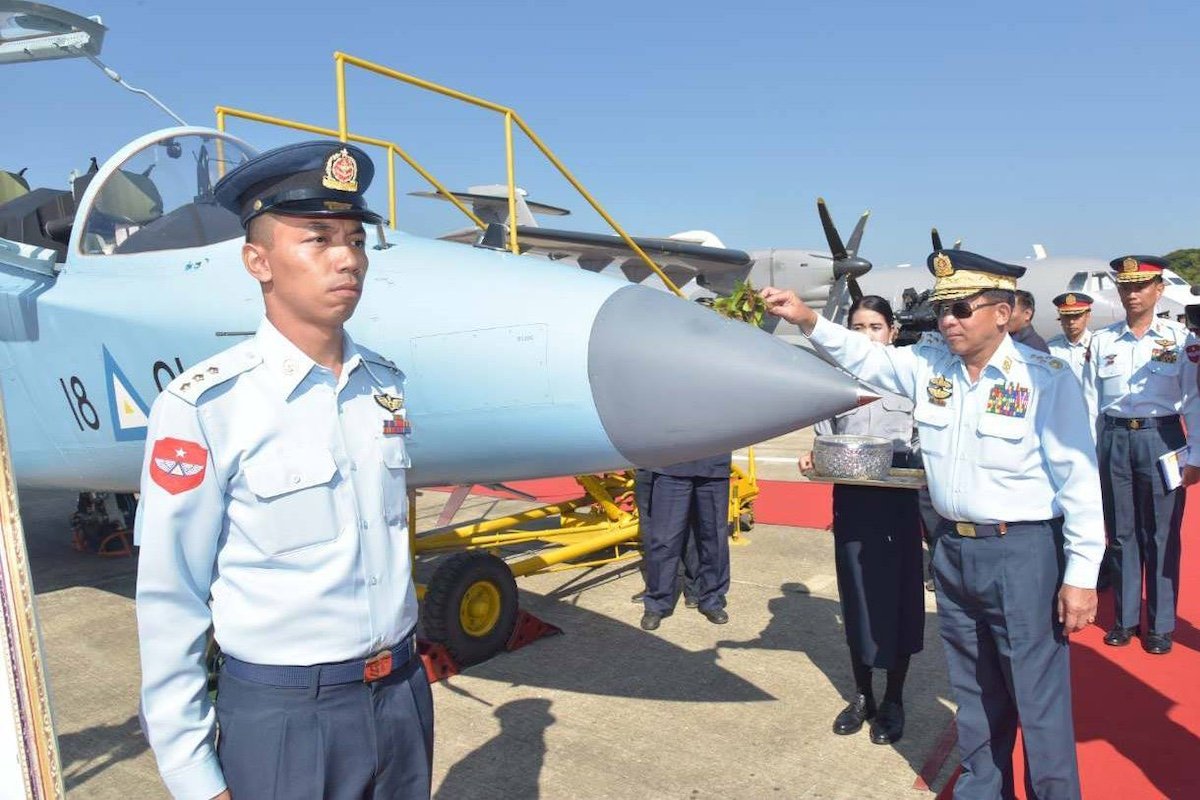
For over five years, Myanmar's military has relied on its air force as its most secure asset. While ground forces have lost bases, towns, and strategic roads to resistance groups, aircraft could always bomb from above and return to heavily fortified airfields. That sense of invulnerability was shaken on September 10, when six first-person-view (FPV) attack drones struck Tada-U Airbase, which shares its runway with Mandalay International Airport.
The National Unity Government (NUG), Myanmar's parallel civilian administration formed after the 2021 coup, said its forces targeted only the military section of the airfield, where aircraft used in bombing operations are stationed. Videos circulating online appeared to show drones heading toward fighter jets inside shelters. The extent of the damage remains disputed, but the attack forced the civilian airport to close. State media claimed all six drones were intercepted "without causing damage or casualties," yet the airport remained closed two days later.
Junta invokes war crimes while bombing civilians
Military authorities accused the resistance of targeting civilian infrastructure and invoked international humanitarian law—even as Myanmar's air force faces growing scrutiny over its own bombing campaign. The Independent Investigative Mechanism for Myanmar (IIMM) reported in August that its investigations revealed a pattern of deliberate aerial attacks on civilians, identifying units and command structures linked to strikes on homes, schools, hospitals, religious buildings, and displacement camps.
A new investigation by Myanmar Witness identified 96 incidents involving children between September 28, 2025, and April 25 this year, amounting to 214 reported child casualties—85 deaths and 129 injuries. Of those, 48 were independently verified using visual evidence. The Myanmar Air Force was the most frequently reported actor, accounting for 61 actor attributions, most involving airstrikes.
A military that has shown no hesitation in bombing children in their homes and schools is now the one invoking the Geneva Conventions and talking about war crimes. That alone is noteworthy.
Asymmetric air war
The Tada-U attack matters for another reason. The air force has become the military's answer to a problem it has faced throughout the post-coup war: how to keep fighting in places its army cannot securely hold. When ground columns stall, aircraft strike ahead of them. When isolated bases need ammunition or reinforcements, helicopters and transport aircraft deliver them. Even after regime troops lose a town, aircraft can continue bombing it. ACLED, an independent conflict-monitoring group, has found that air power remains the military's clearest advantage over resistance groups and is increasingly used ahead of troop advances.
Myanmar's resistance still lacks combat aircraft of its own and has only limited air-defense capability, with some forces relying on heavy machine guns and anti-materiel rifles. The more important change is the use of homemade drones. Resistance units have assembled drones from commercial, often Chinese-made components and locally produced munitions, adapting civilian technology with limited resources.
The military has its own air-defense and counter-drone systems. It operates Russian-supplied Pechora-2M air-defense systems, while the Russian Defense Ministry announced a 2021 agreement to supply Pantsir-S1 systems. The Myanmar Defense & Security Institute (MDSI), a research group established by former military officers who defected after the 2021 coup, has also reported the military's deployment of Chinese-made Skyfend counter-drone systems.
Drones are also changing the fighting on the Irrawaddy River. Beginning in late August, forces led by the Kachin Independence Army (KIA) repeatedly attacked a large military flotilla carrying troops, ammunition, and supplies toward Bhamo, reportedly destroying or damaging much of the convoy. Resistance-released videos circulating online appear to show drones being used against military vessels during the wider river campaign.
Cheap drones have not totally erased the military's conventional advantage. What they have done is give resistance forces new ways to reach expensive assets that were previously mainly untouchable. Aircraft losses have mounted too. MDSI reported in November 2025 that the Myanmar Air Force had lost 20 aircraft and helicopters since the 2021 coup, which it described as the heaviest losses in the force's history. The tally includes losses from different causes, including mechanical failures and aircraft brought down by resistance forces.
Limits of air superiority
The Soviet-Afghan War offers a historical comparison, but only up to a point. Soviet forces enjoyed overwhelming air superiority until US-supplied Stinger missiles gave the Mujahideen a far more effective way to threaten Soviet aviation from 1986, forcing Soviet pilots to change how and where they flew. But Myanmar's resistance has had no such Western arms pipeline.
In Syria, Russian air power helped sustain Bashar al-Assad for years, but it could not save his government when ground forces collapsed in late 2024, and key foreign backing weakened. The Vietnam War demonstrated the same basic limit decades earlier: bombing can impose enormous costs, but aircraft cannot occupy and hold territory.
To be sure, Myanmar is not Afghanistan, Syria, or Vietnam. Its war mixes guerrilla warfare with increasingly conventional battles and territorial campaigns. But aircraft still cannot occupy a town, patrol a road, or administer territory. Soldiers have to do that. Myanmar's military has therefore been conscripting since 2024. By September 2026, state media said the program had reached its 28th training intake, though authorities have never published a cumulative total. The International Institute for Strategic Studies (IISS) estimated the first 16 batches brought in 60,000 to 80,000 men by August 2025, enough to partially rebuild depleted units.
The drone strike on Tada-U is a symbolic and practical blow to the junta's sense of security. It shows that even the sky is no longer a sanctuary. As resistance forces continue to innovate with cheap technology, the military's air advantage—once its most reliable tool—is becoming increasingly contested. The broader implications for the conflict are significant, as the junta's ability to project power from above is now under direct threat.