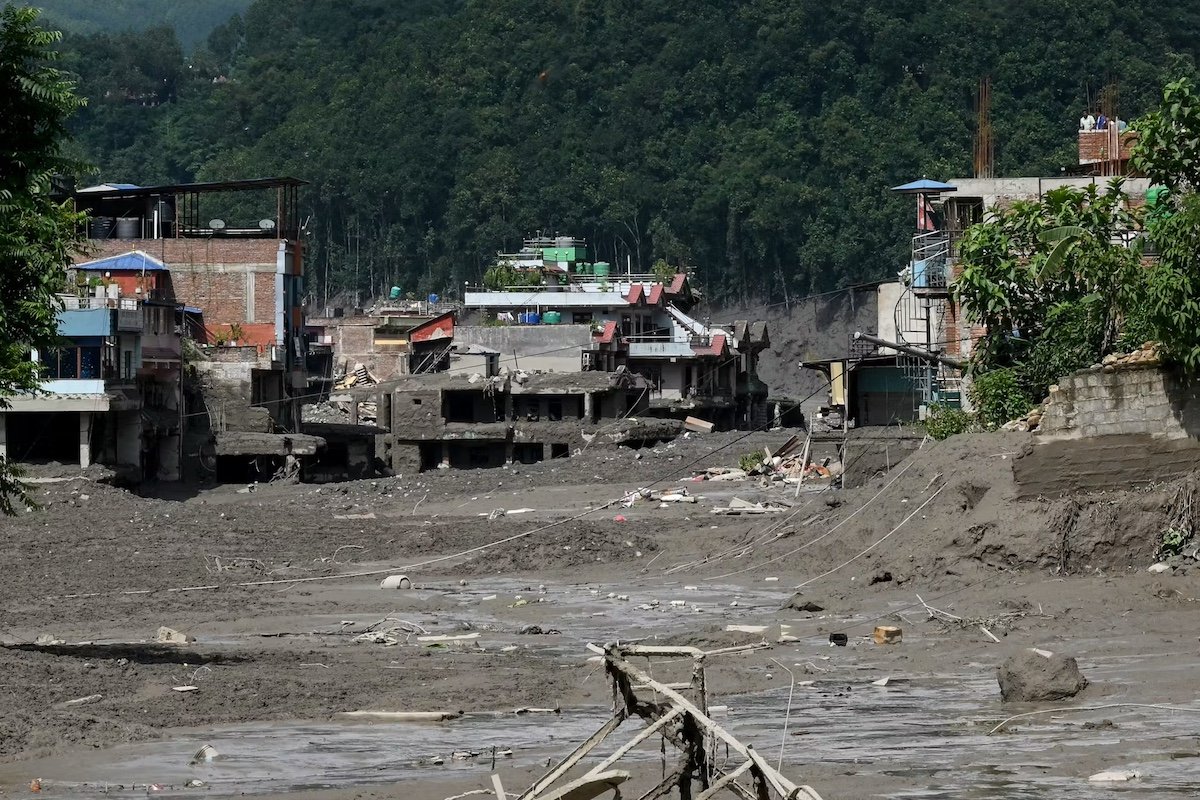
More than 150 people are dead and hundreds remain missing after a colossal wave of water, ice, mud, and rock tore through the Bhote Koshi River valley in Nepal. The valley, a vital artery connecting Kathmandu to Lhasa in Tibet, was hit with little warning, leaving communities from remote mountain settlements to border towns in chaos. At least 34 Australians are among the missing, underscoring the international reach of this tragedy.
The event unfolded with terrifying speed. Footage shows a churning, debris-laden wall of water and sediment surging downstream, engulfing bridges, roads, and buildings. The sheer force of the flow was so immense that it registered as a 4.4 magnitude seismic event on seismographs, initially leading experts to mistake it for an earthquake.
Early analysis points to a sudden collapse of a glacier as the trigger. Satellite imagery suggests a massive ice-and-rock landslide swept down a mountain pass, gathering ice, water, rock, trees, and dirt as it descended. By the time it reached Gyirong Port, a China-Nepal border crossing, the wall of debris resembled a tsunami of dirt, with early estimates suggesting it may have been 30 metres high.
Why the Himalayas are increasingly vulnerable
The Himalayas, often called the world's 'third pole' for their vast stores of snow and ice, are warming at an alarming rate. Unlike glaciers in lower elevations, these high-altitude giants are particularly sensitive to rising temperatures. The steep slopes of these towering peaks are largely composed of permafrost—rock and soil that have remained frozen for centuries. As temperatures climb, this permafrost begins to thaw, destabilising the slopes and making them more prone to landslides and rockfalls.
This disaster is not an isolated incident. Last year, a smaller flood in the same district killed nine people. In Switzerland, a melting glacier triggered a massive debris flow that destroyed the village of Blatten, though early warning systems allowed for evacuations and prevented casualties. In 2023, a landslide and subsequent flood in Georgia killed 33 people at a mountain resort. But the scale of the Nepalese event marks it as one of the largest such disasters in recent memory.
While it is too early to definitively attribute this specific collapse to climate change, the broader trend is clear. Glaciers worldwide are retreating, and as they do, the risk of catastrophic floods and debris flows increases. The question is no longer whether these events will happen, but how often and how severe they will become.
Can such disasters be prevented?
The Swiss example offers a glimmer of hope. Early warning systems, which monitor river levels, seismic activity, and weather patterns, can provide crucial lead time for evacuations. In Nepal, the Green Climate Fund announced funding last year for better monitoring systems, a positive step. However, installing and maintaining these systems requires significant investment, a challenge for lower-income countries already stretched thin.
Beyond the immediate humanitarian crisis, there are long-term implications. The meltwater from Himalayan glaciers feeds rivers that sustain billions of people across Nepal, Pakistan, India, and China. As glaciers shrink, river flows may initially increase, raising flood risks, but eventually decline, leading to water scarcity, particularly during dry seasons. This looming water crisis adds another layer of urgency to global efforts to reduce greenhouse gas emissions and invest in adaptation measures.
For now, the focus remains on search and rescue operations in Nepal, as families await news of loved ones. But the broader lesson is inescapable: the world's 'third pole' is melting, and the consequences are arriving faster than many anticipated.