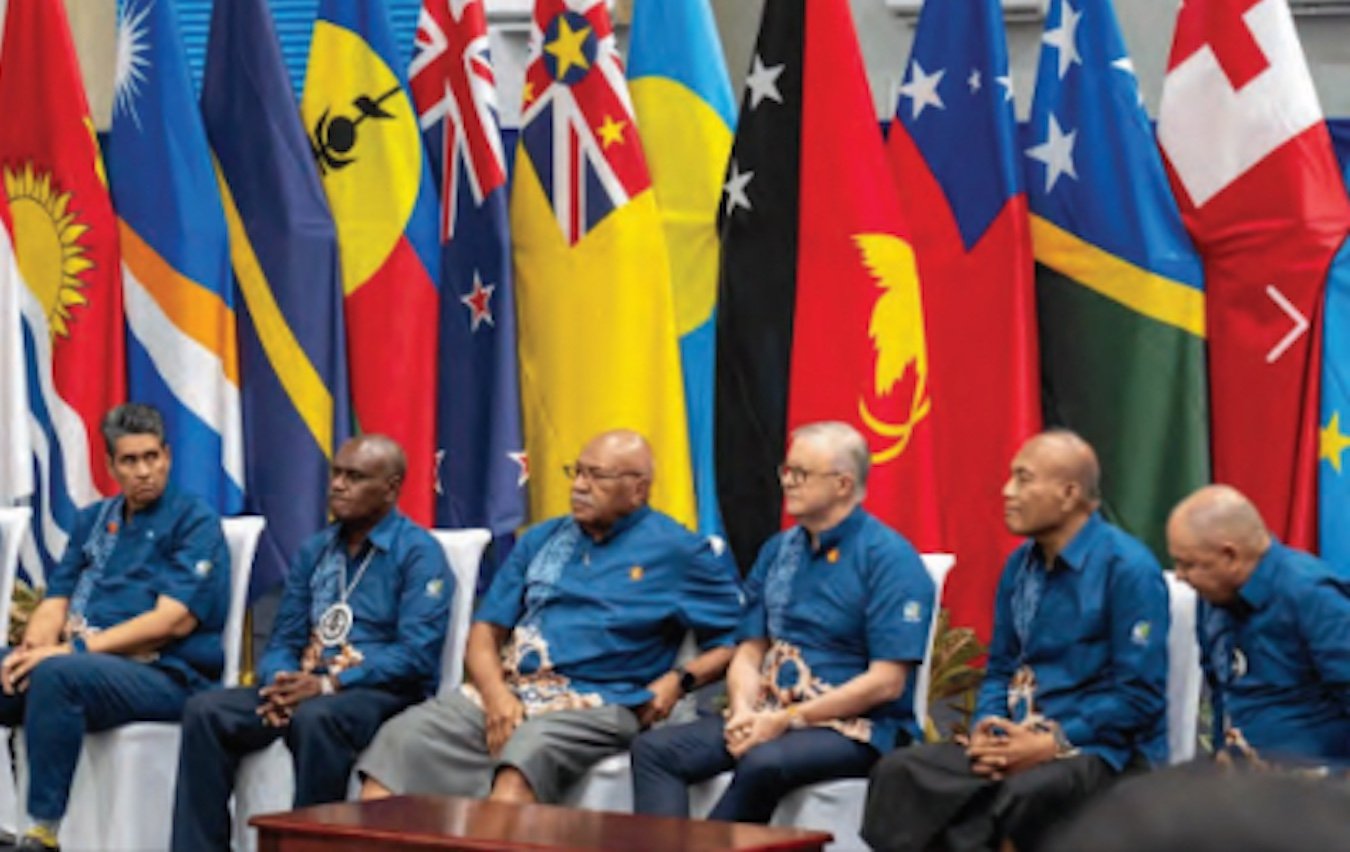
The phrase “Ocean of Peace” has been floated by a handful of Pacific Island leaders as a vision for a region free from great-power rivalry. It evokes a certain idealism, but as a practical security framework, it remains little more than a bumper sticker.
Fijian Prime Minister Sitiveni Rabuka is credited with coining the term in 2023, and it was adopted at the Pacific Islands Forum (PIF) meeting in the Solomon Islands in 2025. Yet the Pacific is vast and diverse, home to sovereign nations with distinct interests. The region has never been uniformly peaceful—historical tensions, such as those between Fiji and Tonga, are a reminder that conflict is not alien to the Pacific.
Recent events underscore the gap between rhetoric and reality. At the PIF meeting in Palau in late August, leaders could not agree on a statement condemning a Chinese missile test in the region. Six leaders were absent, and the final communiqué only expressed “concern” without naming China. Nauru opposed the statement entirely, and Kiribati skipped the discussion. Both nations are under significant pressure from Beijing.
Beyond the great-power rivalry frame
The usual narrative pits China and the United States as rival powers using the Pacific as a staging ground. But this framing misses a crucial asymmetry. There is little evidence of American coercion or instability in the region. In contrast, China’s actions—from economic pressure to political interference—are well documented.
For instance, China has repeatedly used tourism boycotts to pressure Palau’s economy, and there are reports of threats against President Surangel Whipps Jr. and his family over Taiwan’s participation in the PIF. Chinese organized crime and corruption have also spread across the region, undermining local institutions. Former Federated States of Micronesia President David Panuelo’s public letters detail a pattern of subversion, and the US-China Economic and Security Review Commission’s 2025 report provides further examples.
This is not a rivalry between equals; it is a concerted effort by one nation to dominate the democratic and economic institutions of many others.
Agency and security realities
Some argue that Pacific Island nations are losing agency, becoming pawns in a larger game. But this overlooks the fact that these nations have the right to shape their own security arrangements. The Compact of Free Association agreements with the United States, for example, allow Palau, the Federated States of Micronesia, and the Marshall Islands to regulate US military activities on their soil. Similarly, Australia and New Zealand operate in the region with the consent of local governments.
The idea that the Pacific would be peaceful if only external powers left is naive. Without some military capability, fish stocks would be plundered, and transnational crime would flourish. The question is not whether to have security partnerships, but with whom.
Pacific leaders are capable of making these choices. They have agency, and they can decide which partners align with their values. The United States, Australia, and New Zealand are democracies that respect law and human rights. China’s record in the region is markedly different.
The “Ocean of Peace” is a noble aspiration, but it cannot substitute for a realistic security strategy. As long as coercion and division persist, the Pacific will remain a region of contested interests, not a haven of tranquility.