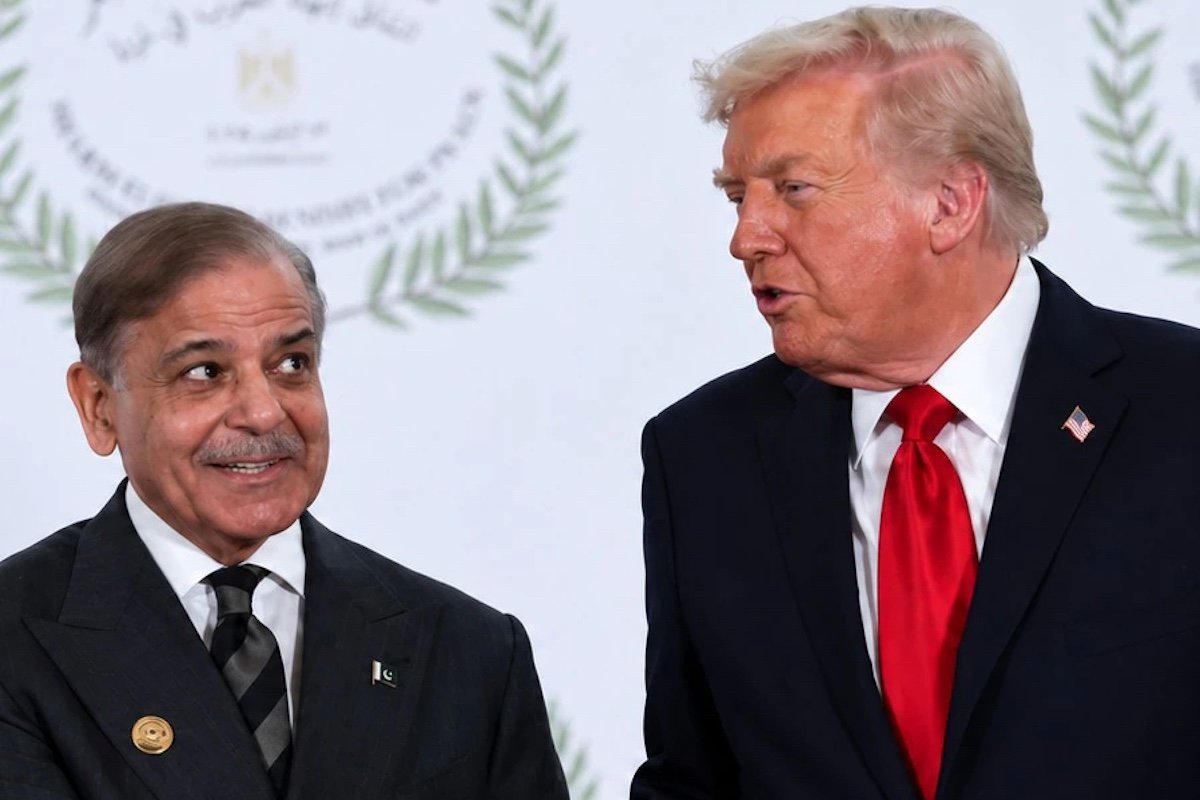
Islamabad's courtship of Donald Trump has been nothing if not thorough. From cryptocurrency overtures tied to the Trump family to showcasing rare-earth minerals in the Oval Office, Pakistan's military-aligned civilian government has tried every lever of transactional diplomacy. Prime Minister Shehbaz Sharif has heaped praise on Trump at every opportunity—on Iran, Gaza, and global security—while the army chief, Field Marshal Asim Munir, has been celebrated by Trump as his “favorite field marshal.” Yet for all the effort, the returns have been largely symbolic.
A costly lobbying blitz
Pakistan committed nearly $5 million to six Washington lobbying firms, including a $200,000-per-month contract with Seiden Law, which subcontracted Javelin Advisors—a firm co-founded by former Trump Organization executive George Sorial and Keith Schiller, Trump's ex-bodyguard and Oval Office operations director. A parallel deal with Orchid Advisors, which brought in Squire Patton Boggs, also aimed at the administration's inner circle. In May 2026, the embassy signed a new $1.2 million multi-year contract with Ervin Graves Strategy Group, led by former Republican Congressman Tom Graves, to push Islamabad's narrative at the Pentagon and on Capitol Hill.
For a country that depends on IMF bailouts and faces recurring economic crises, such spending raises uncomfortable questions about priorities. The government's willingness to divert scarce resources to buy influence in Washington suggests a belief that personal access can substitute for structural reform.
Mineral deals and crypto gambits
The cryptocurrency angle was particularly striking. In January 2026, Pakistan's finance ministry signed a memorandum of understanding with SC Financial Technologies, an affiliate of the Trump family's World Liberty Financial, to develop a dollar-linked stablecoin for cross-border payments. Meanwhile, the military's Frontier Works Organization (FWO) inked a $500 million critical-minerals framework with Missouri-based U.S. Strategic Metals, following a high-profile Oval Office meeting where Pakistani leaders presented raw mineral samples to Trump.
Defense ties also got a transactional gloss. In September 2026, Munir finalized a procurement and joint-technology MoU with Powerus, an American autonomous systems company backed by Donald Trump Jr. and Eric Trump through a 9.9% stake held by American Ventures. These moves were designed to signal alignment with Trump's business-oriented foreign policy.
Symbolic gains, strategic emptiness
What has Pakistan actually received? Trump's public praise of Munir—repeated at the October 2025 Sharm el-Sheikh Peace Summit—boosted the army chief's domestic standing and helped deflect criticism over the imprisonment of former Prime Minister Imran Khan and the military's growing political dominance. The government has used these moments to justify the constitutional centralization of power under Munir, who was elevated to field marshal in May 2025 and appointed the country's first chief of defense forces under the 27th Amendment.
But beyond flattery, there has been no financial rescue package, no major investment, no strategic breakthrough. Pakistan's prominence in Washington remains a mirage—a transactional mirage that yields little of substance.
India's contrasting resilience
India's strategic partnership with the United States tells a different story. Even when relations were strained under Trump—particularly when he lent some support to Pakistan's narrative around Operation Sindoor—the broader relationship held. In October 2025, the two countries signed a new 10-year defense cooperation framework. Technological collaboration advanced through initiatives like TRUST, covering AI, semiconductors, and critical technologies.
American companies have poured over $67.5 billion into India's tech and infrastructure. Google committed $15 billion for a gigawatt-scale AI data center hub, Amazon Web Services pledged $35 billion for cloud infrastructure, and Micron Technology operationalized a $2.75 billion semiconductor assembly and test facility in Gujarat, Prime Minister Narendra Modi's home state.
The contrast is instructive. India's ties with Washington are built on institutional depth and mutual strategic interest, not on personal chemistry or transactional favors. Pakistan's approach, by contrast, has been to bet everything on one man—and that bet is not paying off.
As Trump's second term enters its final stretch, Islamabad may find that its investment in access has produced little more than a photo opportunity. The midterm rebuke that reshaped Trump's political standing has also made clear that personal diplomacy is a fragile foundation for national interest. For Pakistan, the mirage of transactional influence is fading, leaving behind a costly lesson in the limits of flattery.