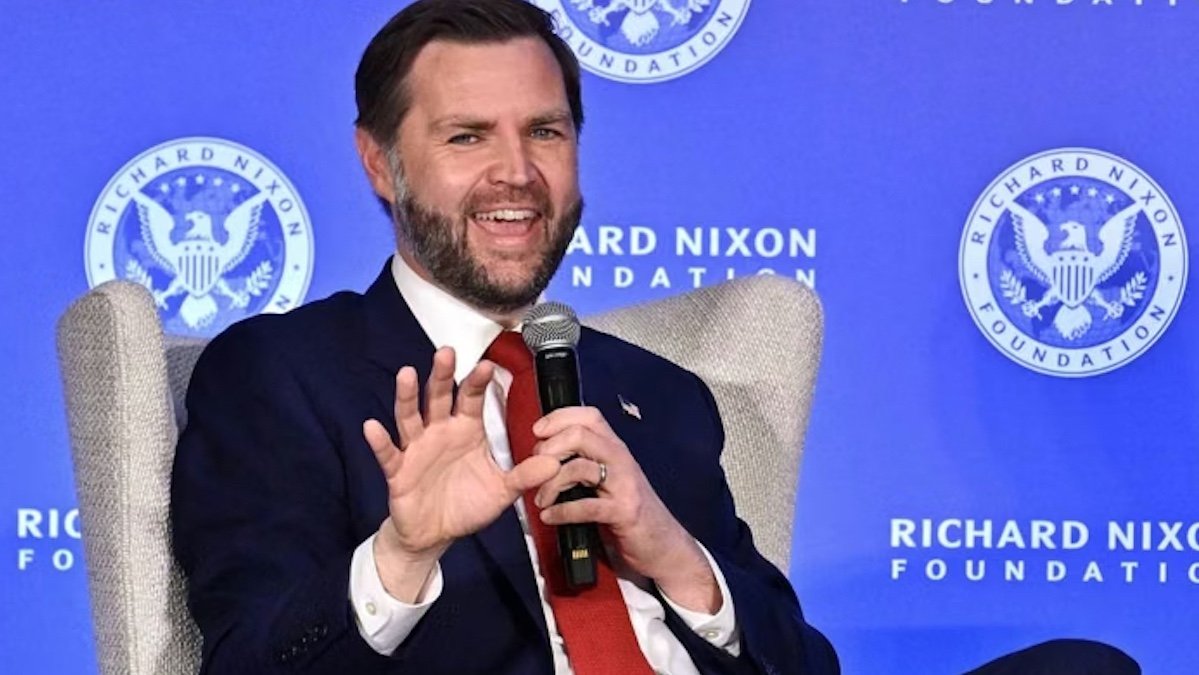
In the wake of the Republican Party's significant losses in the US midterm elections, Vice President JD Vance issued a lengthy statement on X that many have interpreted as a rare admission of failure or even a subtle rebuke of President Donald Trump. Vance offered a seemingly candid explanation for why voters had turned away, citing a pollster's findings on what might bring disillusioned Trump 2024 voters back into the fold. The top four responses: end the war, focus on cost of living and inflation, put America First, and change the relationship with Israel.
While Vance's remarks have stirred controversy within the GOP, the implications and the speed of his response warrant closer examination. Acknowledging that an unpopular war on Iran, economic insecurity, and unwavering support for Israel have alienated voters is hardly revelatory. Yet it is striking how readily Vance, a key architect of these very policies, has identified them, and how quickly this is being framed as political introspection or a break from Trump.
At first glance, Vance's statement appears to be an exercise in democratic humility. He claims to be "shocked" and eager for an "honest conversation" about the party's future, inviting voters to explain where the GOP went wrong. He writes as though Republican voters might actually be included in shaping the party's direction: "I remain hopeful about our country. To the people who are pissed off and want to say, 'I told you so,' you're right, you did tell us so. Take that energy into electing Republicans who share your worldview."
The performance would be more convincing if Vance were not the vice president of the administration he is now diagnosing, and a well-established political puppet of the PayPal Mafia. His political ascent has been financed and cultivated by Silicon Valley's billionaire class, whose interests increasingly depend on the expansion of the American war machine, the privatization of state power, and the accumulation of private wealth at the expense of public services. Most infamously, Peter Thiel was Vance's employer, mentor, and principal patron.
It is almost too obvious to point out the absurdity of a man explaining to voters what went wrong when he is himself an instrument of the very oligarchs using the executive branch to secure lucrative markets for their data and AI infrastructure, and the development and deployment of autonomous weapons systems. Their fortunes are tied to the expansion of state violence and surveillance at home and abroad. They are the vanguard of a class exploiting public resources, evading taxation, and extracting billions in government contracts.
But exposing Vance's hypocrisy, or reading his statement as a thinly veiled repudiation of Trump, misses the more consequential calculation. Vance is not reconsidering the politics that produced the administration's failures. Rather, he is signaling how the interests that control him intend to recover the political ground they have lost. This is a strategic recalibration, not a change of heart.
Repositioning for 2028 and beyond
Vance's 2028 ambitions offer a window into this recalibration. His ideological moderation signals no shift in political direction, but rather a more sophisticated effort to reposition the Republican Party without relinquishing its underlying commitments. Vance and his backers understand that reclaiming their political appeal requires more than simply appropriating the language of popular demands. The longer-term objective is to accommodate popular discontent rhetorically while severing it from the structural changes necessary to address its underlying causes.
The Republican establishment does not need to defeat anti-war politics if it can detach opposition to a particular war from opposition to American imperialism. It does not need to defeat economic populism if it can detach economic discontent from a critique of corporate ownership and concentrated wealth—narrowing the narrative to prices at the pump or the cost of groceries. Nor does it need to abandon its relationship with Israel if it can present a revised relationship—including through changes to the National Defense Authorization Act—as evidence that it has listened to voters, without challenging the military and financial arrangements that sustain Israeli occupation of Palestine and its broader expansionist project.
The grievances can be acknowledged, the language adopted, and the constituencies courted, all without altering the fundamental structures of power. This is a classic maneuver of a ruling class that has suffered an electoral setback but retains its grip on the levers of state and capital.
For Asia, this matters. The US midterm results and the administration's response have direct implications for the Indo-Pacific. As Iran war costs Republicans the US midterms, the administration's focus may shift, but the underlying militarism and economic priorities remain. The midterm rebuke leaves Trump cornered and dangerous on Iran, and by extension, on other fronts. The Democrats' plans to check Trump's Iran war could also shape the broader regional calculus.
Vance's statement is not a genuine opening to voters; it is a calculated move to co-opt their anger and redirect it into the same channels of power. The real test will be whether the administration's actions match its rhetoric, and whether the Indo-Pacific sees a genuine shift in US policy or merely a repackaging of the same imperial agenda.