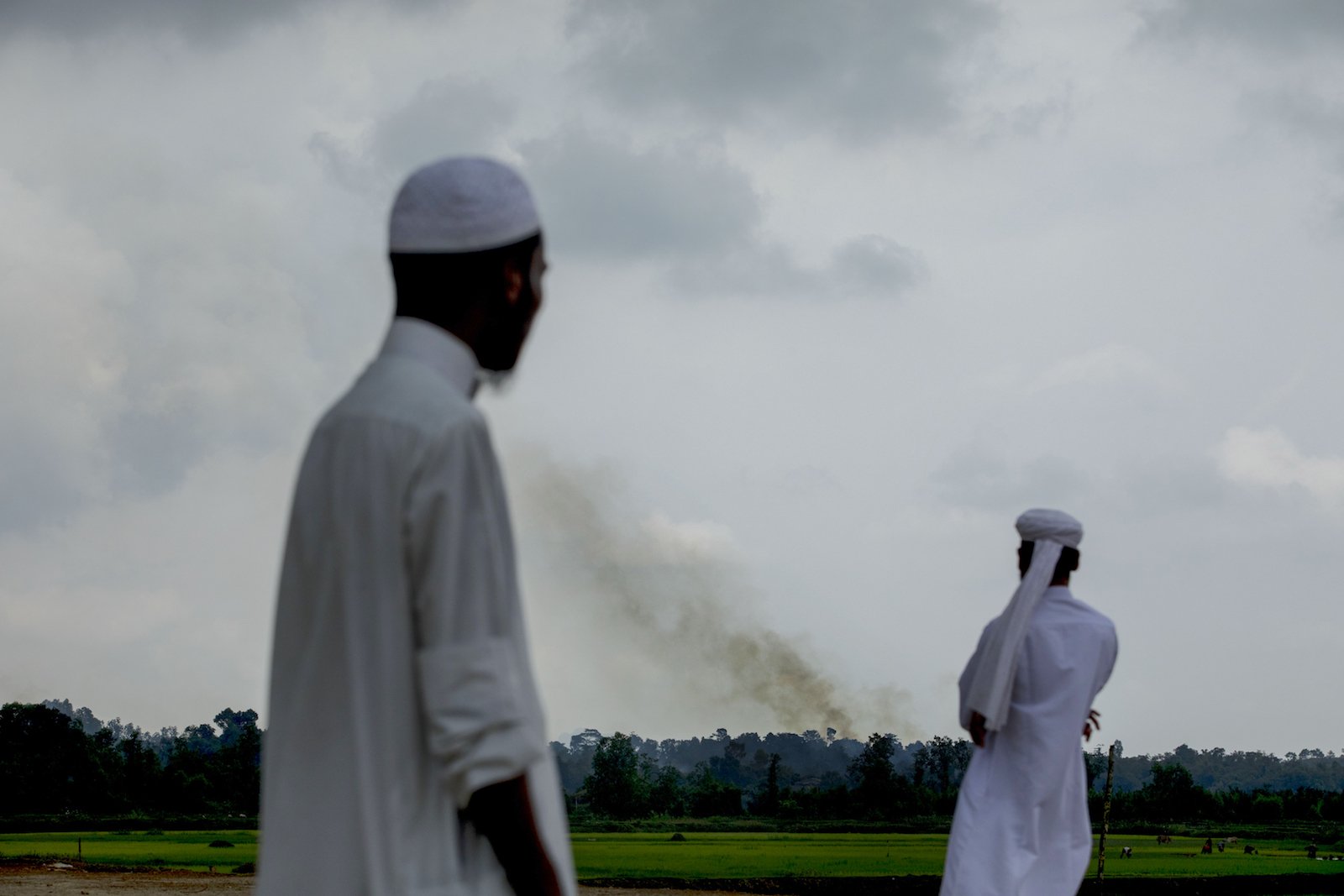
For nearly a decade, Myanmar's military leadership has repeated a single narrative: that the 2017 operations in northern Rakhine State were a legitimate counterinsurgency campaign against terrorists. On November 19, that defense collapsed at the International Court of Justice (ICJ) in The Hague.
In a landmark ruling, the court found by nine votes to six that Myanmar committed genocide against the Rohingya—the first such judgment against a state in the ICJ's history. The judges acknowledged that the Arakan Rohingya Salvation Army (ARSA) had attacked security posts, but concluded that the mass killing of civilians, widespread rape, violence against children, and the systematic destruction of Rohingya villages could not be explained as mere counterinsurgency.
The court ordered Myanmar to facilitate the safe, voluntary, and dignified return of displaced Rohingya, restore or replace their property, and compensate victims for irreparable losses. The ruling binds Myanmar as a state, but the practical question of implementation now rests with a different authority.
The Arakan Army's moment
Min Aung Hlaing, who commanded the military during the atrocities and now serves as president, leads a government that dismissed the verdict as unfair, citing the six dissenting judges. Its foreign ministry still refers to the Rohingya pejoratively as “Bengalis.” The generals want the world to focus on the dissent while refusing to acknowledge the identity of the people they persecuted.
But the judgment raises a more immediate question: who can actually put the court's orders into practice in the territory where Rohingya families once lived? The answer increasingly lies with the Arakan Army (AA), a predominantly ethnic Rakhine armed group whose political wing, the United League of Arakan (ULA), now governs most of Rakhine State.
The AA's leader, Twan Mrat Naing, has spoken in favor of Rohingya return since 2022. In 2024, he supported safe and voluntary repatriation in principle, and as recently as May 2026 he mentioned creating conditions for their return. Yet the harder issues—security guarantees, property restitution, and equal rights—remain unresolved. The ICJ judgment gives the AA an opportunity to prove it can deliver on its words.
A history of distrust
Myanmar's military has long exploited distrust between Rakhine Buddhists and Rohingya Muslims, portraying an entire community as a security threat and framing attacks on civilians as defense of race, religion, and motherland. The ICJ considered decades of discriminatory laws and anti-Rohingya hate speech when assessing evidence of genocidal intent.
That playbook survived the 2021 coup. The military forcibly recruited Rohingya men to fight the AA, while Rohingya armed groups, including ARSA and the Rohingya Solidarity Organization, have clashed with the AA, deepening communal scars. Ordinary civilians on both sides continue to suffer.
But the military no longer controls most of the territory where the 2017 atrocities occurred. The AA holds 14 of Rakhine's 17 townships, including Maungdaw and Buthidaung, and controls the border with Bangladesh. The ICJ ruling binds Myanmar as a state, not the AA, but any meaningful repatriation and restitution will require cooperation from those governing the land.
Words vs. deeds
The AA is a relative newcomer to governing such a large and diverse population. It did not conduct the military's 2017 clearance operations, which gives it a chance to learn from the generals' record—but no immunity for its own actions. After the verdict, AA spokesperson Khaing Thukha told Burmese media that the group stood for “truth and justice” and would act in Rakhine's interests, but offered no concrete steps on repatriation or accountability.
There have been some encouraging developments. The ULA/AA administration has brought Muslim residents into local administrative and advisory roles, and a historic mosque in Maungdaw reopened in September 2025 after years of closure. But such steps do not amount to equal rights.
The UN Human Rights Office has reported serious abuses against Rohingya under AA control, including arbitrary detention, forced recruitment, sexual violence, and seizure of property. Rights organizations have also accused AA forces of attacking Rohingya civilians. The AA has denied these allegations. If it rejects the accusations, it should welcome credible, independent investigations. Denial alone will not satisfy the Rohingya or the international community.
Another test concerns identity. The AA has generally preferred to call Rohingya “Muslims,” while some leaders have also used “Bengali,” rather than consistently recognizing the community's chosen name. Acknowledging the Rohingya name would not settle the citizenship question, but refusing it repeats an exclusionary practice that helped make this crisis so entrenched.
The AA wants recognition as Rakhine's legitimate governing authority. Military victories alone cannot secure that recognition. It must demonstrate that Rakhine Buddhists, Rohingya, and other minorities can live under its administration without discrimination or fear.
The international community should stop treating Naypyitaw as the only authority capable of addressing the Rohingya crisis. Bangladesh has confirmed contacts with both the military-backed government and the AA over repatriation. On November 20, a Bangladeshi state minister told Reuters that Dhaka hoped to secure a path to return for the refugees. The ICJ ruling has shifted the focus to Rakhine's new power holders—and the world is watching whether they can rise to the challenge.