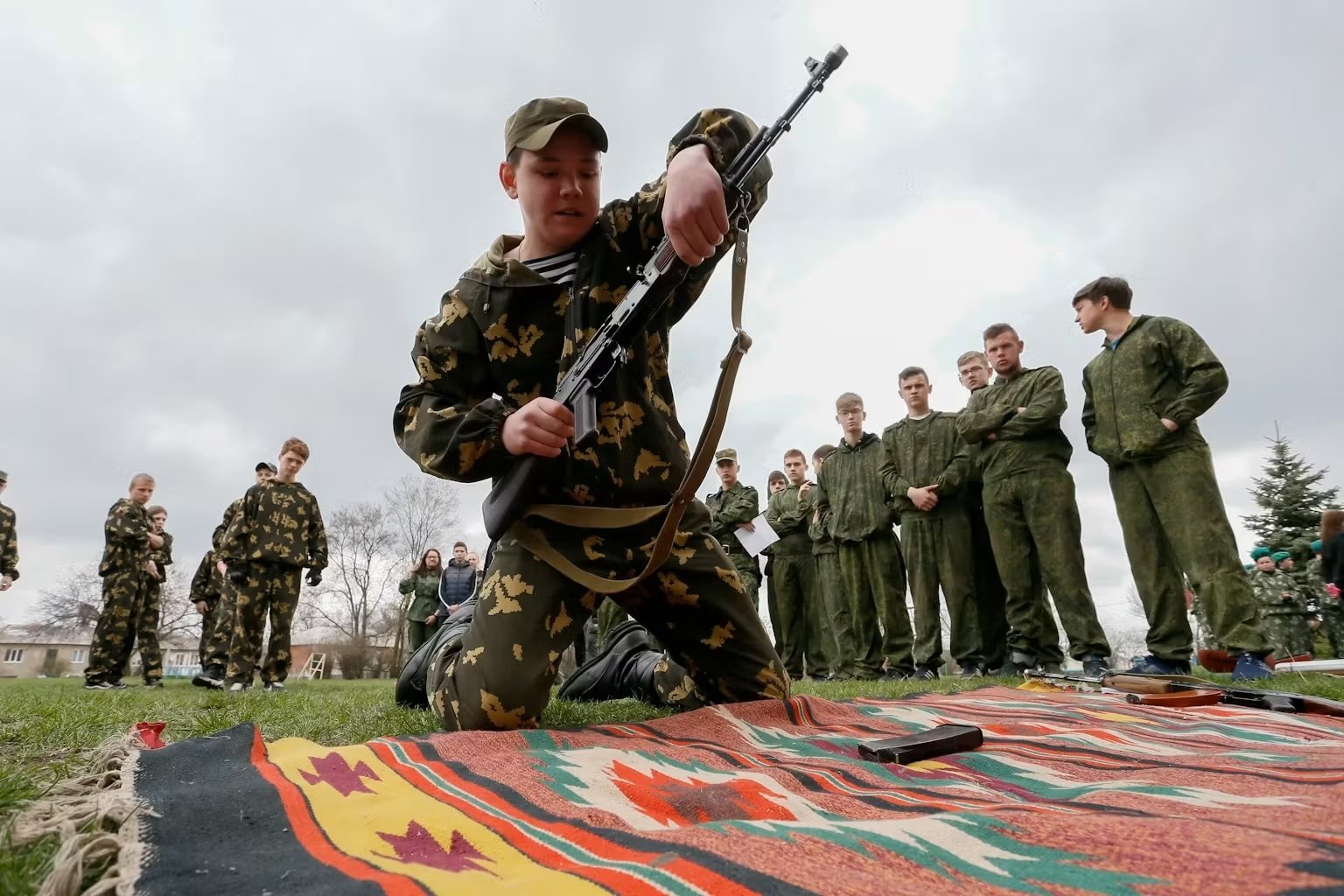
When the OSCE tasked us with investigating Russia's indoctrination and militarization of children in the Ukrainian territories it has occupied since 2014, we thought we understood the Kremlin's playbook. Two of us grew up under Soviet occupation in Latvia and East Germany, and we recognized the familiar patterns of ideological "upbringing." But what we found in Ukraine still shocked us.
Our mission, the sixth established by the Organization for Security and Co-operation in Europe (OSCE) since 2022 to probe human rights abuses linked to Russia's full-scale invasion, focused specifically on children. The first such mission had examined their forcible transfer to Russia. Our task was to assess whether Moscow's conduct violates international law, including the Geneva Conventions and the Convention on the Rights of the Child.
Over three weeks, we gathered and analyzed a vast array of evidence: reports from the United Nations, the OSCE, the Council of Europe, and the European Union, as well as testimonies from young adults who had lived through the occupation and from teachers who had escaped to Ukrainian-controlled territory. In Kyiv, we interviewed Ukrainian government officials and civil society groups. Our findings, presented to the OSCE Permanent Council on July 9, are deeply troubling.
Coercion and the Conscription Pipeline
One written testimony described how a school headteacher, flanked by heavily armed soldiers, went door-to-door to pressure parents who had not sent their children to school or applied for Russian passports. The headteacher threatened to strip them of parental rights and place their children in state institutions. Faced with such intimidation, the parents capitulated. This case, far from isolated, illustrates the level of coercion applied to entire families and the collaboration among Russian state agencies.
Forced passportization is a key element of what we call the "conscription pipeline." By compelling Ukrainian children to take Russian citizenship, Moscow makes them eligible for conscription at age 18. Evidence shows that many are not merely doing routine service; they are being sent to the front lines, where several have died.
The indoctrination begins in schools. Ukrainian is banned in education and severely restricted in public life. Children are taught under the Russian state curriculum, which includes extensive historical falsification. The Grade 11 history textbook devotes 29 pages to the so-called "special military operation," framing the invasion as a defensive response to Western aggression. Versions for lower grades have been used across occupied territories since the 2025-26 academic year. Amnesty International has called this "a blatant attempt to unlawfully indoctrinate school children."
Militarization is equally systematic. Since the 2023-24 academic year, a compulsory course called "Fundamentals of Security and Defense of the Motherland" has been introduced in all occupied schools. According to the UN, it includes 170 hours of military training covering grenades, small arms, anti-tank launchers, and sniper rifles.
The Kremlin has also revived Soviet-era youth programs. The Movement of the First, created by Vladimir Putin in December 2022, has rolled out a military war game across occupied territories since 2024. Children are divided into armies, trained in assembling weapons, operating drones, acting as "storm troopers," and completing tactical obstacle courses. They also practice cyber warfare and information operations. The Institute for the Study of War describes this as part of "a wider Russian ecosystem operating throughout occupied Ukraine with the explicit purpose of militarizing Ukrainian children, indoctrinating them against their Ukrainian identities and training them to fight for the Russian military."
Russia does not deny these practices. Senior officials have openly justified the indoctrination, framing it as patriotic education. But the international community must recognize this for what it is: a systematic violation of children's rights and a cynical strategy to turn a captive population into cannon fodder. The implications extend beyond Ukraine, as Moscow's tactics in occupied territories echo its broader efforts to reshape regional security dynamics, including its growing military cooperation with North Korea and its energy leverage over Europe. The OSCE's report is a stark reminder that the war in Ukraine is not just a territorial conflict but a battle over the future of a generation.