As the war in Ukraine grinds on, Russia is scrambling to replace the battlefield connectivity it lost when Elon Musk's Starlink cut off Russian forces in early February 2026. The answer, Moscow hopes, lies in a new satellite constellation called Rassvet-3 ("Dawn"), developed not by the state but by private Russian technology firms. The project underscores a broader shift: private capital and engineering are now driving Russia's most ambitious military tech programs.
From mesh networks to satellites
After Starlink access was blocked—via a combination of geofencing and terminal whitelisting—Russian forces initially turned to mesh networks. These link drones and ground nodes to create ad-hoc broadband connections, often using frequency-hopping spread spectrum in the 1.3–1.5 GHz band. But mesh networks have serious drawbacks: limited coverage, latency that can be fatal when guiding a suicide drone, and a constant transmission signature that makes them easy to jam or destroy.
Starlink, by contrast, relies on more than 10,000 satellites in low Earth orbit, delivering latency of just 20–50 milliseconds and using laser inter-satellite links that are nearly impossible to jam. Ukraine's frontline forces depend on it for everything from live drone video to encrypted command coordination. Without a comparable system, Russia's tactical edge erodes.
Rassvet-3: a private-sector answer
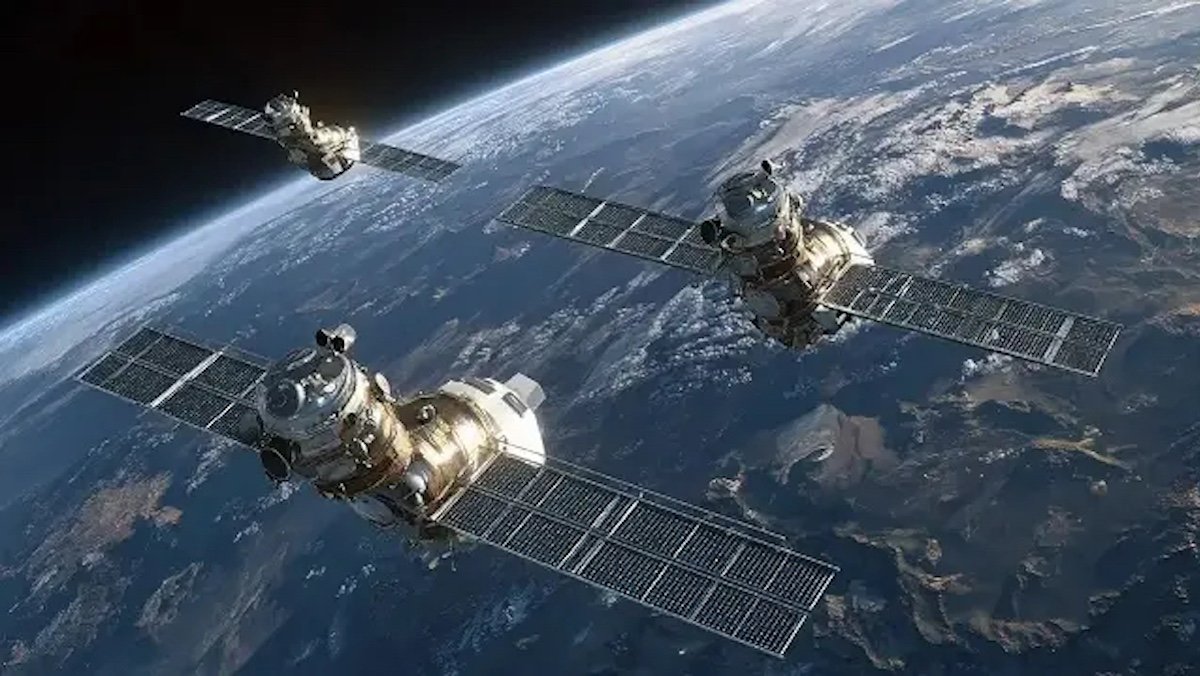
Rassvet-3 is the Kremlin's answer. Developed by Bureau 1440, a subsidiary of the Yadro technology group under IKS Holding, the system uses Ka and Ku bands and supports inter-satellite laser communications, with test speeds up to 10 Gbit/s. It also supports 5G NTN standards for direct satellite-to-cellular connectivity, enabling encrypted military data relay and drone command links.
The project is a financial hybrid. IKS Holding is funding roughly 329 billion rubles (about US$4 billion) from its own commercial capital and private credit lines. MegaFon seeded the project in 2020 with 6 billion rubles, and VTB Group acquired a 15% stake in 2021. The federal government has committed another 102.8–116 billion rubles through its "Data Economy" roadmap, subsidizing launch vehicles, frequency licensing, and terminal manufacturing infrastructure.
This public-private partnership is notable. It allows Moscow to pursue a high-priority defense program without fully nationalizing the effort, and it taps into commercial expertise that state agencies often lack. But it also creates vulnerabilities: many terminal components are sourced from China as commercial off-the-shelf parts, and production capacity remains a bottleneck.
Coverage gaps and production hurdles
As of now, Rassvet-3 has only 12–15 satellites in orbit, providing just two to three communication windows per day over Ukraine, each lasting 1–1.5 hours. That is enough for testing but far from sufficient for tactical needs. Russia launched another 16 satellites on July 19, but details remain scarce. The goal is 156 satellites by the end of 2026—still a fraction of Starlink's constellation.
Terminal manufacturing is another challenge. Bureau 1440 is tasked with producing portable ground terminals, but sourcing components from China could delay deployment. The project's success hinges on scaling production quickly, a task that has historically tripped up Russian defense programs.
Despite these hurdles, Rassvet-3 represents a significant step. It is Russia's first serious attempt to build a Starlink-like capability, and its private-sector backing marks a departure from traditional state-run military projects. Whether it can deliver on the battlefield remains to be seen, but the effort signals a new era in Russian military innovation—one where private firms, not just the state, are leading the charge.
For Ukraine, the stakes are clear. If Rassvet-3 matures, it could level the connectivity playing field. But for now, the system's limited coverage means Ukrainian forces retain a critical advantage in command and control. As Russia races to close the gap, the war's technological front is becoming as important as the physical one.