Russia is making a renewed push to sell its latest conventional submarine to Asian navies, but the effort confronts a web of obstacles including Western sanctions, shifting alliances, and fierce competition from European and Asian shipbuilders.
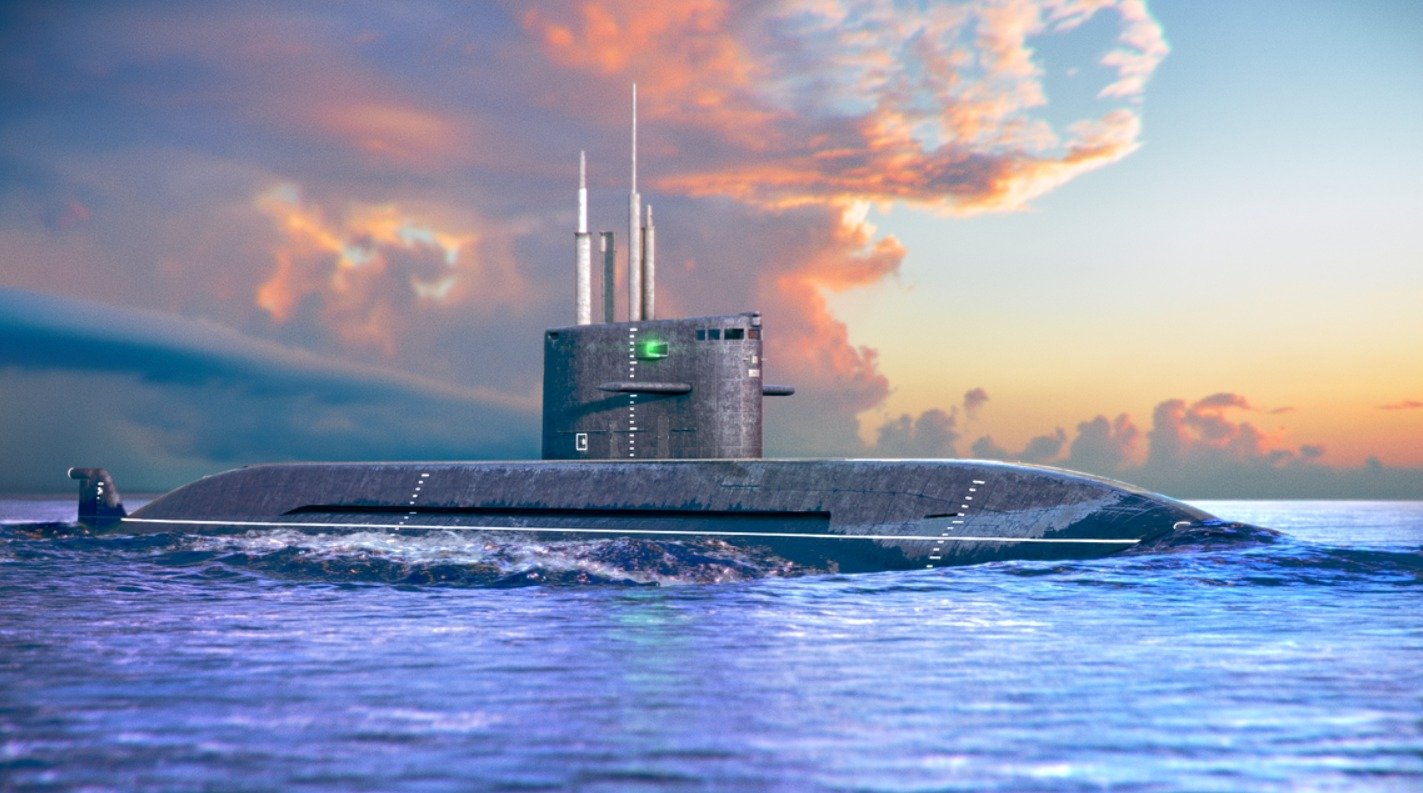
At the Fleet 2026 defense exposition, Russia's United Shipbuilding Corporation presented a new variant of the Amur-1650, a 1,765-ton non-nuclear attack submarine equipped with vertical launch systems for supersonic BrahMos or Club-S cruise missiles. Designed by the Rubin Design Bureau, the platform can optionally include air-independent propulsion (AIP) for submerged endurance of up to 45 days. This capability allows smaller navies to field long-range precision strike weapons typically reserved for nuclear-powered fleets.
The Amur-1650 employs a variable-speed permanent-magnet synchronous electric motor that reduces acoustic signatures by half while doubling passive detection ranges compared to rival export models. Its automated combat management system can carry 28 weapons and execute rapid, multi-axis salvo launches, compressing enemy air-defense reaction times.
India: A Key but Uncertain Customer
India remains Russia's most plausible buyer for the Amur-1650. According to a March 2026 report from the Stockholm International Peace Research Institute (SIPRI), Russia supplied 48% of its total arms exports to India, which accounted for 40% of India's imports between 2021 and 2025. The Indian Navy faces a severe undersea capability gap after decommissioning INS Sindhughosh in December 2025, leaving only 16 aging conventional submarines. Araudra Singh of the Observer Research Foundation (ORF) noted in February 2026 that decades of procurement delays have pushed the advanced Project-75I submarines to 2035, when much of the current fleet will be retired. This structural deficit undermines India's regional maritime superiority and sea-denial capabilities.
Pakistan's acquisition of four China-built, AIP-equipped Hangor-class submarines adds urgency. India needs advanced platforms to restore strategic deterrence. The co-production of BrahMos missiles between India and Russia also reduces integration risks for the Amur-1650.
However, India-Russia defense ties face serious strains. Rajorshi Roy wrote in a 2023 article for the MGIMO Review of International Relations that delivery disruptions and export schedule uncertainty have worsened as Russia prioritizes its domestic wartime needs in Ukraine. Western sanctions restrict access to critical technology components and complicate financial transactions. India's structural shift toward indigenous defense manufacturing and supplier diversification is steadily reducing Russia's market share. Roy also noted that Russia's arms sales to China further diminish the significance of the bilateral defense relationship. India's decision to expand its Scorpene submarine fleet with French assistance signals growing confidence in alternatives to Russian suppliers.
Southeast Asia: Saturated Market, Limited Openings
In Southeast Asia, demand for submarines is rising but the market is crowded. Evan Laksmana of the International Institute for Strategic Studies (IISS) reported in February 2026 that regional states are pursuing attack submarines as part of broader anti-access/area-denial (A2/AD) strategies. Weaker states view undersea assets as asymmetric tools to deny superior powers access to vital waterways, particularly amid US-China competition over the Taiwan Strait and South China Sea.
Russia has a foothold in Vietnam, which operates six Kilo-class submarines and has signed agreements to acquire BrahMos missiles. This could incentivize Hanoi to consider the Amur-1650 as a sea-based launch platform. But Vietnam is also diversifying its defense suppliers. Nghiem Tuan Hung noted in a 2025 article in the Russian Journal of Vietnamese Studies that heavy reliance on Russian hardware makes Vietnam's supply chain vulnerable to Western sanctions imposed after the Ukraine war.
France, Germany, and South Korea offer stiff competition for additional submarine orders in the region. South Korea's DSME and Hyundai Heavy Industries have successfully exported submarines to Indonesia and the Philippines, while France's Naval Group has supplied Scorpene-class boats to Malaysia and India.
Russia's submarine sales pitch in Asia thus confronts hard realities: sanctions constrain production and payments, potential customers are diversifying suppliers, and rival offerings from Europe and Asia provide credible alternatives. Without significant changes in the geopolitical landscape, the Amur-1650 may struggle to find buyers beyond existing Russian clients.