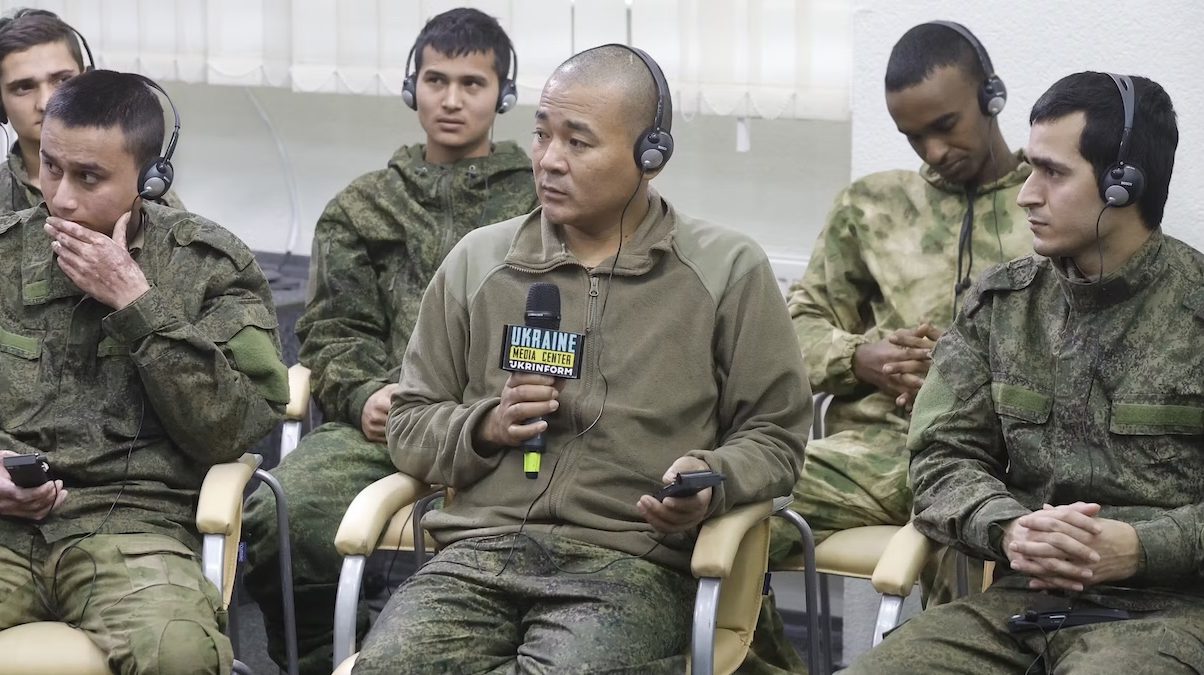
Ukraine recently captured its first Indonesian prisoner of war, a 49-year-old man from Java who had been promised construction work in Russia. According to the Ukrainian state-run I Want to Live project, he only realized he had been recruited into the army while being transported to Donetsk.
His case is not unique. Since President Vladimir Putin endorsed a plan to recruit foreigners in March 2022, hundreds of men from South Asia, Southeast Asia, Central Asia, and Africa have ended up fighting for Russia in Ukraine. Many are mercenaries, but a significant number were deceived—traveling to Russia on tourist visas or believing they were headed to Dubai, Germany, or Poland for civilian jobs, only to be handed over to Russian authorities, often via Belarus.
These recruits describe having their passports confiscated and being forced to sign documents in Russian that they did not understand. With minimal training, they are sent to the front lines, where attempts to escape are met with beatings or imprisonment.
Distinguishing forced fighters from mercenaries
In my research, I call these individuals “forced fighters.” They are victims of human trafficking, not mercenaries. A mercenary is someone who deliberately joins a conflict for significant financial gain and is not part of an official armed force. Mercenaries can be prosecuted for mere participation and are not entitled to prisoner-of-war status.
Forced fighters, by contrast, are not motivated by private gain. They do not know they are going to a war zone—or even to Russia. Under international humanitarian law, because they have joined the Russian army, they are classified as privileged combatants. That status protects them from prosecution for fighting and grants prisoner-of-war rights if captured. But it does not acknowledge that they were deceived into service, and it only applies in the narrow circumstance of capture.
Many forced fighters are killed rather than captured, which is unsurprising given they are kept in poor conditions, given minimal training, and used as “cannon fodder” ahead of Russian troops.
Human trafficking under international law
The Palermo Protocol, adopted in 2000, defines human trafficking as the recruitment, transportation, or harboring of persons through coercion or deception for exploitation. Forced fighters in Ukraine clearly fit this definition. Russian agents recruit them via social media, often in their home countries, and transport them to Russia or the conflict zone under false pretenses, receiving payment for each recruit.
Human trafficking is prohibited under the International Covenant on Civil and Political Rights, which Russia has ratified. Moscow is therefore obligated to stop receiving and using forced fighters and to prevent agents from recruiting them.
Indonesia recently reminded Russia of this obligation. After reports emerged in early November that an Indonesian national had been killed fighting in Ukraine, foreign ministry spokesperson Yvonne Mewengkang called on Russia to halt recruitment of Indonesian citizens. She stated: “The Indonesian government has asked the Russian government to take the necessary steps to ensure that Indonesian citizens are not recruited into the Russian military or other military-related formations through any channel.”
Recognizing forced fighters as trafficking victims would provide a remedy that combatant status cannot: repatriation before the war ends. This is crucial as Russia’s recruitment drive continues to expand. According to I Want to Live, 283 Indonesians were recruited in the first nine months of 2026 alone, compared to fewer than ten over the previous three years.
The broader implications for the Indo-Pacific are significant. As the war grinds on, the human cost extends far beyond the battlefield, ensnaring citizens of neutral nations in a conflict they never chose. For the families in Jakarta, Manila, or Nairobi, the promise of a better life has turned into a nightmare on the steppes of Ukraine.