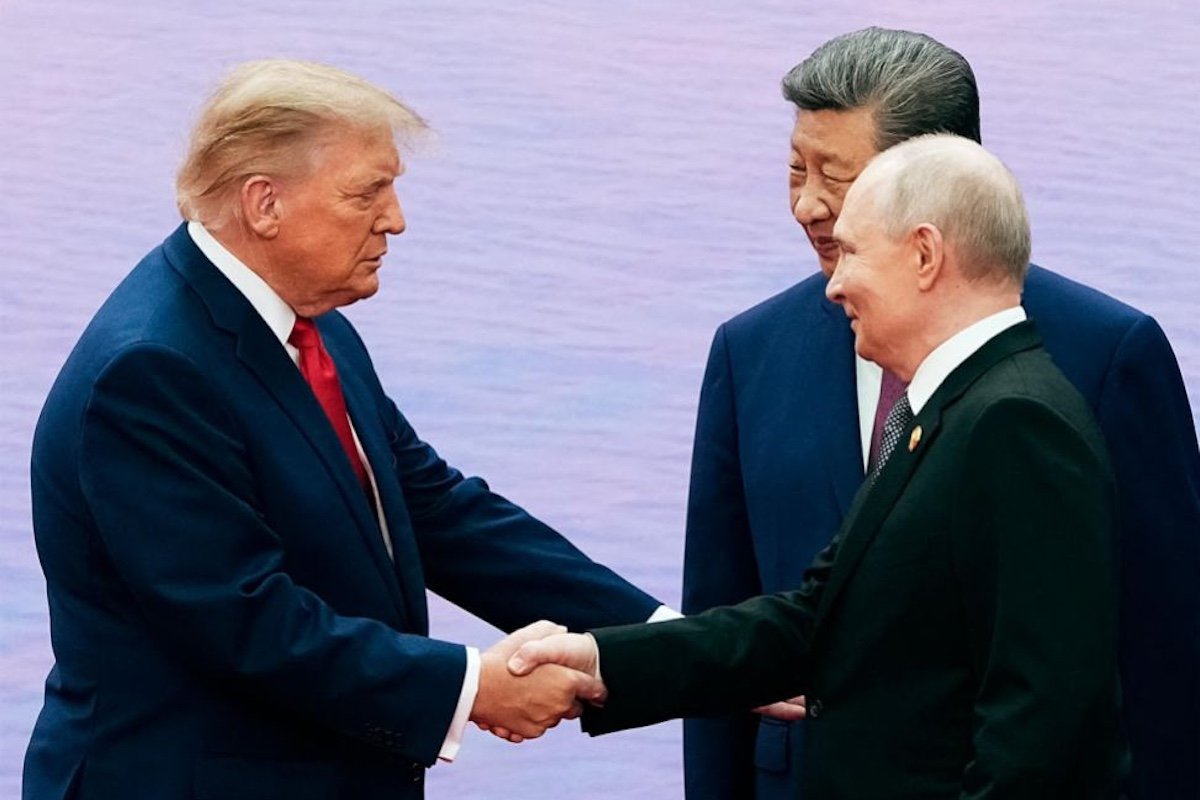
The much-anticipated trilateral summit in Shenzhen on November 19 brought together Chinese President Xi Jinping, US President Donald Trump, and Russian President Vladimir Putin for talks that were historic in format but modest in outcome. The joint Declaration toward Peace pledged cooperation on nuclear risk reduction, United Nations reform, energy supplies, and the immunity of state officials—yet it contained no settlement for Ukraine or Iran, no binding arms-control commitments, and no mechanism for resolving the most consequential strategic disputes among the three powers.
The declaration's narrow scope was telling. While the leaders reaffirmed that nuclear war cannot be won and must never be fought, the commitment to dialogue on nuclear-risk reduction fell short of a binding agreement. With the New START treaty set to expire on February 5, 2026, the last bilateral limits on US and Russian strategic arsenals will vanish. Washington has pressed Beijing to join future arms-control talks, but China, whose nuclear stockpile is far smaller, has resisted taking on comparable obligations.
Peace promises meet geopolitical reality
The summit's silence on Ukraine was particularly conspicuous. Moscow continues to seek a settlement that accommodates its security demands, while Kyiv and European governments insist that Ukraine's sovereignty cannot be negotiated without its participation. As Reuters reported, European foreign ministers warned against discussing Europe's future security architecture with Russia before a ceasefire. Ukraine was reportedly discussed in bilateral exchanges, but the final declaration contained no conflict-specific commitments.
The declaration's treatment of international justice also raised eyebrows. It emphasized the immunity of state officials and warned that the International Criminal Court and similar institutions should not abuse their jurisdiction—a provision widely seen as a nod to Moscow, given the ICC's outstanding arrest warrant for Putin over alleged war crimes involving the unlawful deportation of Ukrainian children. The declaration did not address the case directly, but the implication was clear.
Economic disagreements remained unresolved as well. Despite expectations of progress, the summit produced no announcement extending the US-China trade truce, which expires on January 10, 2027. The lack of an extension mattered amid ongoing tariff disputes, semiconductor restrictions, and competition over advanced technologies. It did not mean the truce had ended, but it illustrated the limits of diplomacy in overcoming economic rivalry. As our analysis of the summit's tech rift notes, the pageantry masked a hardening divide.
Each side took something from the meeting. For Beijing, hosting the talks reinforced China's diplomatic centrality. Moscow gained international visibility despite Western efforts to isolate it over Ukraine. Washington maintained direct engagement with two major strategic competitors. Yet the talks produced few concrete breakthroughs, underscoring the gap between diplomatic symbolism and real conflict resolution.
Moscow's alternative vision of global power
A day earlier, Moscow hosted a different kind of gathering: a Global South conference organized by Russia's ruling United Russia party, presided over by former President Dmitry Medvedev. Approximately 300 representatives from 72 countries—including China, India, Iran, Turkey, Indonesia, Vietnam, and nations across Africa and Latin America—attended. The event was part of Russia's Movement for the Freedom of Nations, which advocates sovereignty, opposes unilateral sanctions, and resists what Moscow describes as neocolonial practices.
For Moscow, such platforms expand diplomatic networks and challenge Western efforts to limit Russian influence. Yet participation should not be confused with geopolitical alignment. China's deep economic ties with Western markets, India's simultaneous partnerships with Moscow and Washington, and Turkey's NATO membership all show the limits of political convergence. These countries may favor a more representative international system without supporting a unified geopolitical alliance.
The conference produced political initiatives rather than binding economic or security agreements among participating governments. Its significance lies in the demand for diplomatic alternatives, even as participants pursue competing national interests. The Shenzhen summit and the Moscow gathering together exposed multipolarity's central contradiction: major powers want to preserve their privileges, while countries demanding greater influence remain divided over what should replace the existing order.
As the world moves toward a more fragmented order, the gap between multipolar rhetoric and concrete outcomes is likely to widen. The Shenzhen declaration may be remembered less for what it achieved than for what it omitted—a reminder that even the most powerful leaders cannot easily translate shared interests into lasting agreements.