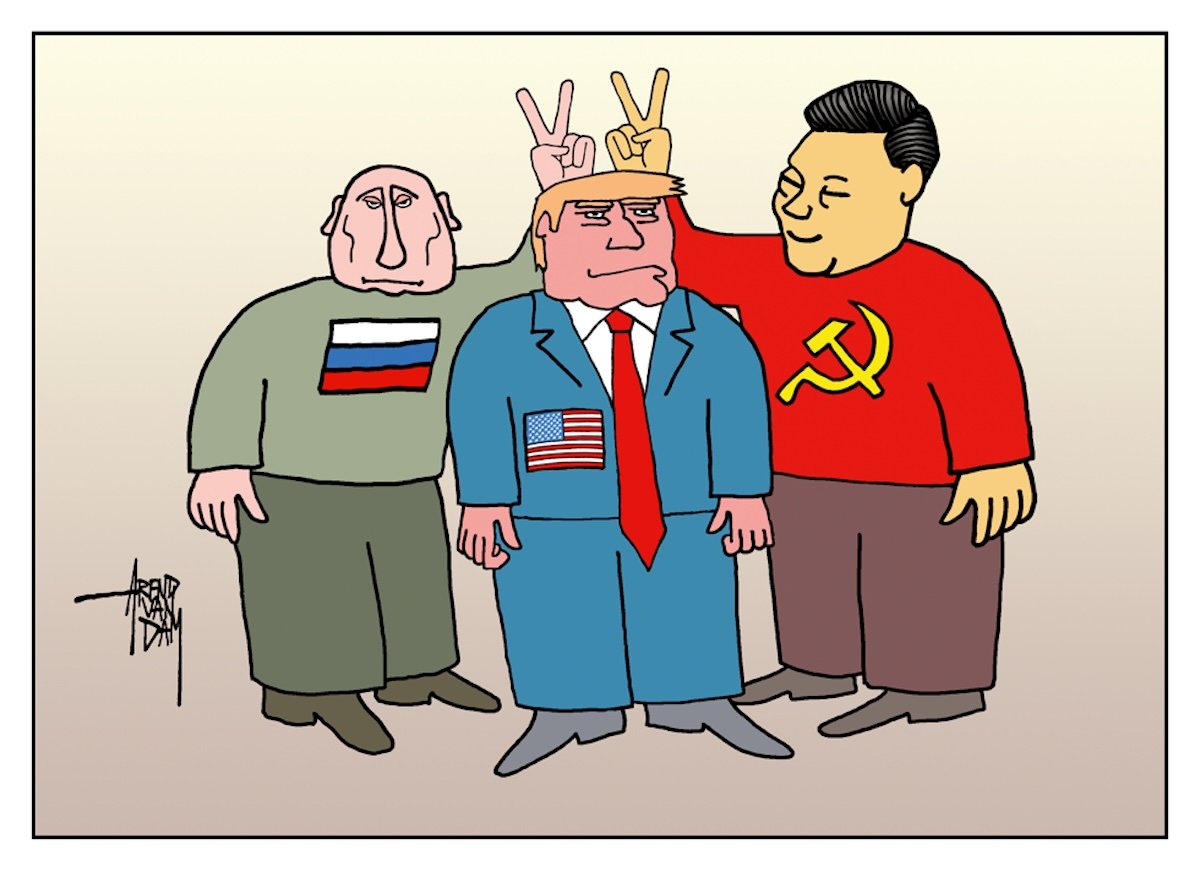
The late-night comedian Jimmy Fallon may have offered the most accurate summary of the November 19th trilateral meeting in Shenzhen. As he noted on NBC's The Tonight Show, the timing made sense: "Now that James Bond has been cast, they're auditioning villains." The encounter between Vladimir Putin, Xi Jinping and Donald Trump was indeed less a diplomatic milestone than a gathering of three leaders who share a contempt for the rules-based order that has underpinned global stability for decades.
For Trump, the meeting was a chance to bask in the company of two autocrats he openly admires. He has called them his "friends," ignoring the fact that Russia and China have repeatedly declared their intention to undermine American influence. Both nations continue to provide financial, technological and military support to Iran, a country with which Trump initiated a conflict nine months ago that shows no sign of ending. The irony was lost on no one but the participants themselves.
A photo op with no deliverables
Despite the hype, the summit produced no concrete agreements. The three leaders posed for cameras and issued vague statements about peace and cooperation, but as far as can be determined, they agreed on nothing of substance. The event was, in essence, a carefully staged photo opportunity designed to project an image of great-power unity that does not exist.
Yet the mere fact of such meetings is damaging while Trump remains in the White House. It legitimizes the very leaders who are actively working against American interests and undermines the values the United States has championed since its founding. But it would be a mistake to see Trump as representing America in these encounters. He represents only himself, as evidenced by his willingness to ignore the reality that Russia and China are allied against the West.
Trump's personal envoy, real-estate developer Steve Witkoff, went so far as to describe Putin as "a humanitarian." This is a statement so absurd that it can only be explained by a desire to curry favor. Putin has sent more than 1.5 million Russians to die or be wounded in Ukraine, has had domestic opponents killed, and has overseen the slaughter of Ukrainian civilians. No rational observer could call him a humanitarian, unless they were hoping for some personal advantage.
Hypocrisy on display
The hypocrisy was shared among all three leaders. Xi Jinping called for the three powers to "jointly uphold world peace," even as Russia and the United States remain embroiled in wars they started. Putin claimed a special role for the three in preserving international law, despite being the world's foremost violator of it. The Trump administration has followed suit, with Deputy Secretary of Defense for Policy Elbridge Colby attacking Ukraine at a NATO meeting for daring to strike back against Russian aggression, including the recent successful attack on the Kerch Bridge.
The joint statement from Russia and China, a clear sign they are operating in concert, asserted that "the immunities of state officials are of utmost importance" and warned that international bodies like the International Criminal Court "must not abuse their authority." This is a direct assault on the principle of accountability that was established at the Nuremberg and Tokyo tribunals in 1945, which were created by the victorious allies—including Russia, China and America—to hold state officials responsible for their actions.
What these leaders truly seek is immunity for themselves and their nations from the laws and norms that apply to everyone else. Their call for UN reform is not about making the institution more effective, but about ensuring it cannot constrain their actions. They have no interest in a UN that can regulate their behavior or dilute their veto power as permanent Security Council members.
When they speak of peace, they mean peace for themselves, while promoting fear and coercion for others. The only statement from the summit that should be taken seriously is their pledge to increase petroleum production, which would help Putin finance his war in Ukraine—a goal all three share. This exposes the fiction that Trump has been using sanctions to pressure Russia; in reality, he is helping to sustain its war machine.
In the end, we can take some comfort in the fact that these three villains are not as powerful as they appear. Their meeting in Shenzhen was a display of weakness, not strength, and the world should see it for what it is: a gathering of leaders who have nothing to offer but empty rhetoric and self-serving deals. As the hollow core of multipolar diplomacy becomes ever more apparent, the international community must remain vigilant against their attempts to rewrite the rules in their favor.