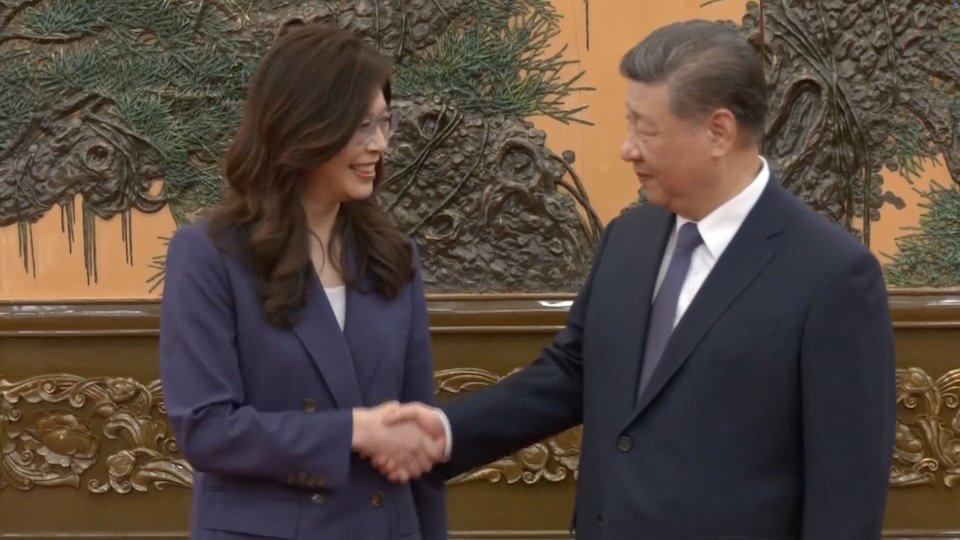
As the Middle East remains mired in conflict, East Asia has seen a notable calm—especially after a significant visit to Beijing by Taiwan's opposition leader, Cheng Li-wun of the Kuomintang (KMT). Her week-long trip, which included stops in Nanjing and a meeting with Chinese President Xi Jinping, represents a pragmatic step toward reducing tensions across the Taiwan Strait. For Washington, long committed to peaceful cross-strait relations, this visit offers a potential diplomatic off-ramp from the risk of war.
The KMT has engaged in direct, party-to-party talks with Beijing since 2005, but Cheng's journey carried particular weight. She visited Nanjing, a city steeped in symbolism: it was the capital of the Republic of China and is home to the Sun Yat-sen mausoleum, a site revered on both sides of the strait. Sun Yat-sen, the American-educated founding father of modern China, remains a unifying figure, with his portrait still hanging prominently in Taiwan's legislature. During her visit, Cheng paid respects at the mausoleum, a gesture that underscored shared cultural heritage.
Meeting Xi Jinping, Cheng did not shy away from Taiwan's identity. She stated that the overwhelming majority of Taiwanese are descended from mainland ancestors, share Chinese surnames, speak Chinese languages, and celebrate Chinese festivals. “Chinese culture has always been part of the DNA of Taiwanese society,” she said. Xi responded by emphasizing that “Taiwan compatriots have never forgotten that their roots are on the mainland,” but notably did not insist on near-term unification, instead noting that the trend toward closer ties “will not change.”
Cheng also proposed concrete areas for cross-strait cooperation, arguing that the two sides' experiences and strengths are complementary. This approach contrasts sharply with the prevailing US strategy, which has focused on military deterrence—including drone swarms and naval buildups—rather than diplomatic engagement. Cheng's pragmatism recognizes that Taiwan cannot win an arms race with China, especially as the US is far away, distracted by other global crises, and has limited military power to project.
A New Thinking on Taiwan's Future
Cheng's peace-oriented initiative has drawn criticism, notably from The Wall Street Journal, which sarcastically described her approach as “Nice kitty.” Yet many Americans would agree that another Asian civil war is not in the national interest. Cheng's diplomacy-first approach does not threaten the US strategic position in the Indo-Pacific; rather, it enhances US national security by reducing the risk of a conflict that could draw in American service members.
This is early days for a new rapprochement. Cheng has a long way to go to achieve cross-strait reconciliation, but her visit signals a shift away from confrontation. For Washington, which has long sought stability in the region, Cheng's approach deserves a careful hearing. If it succeeds in defusing the Taiwan Strait powder keg, it would represent a major step toward US-China peace and stability in the 21st century.
The KMT's offer of a diplomatic off-ramp is particularly timely given the US Navy's focus on next-generation fighters and drone strategies aimed at countering China. While these military measures have their place, Cheng's visit reminds us that diplomacy can be a more effective tool for preventing war. As the US continues to navigate its role in the Indo-Pacific, it would be wise to consider the KMT's pragmatic path—one that prioritizes stability over escalation.