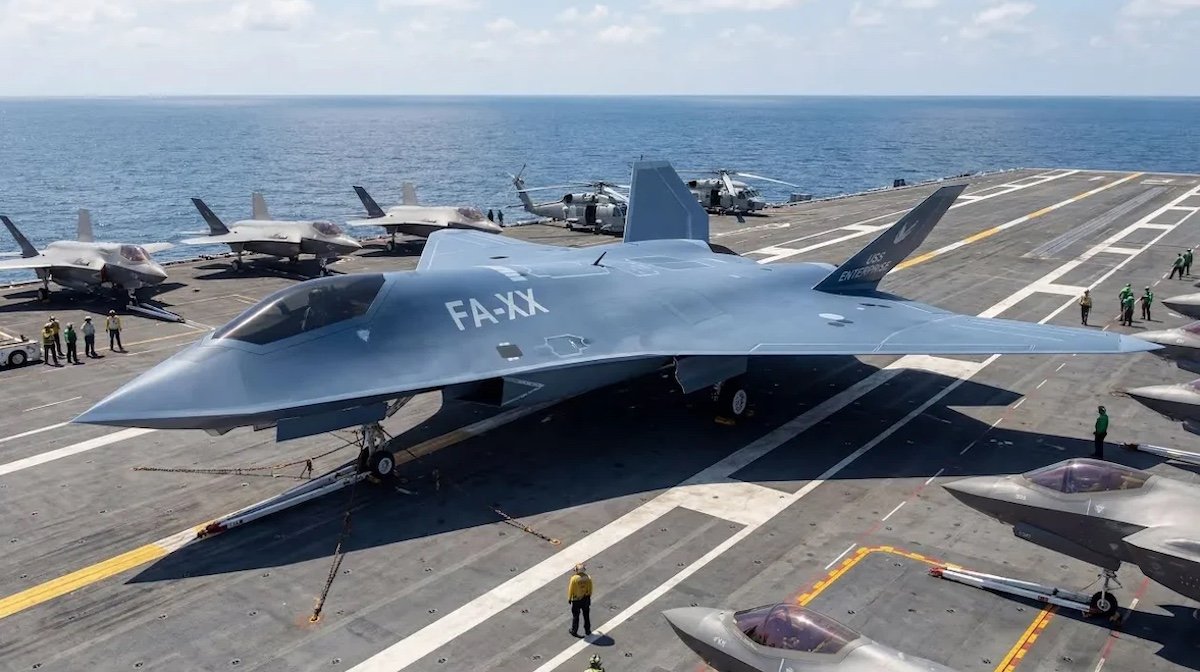
The upcoming selection for the US Navy's F/A-XX next-generation fighter aircraft represents more than a procurement decision; it is a critical move in a broader strategic contest with China over the future of carrier-based power projection in the Indo-Pacific. The program aims to ensure US aircraft carriers remain a credible instrument of deterrence and influence, countering advancements by the People's Liberation Army Navy (PLAN).
A Competition for Carrier Relevance
Chief of Naval Operations Admiral Daryl Caudle confirmed the builder selection will occur in August, following consultations with the Department of Defense. Boeing and Northrop Grumman are the competing contractors for the program, which is designed to replace the F/A-18 Super Hornet in the 2030s. The core challenge is preserving carrier viability against China's growing anti-access/area-denial (A2/AD) capabilities, which leverage geographic proximity and advanced missile systems.
The F/A-XX concept emphasizes extended range, stealth, and sophisticated integration with unmanned systems and collaborative combat aircraft. This approach seeks to allow carrier air wings to operate from safer distances while maintaining strike capability. As analyst Rebecca Grant noted in a report for the Lexington Institute, the future air wing will combine the sensing of the F-35, the range extension of the MQ-25 tanker drone, and the enhanced capabilities of the F/A-XX to generate sustained combat power.
China's Advancing Carrier Ecosystem
China's parallel developments present a direct challenge. Researcher Aita Moriki, in a National Institute for Defense Studies report, highlighted significant progress in China's carrier aviation. The new Fujian aircraft carrier has successfully conducted electromagnetic launch system (EMALS) tests with the J-35 stealth fighter, the J-15T fighter, and the KJ-600 airborne early warning and control aircraft. This combination, particularly the KJ-600 which acts as the carrier group's 'flying eyes,' marks a major step toward a functional blue-water combat capability.
However, Moriki stresses this ecosystem is not yet fully operational. Hurdles remain in EMALS reliability, system adjustments, data validation, and pilot training. The pace of China's progress nonetheless compels a response, underscoring a technological and doctrinal race where platforms like the F/A-XX are only one component. This competition extends to other strategic domains, such as the race to build fusion energy supply chains, which carries long-term geopolitical implications.
Beyond Platforms: The Kill Web and Distributed Operations
The decisive advantage may lie not in individual aircraft, but in which side can maintain an effective, resilient combat network under pressure. Analysts Ying Yu Lin and Tzu-Hao Liao, writing for the Jamestown Foundation, note China is improving fleet coordination through dual-carrier operations, allowing for emergency landings and demonstrating higher sortie rates from the carrier Shandong. Yet, they identify limitations, including unclear cross-service joint operations and a continued reliance on coordinated escort formations, suggesting power projection beyond the first island chain is still developing.
From the US perspective, analyst Bryan Clark argues future naval advantage will depend on distributed, mobile forces enabled by advanced command-and-control, not concentrated platforms alone. The US Navy's Distributed Maritime Operations concept, alongside efforts like Joint All-Domain Command and Control and Project Overmatch, aims to create a resilient 'kill web' that can connect the best sensor, shooter, and commander despite communications disruptions. This model prioritizes operational continuity, whereas China's appears focused on building an integrated, coordinated force structure.
The strategic context of this military competition is shaped by wider regional tensions. For instance, developments such as China's development of drone-launched mines illustrate how new technologies are being integrated into anti-access strategies, potentially complicating US naval operations in contingencies around Taiwan.
Sustaining Power in the Indo-Pacific
The F/A-XX program is ultimately a test of which nation can best sustain carrier aviation as a tool of power. For the United States, it is about modernizing a core element of its forward-deployed military diplomacy. For China, it is about realizing a long-held ambition to operate a world-class blue-water navy. The outcome will influence the balance of power across the Indo-Pacific, affecting allies and partners from Japan and South Korea to Southeast Asia.
This technological arms race occurs against a backdrop of interconnected global crises. Conflicts in the Middle East, for example, have demonstrated how regional instability can reverberate in Asia, as seen when the Iran conflict strained Japan's supply chains and tested regional crisis response mechanisms. The ability to maintain carrier battle group readiness and logistics in the face of such global disruptions is part of the unspoken contest highlighted by the F/A-XX development.
As the August decision approaches, the F/A-XX symbolizes a pivotal moment in military adaptation. The winner of this long-term competition will be the side that successfully merges next-generation hardware with resilient networks, sustainable logistics, and effective doctrine to maintain carrier-based airpower in the contested waters of the Indo-Pacific.