The strategic competition between the United States and China, already defining fields like artificial intelligence and space, is now intensifying in the pursuit of fusion energy. Both Washington and Beijing are aggressively building domestic industrial capabilities and securing supply chains for future fusion reactors, viewing mastery of this potentially limitless, carbon-free power source as a cornerstone of future geopolitical and economic influence.
Europe's Critical Expertise and Strategic Dilemma
To accelerate their programs, both superpowers are turning to Europe, where deep expertise in critical technologies like superconducting magnets, high-power lasers, advanced robotics, and tokamak design is essential for scaling fusion from laboratory experiments to practical deployment. This places European nations and companies at a crossroads, forced to weigh commercial and scientific interests against strategic concerns.
Experts are deeply divided on the path forward. One camp argues Europe must align closely with the United States to prevent China from monopolizing a transformative energy technology that could decisively shift the global balance of power. Others contend that the immense scientific and engineering challenges of achieving net-energy fusion necessitate broad international collaboration, including with Chinese researchers and institutions.
Laban Coblentz, chief strategic advisor to the International Thermonuclear Experimental Reactor (ITER), is a prominent voice for collaboration. He points to China's rapid construction of the Hualong-1 fission reactor as an example of efficient execution aided by international supply chains. "China has the ability to build the Hualong-1 reactor in five years for US$5 billion while the US and Europe build theirs over budget," Coblentz noted in a recent interview. "What’s different? It turned out there were 140 French companies embedded in the Chinese supply chain."
Coblentz expressed hope that upcoming diplomatic engagements could lower barriers. "I hope that when [former President] Trump and [Chinese President] Xi Jinping meet... some of the barriers start to come down, and we start to look at how things could be complementary instead of competitive," he said, referring to challenges in ITER's contract negotiations with American firms.
The ITER Megaproject and Geopolitical Vision
The ITER project, under construction in Cadarache, France, stands as the world's most ambitious fusion collaboration. Conceived in the 1980s, its final design was approved in 2001, with construction launching in 2013. Originally budgeted at 6 billion euros, costs have ballooned, with current estimates reaching approximately 22 billion euros. The US Department of Energy projects total costs could hit $65 billion by 2039, the target date for full fusion operations.
The European Union funds about 45.6% of ITER, while China, India, Japan, South Korea, Russia, and the United States each contribute roughly 9.1%. Coblentz recalled US Senator Joe Manchin's 2022 visit to the site, where the senator noted the mix of languages—Mandarin, French, Italian, English, Russian—as evidence that a successful fusion project could fundamentally reshape geopolitics. Manchin reportedly told staff he saw, for the first time in years, a "light at the end of the tunnel" and even the possibility of world peace, arguing many past conflicts were driven by competition over energy access.
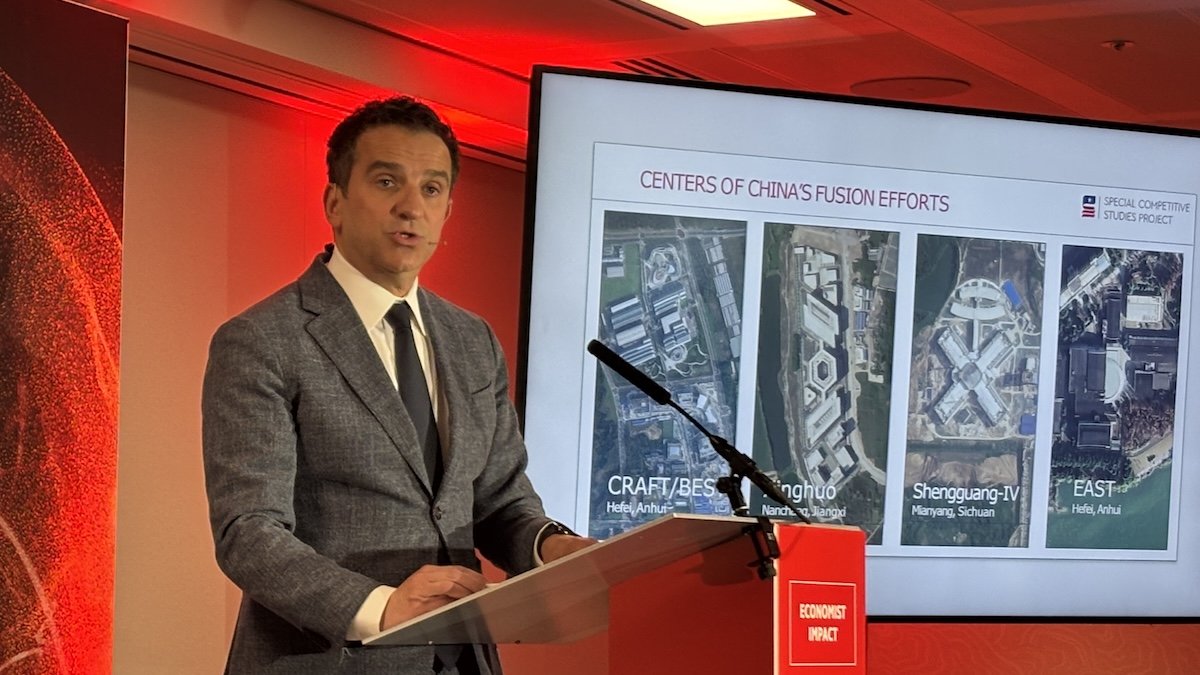
However, the collaborative spirit of ITER contrasts sharply with the emerging bilateral race. Ylli Bajraktari, president of the US think tank Special Competitive Studies Project (SCSP), warned starkly that the West risks repeating past mistakes. "China didn’t make the scientific breakthroughs that brought the first electric vehicles, solar panels or 5G towers to market. They focused on subsidies and scaling manufacturing, and it paid off," he stated in a recent speech. "China isn’t building solar panels because they want to reach net zero. They’re selling solar panels at a loss to get the world in their debt."
Bajraktari argued the same dynamic could unfold in fusion if the US and EU do not act swiftly and in concert. He highlighted China's aggressive spending, claiming the country has invested $6.5 billion in fusion infrastructure since the US Lawrence Livermore National Ignition Facility first produced energy three years ago, with less conservative estimates putting the figure as high as $13 billion.
China's Accelerated Domestic Push
China is advancing a portfolio of major domestic fusion projects, signaling its long-term commitment. These include the Chinese Fusion Engineering Testing Reactor (CRAFT) and the Burning Plasma Experimental Superconducting Tokamak (BEST) in Hefei, Anhui province—a large integrated research campus designed to demonstrate net fusion power this decade. In Nanchang, Jiangxi, the Xinghuo ("spark") fission-fusion hybrid reactor aims for about 100 megawatts of output in the early 2030s. Furthermore, the Shengguang-IV facility in Mianyang, Sichuan, is a large-scale laser fusion project estimated to be significantly larger than the US National Ignition Facility.
This concentrated investment and development, coupled with China's existing partnerships with nations like Russia and Iran, amplifies concerns among some Western strategists. They warn that China's fusion ambitions are part of a broader strategy to achieve technological and energy independence, which could have significant implications for regional security dynamics. For instance, a breakthrough in energy abundance could influence strategic calculations regarding nuclear energy and security postures across the Indo-Pacific, and potentially complicate existing security frameworks, including the US counterterrorism and security strategy in Asia.
The fusion race is no longer a distant scientific dream but an active arena of great-power competition. As the United States and China forge rival supply chains and technological ecosystems, Europe's choice—whether to side decisively with one, attempt to bridge the divide, or pursue a third path—will have profound consequences for the future of global energy and the geopolitical landscape of the 21st century.